How to Choose a Hair Transplant Clinic (UK Patient’s 2026 Guide)
How a UK patient chooses a hair transplant clinic in 2026: accreditation, surgeon credentials, pricing red flags, Istanbul vs London logistics.
Medical disclaimer. This article is educational and not medical advice. Hair restoration outcomes are individual; only a qualified surgeon can assess your case in a personal consultation.

Quick answer
Choosing a hair transplant clinic in 2026 isn’t really about price — it’s about three things in this order: who actually performs the surgery, what hospital or clinic regulator stands behind that surgeon, and what aftercare exists when you fly home. Most published rankings focus on cost, which is the easiest variable to fake. The harder variables — surgeon load per day, accreditation gaps, defensible quotation — are where the real differences live. This guide walks through them in the order a UK patient should weigh them, and ends with the specific Istanbul-vs-London logistics decision that BergemHealth’s two-clinic model now makes available.
- Decision-grade signals: ISHRS membership, JCI hospital accreditation, GMC- or CQC-registered consulting team, single-surgeon ownership of the surgical day.
- Red flags: “package” pricing under £1,800, 15+ patients-per-day surgeons, technician-led extraction, no defensible per-graft breakdown.
- The Istanbul-vs-London choice isn’t about price — both BergemHealth pathways price at Turkish-grade levels — it’s about travel, recovery setting, and whether GMC oversight in person matters to you.
Table of contents
- The two-clinic decision (start here)
- What good clinic-choice actually looks like
- Accreditation hierarchy: JCI vs CQC vs GMC
- Surgeon-led vs technician-led: the daily-load test
- ISHRS membership — what it requires
- Why “package pricing” is a warning sign
- What a defensible quote looks like
- The eight questions to ask before booking
- UK vs Turkey: when each makes sense
- Common myths UK patients carry
- How BergemHealth approaches this
- Frequently asked questions
The two-clinic decision (start here)
For a UK patient in 2026, the meaningful question isn’t “where can I get the cheapest hair transplant?” — it’s “where can I get this surgery performed by a surgeon I can verify, in a hospital I can verify, with aftercare that holds when I’m back in the UK?”
The model that’s emerged is what BergemHealth calls the two-clinic pathway: the same surgical network operates a JCI-accredited theatre at Liv Hospital Ulus in Istanbulliv-jci and a CQC-registered consulting and minor-procedure clinic at 99 Harley Street in London. Pricing on both sides is anchored to the Istanbul cost base — so the Harley Street option isn’t a higher tier; it’s the same operation at the same price, with London logistics instead of Istanbul logistics.
That re-frames every other question in this guide. You’re not picking between cheap and safe. You’re picking between two travel patterns. The rest of this article exists to tell you what both pathways need to do well so the choice is genuinely a logistics one — not a quality one.
What good clinic-choice actually looks like
Definition. A defensible hair transplant clinic is one where every public claim — surgeon credentials, accreditation, patient volumes, prices, aftercare protocols — is verifiable by a third party. That’s the only filter that works.
The 2024 ISHRS practice census found that the global hair-restoration market grew to roughly $5 billion, with the share of patients travelling internationally for surgery rising every yearishrs. That growth has dragged in a tier of clinics whose marketing has scaled faster than their clinical practice. The result is a market with two distinct populations of providers in the same Google search results, often at similar surface prices.
When you search “hair transplant clinic Istanbul” or “hair transplant Harley Street”, roughly 30–40% of the top organic results are clinics whose surgeon-of-record doesn’t perform the surgery, whose facility isn’t independently inspected, and whose published before-and-after photos can’t be traced to a named procedure date. That’s a structural feature of an under-regulated cosmetic-surgery verticalbaaps.
What separates a defensible clinic from the rest is paperwork. A real clinic publishes the surgeon’s licence number (GMC for UK doctorsgmc; ISHRS member directory for international hair-restoration specialistsishrs), shows the hospital’s JCI or CQC certificate with a current expiry datejcicqc, puts the patient name and procedure date on every published photograph (with consent), and gives you a quote that itemises graft count, technique, anaesthesia, accommodation and aftercare — instead of a single round number.
Accreditation hierarchy: JCI vs CQC vs GMC
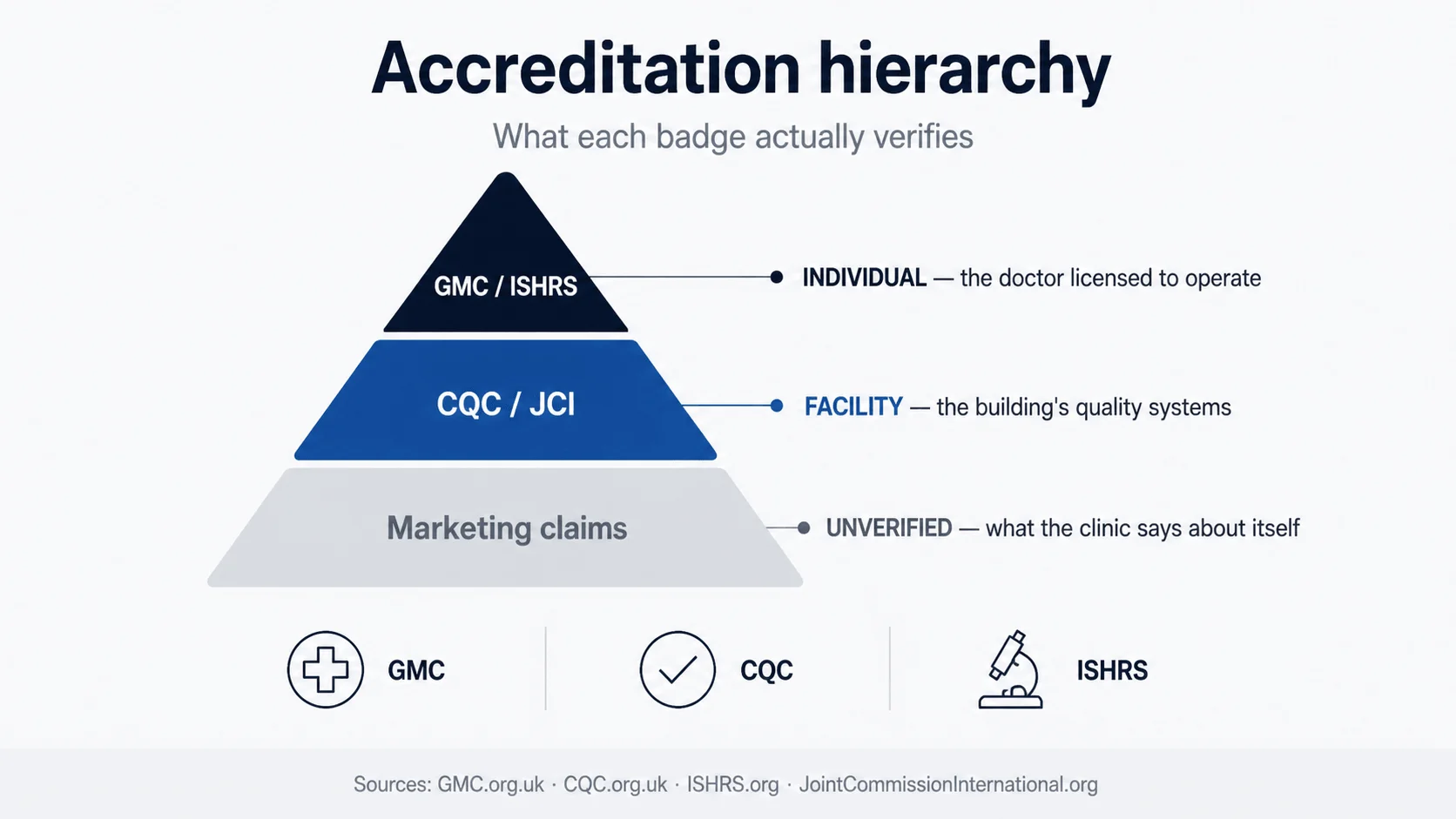
The single most common mistake UK patients make in this decision is treating accreditation as a binary — either a clinic “is accredited” or “isn’t” — when in fact there are three different bodies that mean three different things. (Full breakdown in the JCI vs CQC vs GMC cluster guide.)
| Body | What it accredits | What it does NOT accredit |
|---|---|---|
| JCI (Joint Commission International) | The hospital as a system: infection control, theatre standards, anaesthesia protocols, emergency response | The individual surgeon’s skill or daily caseload |
| CQC (Care Quality Commission) | The UK clinic’s registration and minimum-standard compliance | Surgical outcomes; UK clinics can be CQC-registered and still operate technician-heavy models |
| GMC (General Medical Council) | The individual UK doctor’s right to practise | The hospital where they work; a GMC-registered doctor can work in a non-CQC location |
A defensible clinic clears at least two of these three. BergemHealth’s Istanbul pathway operates inside a JCI-accredited hospital (Liv Hospital Ulus, accredited since 2013)liv-jcijci with surgeons who are ISHRS membersishrs; the London pathway operates from a CQC-registered facility on Harley Street with a GMC-registered consulting team. Neither pathway leans on a single accreditation badge.
The asymmetric case to watch for is the clinic that publishes one badge prominently — usually JCI, because it’s the most impressive-sounding to a UK reader — without telling you what the other two answers are. Hospitals can hold JCI without their hair-transplant surgeons being ISHRS members. CQC-registered UK clinics can be entirely technician-staffed. GMC registration alone doesn’t tell you which facility a doctor operates in. Each gap is a place a marketing team can put a thumb on the scale, and most of the marketing copy you’ll read in this market is calibrated to one badge being the loudest in the room.
The simpler rule: if a clinic is reluctant to talk about the other two badges, that’s the most informative thing it has told you. A defensible operator publishes hospital accreditation, surgeon membership, and (in the UK) doctor-level GMC registration in the same paragraph. A non-defensible operator publishes whichever single badge the marketing team thinks reads best, and treats the other two as administrative trivia.
Surgeon-led vs technician-led: the daily-load test
The single highest-information question you can ask a hair transplant clinic is: “How many patients does the named surgeon actually operate on each day?”
The 2024 ISHRS practice census reports that surgeon-supervised, technician-extracted hair transplantation has become the dominant model in unregulated medical-tourism markets, with some Istanbul clinics openly running 15–25 patients per day per “surgeon”ishrs. At those volumes, the named doctor is doing the consultation, the hairline drawing, and possibly the channel-opening on a fraction of patients — the rest of the procedure (extraction, slit-creation, implantation) is performed by trained technicians, not doctorsgarg.
What “surgeon-led” actually means, in measurable terms:
- Surgeon performs extraction or channel-opening directly on every patient — not “supervises” a technician doing it
- Daily caseload of 1–4 patients, not 15–25
- The same surgeon you consulted with is the one in theatre — this seems obvious; it isn’t always true
The reason daily load matters is mechanical, not philosophical. Manual FUE extraction takes a trained surgeon roughly 3–4 hours of focused work for a 2,500–3,500 graft casesharma. Channel-opening with a Sapphire blade adds another 2–3 hours. There aren’t enough hours in a 10-hour day for a single doctor to do this work on more than 2–3 patients while also supervising anything. Anyone running 15+ daily volumes is, by arithmetic, supervising a technician-led model — that’s not a value judgement, it’s an arithmetic constraint that the clinic has decided how to resolve.
That doesn’t make the technician-led model categorically wrong. Well-trained technicians, working under genuine real-time surgeon oversight, can produce acceptable cosmetic outcomes for many patients. The patient-side problem is that the variance of outcomes is wider, and the price often does not reflect the difference. A defensible quote at a surgeon-led clinic and a similar headline figure at a technician-led clinic look identical on paper but represent two different operations with two different risk distributionsgarg.
A second reason daily load matters: aftercare bandwidth. A clinic running 4 patients per day per surgeon has roughly 6× the per-patient post-op review capacity compared to a clinic running 25. That capacity is what funds the month-1, 3, 6, 9, 12 review schedule that defines a real aftercare programme rather than a token one.
ISHRS membership — what it requires
The International Society of Hair Restoration Surgery is the closest thing to a global professional standard for hair transplant surgeons. ISHRS membership requires a verified medical degree, a minimum number of hair-restoration cases performed, completion of continuing-education credits annually, and adherence to a published code of ethicsishrs.
It’s not a perfect filter — plenty of competent surgeons aren’t ISHRS members, and membership doesn’t guarantee outcome. But it does establish a verifiable floor: the surgeon has met an external, third-party standard, and you can look them up in the ISHRS directory directly. ISHRS membership for the named surgeon, plus JCI for the hospital, plus a defensible per-graft pricing model, is roughly the minimum trio for a clinic that wants to call itself credentialed.
A non-ISHRS-member surgeon isn’t disqualifying — but it shifts the burden of proof onto the clinic to show what other third-party verification exists. A surgeon with a relevant national specialty registration (dermatology, plastic surgery), a substantial published case archive, and a hospital affiliation that itself carries JCI or equivalent accreditation can be just as defensible as an ISHRS-member counterpart. What you should not accept is “trust us, our surgeon is excellent” without a verifiable register lookup attached. Public registers exist precisely so the patient does not have to take that on faith.
Why “package pricing” is a warning sign
Most Turkey-marketed hair transplant clinics quote in packages: “£1,499 all-inclusive — surgery, hotel, transfers, aftercare, even a tour.” This pricing structure is the single most predictive signal of a graft-mill business model.
A genuine surgical day at a JCI-accredited hospital, with a single named surgeon doing 2–4 hours of his own extraction and channel work, has a hard cost floor: theatre time, anaesthetist, surgical staff, hospital overhead, instruments, blood-pressure monitoring, pre-op and post-op pathology if needed. That floor is roughly £900–£1,200 per case at Istanbul wage and rent levels, before any surgeon fee. Add a 4-star hotel for 3 nights, transfers, and a full follow-up programme, and you’re at £1,300–£1,500 in fixed costs. There is no surgeon margin in £1,499.
The way the £1,499 quote works is: the named “surgeon” is not the operator. Extraction is technician-led at high volumes. The hotel is functional. Aftercare ends at week 2. The 12-month touch-up promise is enforceable in theory and absent in practice. This is the model that BAAPS and ISHRS have repeatedly flagged in trade-press warnings about Turkey medical tourismbaapsishrsgarg.
A defensible quote in 2026 starts at roughly £1,250 per case at the Istanbul wage base and roughly £3,500–£4,250 per case at London-wage equivalents — except where, as with BergemHealth, the London side is anchored to the Istanbul cost base and prices in at the same lower number. (Full breakdown in the hair transplant cost UK vs Turkey article.)
The “package pricing as warning sign” rule has one legitimate exception: a transparent all-inclusive option built on top of an itemised per-graft quote. If the clinic shows you the per-graft cost first, then offers an optional bundled add-on (hotel, transfers, airport assistance) at a clear add-on price, that’s not packaging — that’s convenience pricing. The flag is the single round number that replaces itemisation, not the bundle that supplements it.
What a defensible quote looks like
A real quotation, from a defensible clinic, names every variable separately. Anything missing is a question worth asking.
Minimum line items:
- Graft count range (e.g., “up to 3,500 grafts”) — not just a flat fee
- Technique (Standard FUE, Sapphire FUE, Direct DHI) — at correct method-specific pricing (see method comparison)
- Surgeon name — the specific doctor, not “our team”
- Anaesthesia type (local, with or without sedation)
- Hospital or clinic of operation, with its accreditation status
- Number of treatment days in the country
- Aftercare programme duration — defensible clinics publish 12-month aftercare and free touch-up at month 9 if density warrants
- What happens if grafts fail to take — the guarantee language matters here, but only if it’s specific (e.g. “free corrective procedure if density falls below X%”)
A useful diagnostic: ask the clinic to send the quotation in writing with the line items above. A clinic that resists itemisation, or replies with a single round figure repeated, has told you something. A clinic that sends back a properly itemised quotation has both confirmed how its pricing works and given you a document you can compare directly to other clinics on a like-for-like basis. The itemised quote is itself a quality signal — only operators with a defensible cost structure are comfortable publishing one in writing.
Cross-clinic comparison only makes sense once both sides are itemised. Comparing a £1,499 all-inclusive package to an itemised £2,800 quote from a defensible clinic, on the headline number alone, is comparing two different products. The £2,800 figure may include 12 months of structured aftercare, an operator-of-record commitment, and a defined touch-up policy that the £1,499 figure does not. Once both are line-itemised, the difference is visible and the comparison is meaningful.
The eight questions to ask before booking
Print this list. Use it on every clinic you’re shortlisting.
- Who is the named surgeon, and what’s their GMC or ISHRS member ID? (Verifiable in 30 seconds online)
- What’s the hospital’s JCI or CQC status, with current expiry date?
- How many patients does the named surgeon operate on per day? (Target: 1–4. Concerning: 8+)
- What percentage of the procedure is performed personally by the surgeon, vs. supervised technicians?
- What’s the per-graft price at the technique I need, and how is “graft” defined? (Multi-follicle units vs single follicles changes the count by ~30%)
- What’s included in aftercare, and for how long? (Industry-defensible: 12 months)
- What’s the touch-up policy? (Free if density falls below threshold? Or paid?)
- Can I see traceable, named, dated before-and-after photos with patient consent in writing?
A clinic that answers all eight crisply is in the defensible tier. A clinic that deflects on three or more should be off your shortlist. None of the eight is exotic — they’re each either a 30-second public-register lookup or a written question the clinic can answer in a paragraph. The pattern of refusal-to-answer is the diagnostic, not any single specific answer.
UK vs Turkey: when each makes sense
There’s no universal answer here — the right pathway depends on your job, your travel comfort, your support network, and how much GMC oversight in person matters to you. (Full decision matrix in the Istanbul vs London cluster guide.)
| Factor | Istanbul makes more sense if… | London makes more sense if… |
|---|---|---|
| Travel | You’re comfortable flying, can take 4–5 days off | Travel is genuinely difficult (work, caring duties, anxiety) |
| Recovery setting | You’d rather recover in a quiet hotel than at home | Recovering at home with family is important to you |
| Oversight preference | Hospital-grade JCI environment is reassuring | Direct GMC-registered post-op review in person matters |
| Time pressure | You can take one block of time off | You need to fit appointments around UK work |
| Cost | Pricing parity now exists with BergemHealth’s model — cost no longer drives the choice | Same — at parity pricing it’s logistics, not budget |
Historically the UK-vs-Turkey question was a price-vs-proximity trade-off; with BergemHealth’s two-clinic model the price variable drops out, and the question simplifies to “what’s the recovery you actually want?” (More on this in Why UK patients travel to Turkey for hair transplant.)
The remaining UK-vs-Turkey research a patient does in 2026 should therefore answer one quieter question: is the provider you’re shortlisting one of the small group of two-clinic networks that prices both sides at the Istanbul cost base, or is it a single-location clinic with a partnership marketing arrangement? The first category gives you logistics-only choice. The second category — usually a UK private clinic at £8,000+ marking up the Harley Street postcode by 200%, or an Istanbul clinic with no UK aftercare arm — leaves you with the old price-vs-proximity decision and the inherited risks on both ends. The verification is simple: ask the clinic, in writing, whether the same surgical network owns both sites and whether per-graft pricing is identical between them.
Common myths UK patients carry
Myth: “If a clinic is on Harley Street it’s automatically reputable.” No. The Harley Street postal code is a brand, not an accreditation. CQC registration of the specific clinic at the specific address is what matterscqc.
Myth: “I can just do my hair transplant in a holiday week.” Realistic minimum in-country time is 4–5 days (consult day, surgery day, day-1 wash, day-2 review, fly home day-3 minimum). A 7-day window is more comfortable. Day-of-arrival surgery is itself a red flag — defensible clinics insist on a face-to-face consult before the operating day.
Myth: “All FUE is the same.” No. Standard FUE, Sapphire FUE, and Direct DHI are different operations with different indications, different timings, and different price points. They are not interchangeable, and a clinic that quotes a single FUE price across all three has either commoditised the technique or is leaving the choice to the technician on the day. (Method comparison here.)
Myth: “If the surgeon promises blanket-permanence results that’s reassuring.” It’s the opposite. The transplanted follicles largely keep growing because they come from the DHT-resistant donor zone — but native hairs around them can still recede with progressing AGA. Anyone who promises blanket permanence in absolute terms is using marketing language, not clinical language. The defensible version of the same statement names the donor follicles, names the AGA caveat, and names the role of medical management (finasteride or minoxidil) in protecting the surrounding native hair.
Myth: “Cheaper Turkey clinic equals worse surgery.” Not always — the cost difference is mostly structural (wages, real estate, VAT, indemnity) rather than a quality compromise at the JCI tier. Below the JCI tier the cost difference shifts categories and the model genuinely changes. The signal isn’t the country or the headline price; it’s the verification stack on the surgeon and facility. (More in Why UK patients travel to Turkey.)
How BergemHealth approaches this
BergemHealth’s structural answer is the two-clinic model — same surgical network at JCI-accredited Liv Hospital Ulus in Istanbulliv-jci and CQC-registered 99 Harley Street in London — but the operational answers are more specific.
In Istanbul, Dr. Hamid Aydın limits his surgical schedule to 2–4 patients per day, personally performs the entire extraction or channel-opening phase (depending on technique) on every case, and has been an ISHRS member with 25,000+ procedures since 2000ishrs. The hospital has held JCI accreditation continuously since 2013jciliv-jci. Pricing is published per-graft, not packaged: Standard FUE from £1,250, Sapphire FUE from £1,750, Direct DHI from £2,250.
In London, Dr. Sumeyye Yuksel leads the GMC-registered consulting teamgmc. Consultations, post-op reviews at month 1, 3, 6 and 12, and minor in-clinic procedures (PRP, suture removal where applicable) are performed at the Harley Street facility. Patients who choose the London surgical pathway have the same pricing structure as Istanbul — the cost base is shared across the network, not marked up for the postcode.
What this looks like in practice: same surgeon-of-network, same per-graft pricing, same 12-month aftercare programme with free touch-up at month 9 if density warrants. Istanbul gives you a JCI hospital, a quiet recovery hotel, and 4–5 days off work. London gives you GMC-registered post-op care in person, recovery at home, and appointments scheduled around your week. There is no quality penalty either way — only a logistical one. The eight questions earlier in this guide return the same answers regardless of which side of the network the booking sits on, because the operating-model discipline is the network’s, not the city’s.
What to do next
If you’re still mapping the territory, the cluster guides under this pillar fill in the detail: why UK patients increasingly travel to Turkey, Istanbul vs London as a logistics decision, JCI vs CQC vs GMC explained, and the red flags that mark a graft-mill clinic.
If you’re ready for a per-case quotation and a personalised assessment, request a free consultation with BergemHealth’s London or Istanbul team. The consultation reviews your donor area, gives you a graft-count estimate, walks through both pathways, and ends with a defensible written quote line-itemised the way this guide describes. CQC-registered facility in London. JCI-accredited hospital in Istanbul. ISHRS-member lead surgeon. Same per-graft pricing on both sides.
Frequently asked questions
How do I check if a hair transplant surgeon is GMC-registered?
Search the GMC’s online register at gmc-uk.org. The register lists every doctor licensed to practise medicine in the UK, including their specialty, qualification dates, and any restrictions. ISHRS members can be cross-checked at the ISHRS member directory. A surgeon who can’t be found on either register, but advertises in the UK market, is a serious red flaggmcishrs.
Is JCI accreditation more important than CQC?
Neither is “more important” — they regulate different things. JCI accredits the hospital as a system: theatres, infection control, emergency response. CQC registers UK clinics for minimum-standard compliance. A defensible clinic clears the relevant body for its country. JCI matters in Istanbul; CQC matters in London. Neither replaces individual surgeon credentialsjcicqc.
What’s a “graft mill” and how do I spot one?
A graft mill is a clinic that runs hair transplant surgery as a high-volume technician-led production line, typically 15–25 patients per day per “named surgeon” who performs only consultation and hairline drawing. Spot signals: package pricing under £1,800, opaque per-graft cost, surgeon’s name on the website but not in the operating theatre, before-and-after photos that can’t be traced to dated cases. Full pattern in the red-flags guide.
How many grafts will I need?
It depends on your Norwood stage, donor density, and target hairline. As a rough guide: Norwood II–III usually needs 1,500–2,500 grafts; Norwood IV–V typically 2,500–4,000; Norwood VI–VII can require 4,000+ and may need staged sessions. A defensible consultation includes a donor-area assessment and gives you a range, not a single number.
Is hair transplant surgery covered by NHS or private health insurance?
Hair restoration is classified as cosmetic by the NHS and is not covered, except in rare reconstructive cases (e.g., burns, surgical scarring)nhs. UK private health insurance generally excludes cosmetic procedures by default, though some insurers cover hair restoration after trauma. The default assumption for elective hair transplant is that you’re paying out of pocket.
How long should I take off work for a hair transplant?
For a desk-based job: 5–7 days off is comfortable, 3–4 is the absolute minimum. For physically demanding or public-facing work: 10–14 days. The donor and recipient areas show visible redness and small scabs for 7–10 days; most people are back to normal appearance by week 2.
What does “free touch-up” actually cover?
In a defensible clinic, the touch-up is a corrective procedure performed at no additional surgeon fee if the density at month 9–12 hasn’t met a pre-agreed threshold. It is not a guarantee of outcome — it’s a cap on your downside. The quality of the touch-up policy depends on how clearly the threshold is defined in writing before the original surgery. Vague language (“we’ll take care of you”) is unenforceable.
Do I need to fly to Istanbul to get the cheaper price?
No — at least, not with BergemHealth’s two-clinic model. The Harley Street pathway is priced at the Istanbul cost base because the surgical network is shared. Other UK private clinics still charge UK-wage prices (£8,000–£18,000+); for those, the Turkey trip is a price decision. With a parity-priced provider, it’s a logistics decision. (See Istanbul vs London.)
Should I be worried about hair transplant complications?
Hair transplant has a low complication rate when performed in a regulated facility by a credentialed surgeon — the published complication-frequency literature reports rates well under 1% for serious adverse events, with the most common minor issues being folliculitis (small infected follicles, treatable with antibiotics) and temporary numbness in the donor areagarg. Complication risk rises substantially in unregulated, technician-led, high-volume settings.
How long do hair transplant results last?
The transplanted hairs come from the DHT-resistant donor zone at the back and sides of the scalp and continue to grow throughout life. The caveat is that native hairs in the recipient area can still thin if androgenetic alopecia continues to progress around the transplanted ones, which is why surgeons often recommend ongoing finasteride or minoxidil to preserve native hair density. The transplant solves the bald patch; medical management protects the surrounding hair.
Sources
BergemHealth bu konuya nasıl yaklaşıyor
Operasyonlar JCI akreditasyonlu Liv Hospital Ulus, İstanbul’da Dr. Hamid Aydın ve bölüm cerrahi ekibi tarafından yapılır. Birleşik Krallık konsültasyonu ve 12 aylık takip CQC denetimli Harley Street ofisimizde. Şeffaf fiyatlandırma ve gerektiğinde ücretsiz touch-up.
Ücretsiz konsültasyon →