Hair Transplant Istanbul vs London: Logistics, Not Price (2026)
Istanbul or London for your hair transplant? At parity-priced providers it's a logistics decision, not a price one. A patient's decision matrix for 2026.
Medical disclaimer. This article is educational and not medical advice. Hair restoration outcomes are individual; only a qualified surgeon can assess your case in a personal consultation.
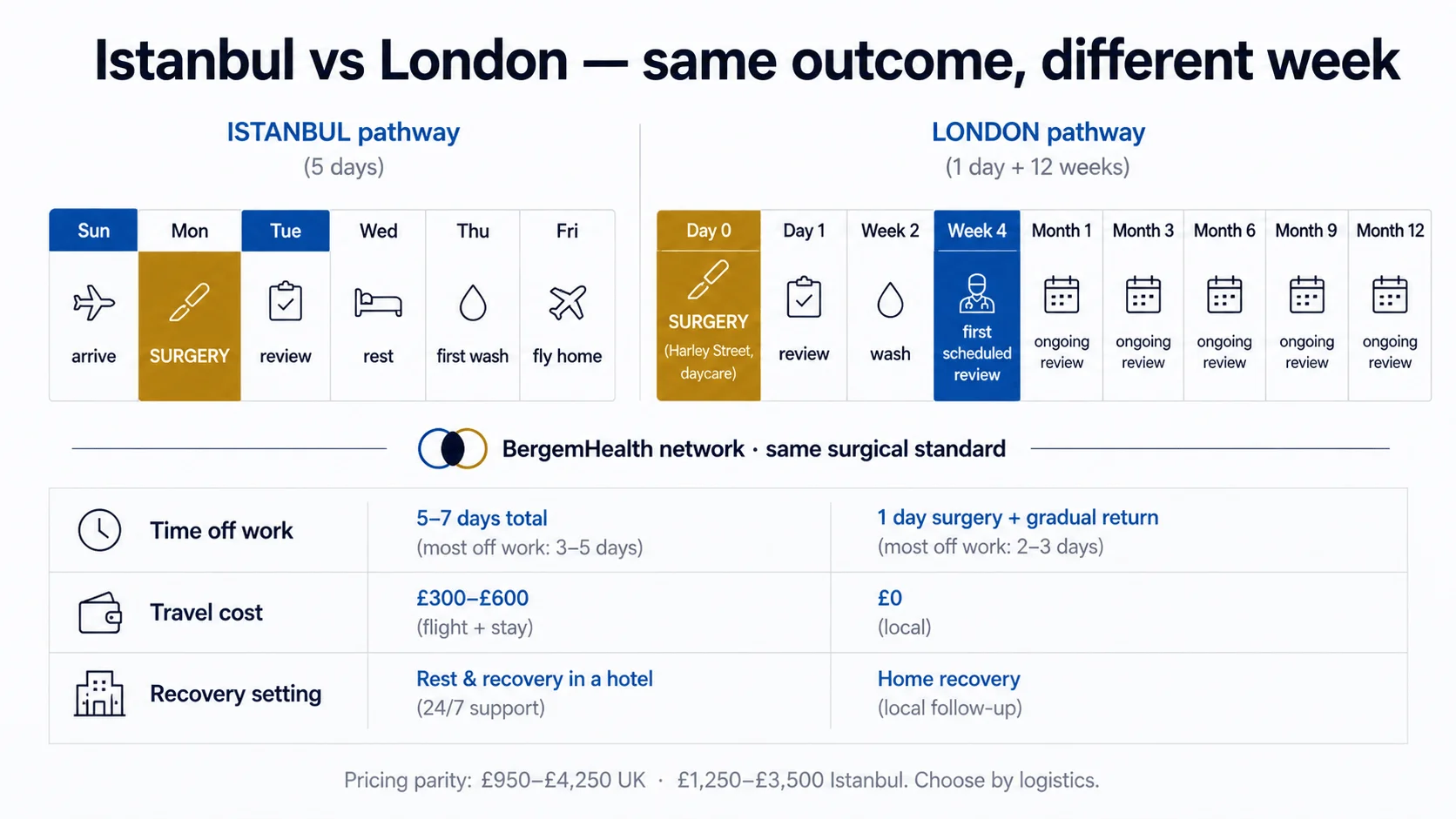
Quick answer
For UK patients comparing Istanbul and London for hair transplant in 2026, the historical framing — “Istanbul is cheaper, London is closer” — no longer applies at parity-priced two-clinic providers. The same surgical network now operates Liv Hospital Ulus in Istanbul (JCI-accredited) and 99 Harley Street in London (CQC-registered), with identical per-graft pricing on both sides because the cost base is shared. The choice between them is a logistics decision: travel comfort, recovery setting, in-person GMC oversight, and how your week off work needs to look. This article gives you the matrix to make that choice.
Table of contents
- It’s a logistics comparison, not a price comparison
- What’s actually identical between the two pathways
- What’s different (and how to weigh it)
- The decision matrix
- Side-by-side: Istanbul week vs London month
- How BergemHealth approaches this
- Frequently asked questions
It’s a logistics comparison, not a price comparison
The market-default framing of “UK private clinic at £8,000+ vs Turkey clinic at £1,500” was accurate when those were the only two structures available. It’s misleading in 2026. A small group of providers now share their surgical network and overhead across both an Istanbul hospital and a UK consulting clinic — which means a UK patient can access the Istanbul pricing structure without leaving the UK, or access the Istanbul facility while paying the same as they would in London.
That changes the question. When the same provider offers the same surgical team at the same per-graft price in both cities, you stop optimising for budget and start optimising for fit. Specifically:
- How do you want the week of surgery to look?
- Where do you want to recover?
- How important is in-person follow-up vs remote photo review?
- What does your work / family / travel context allow?
The rest of this article walks through those four questions in sequence.
What’s actually identical between the two pathways
Definition. A parity-priced two-clinic provider is one where the same surgical network operates a JCI-accredited hospital and a CQC-registered UK clinic, with identical per-graft pricing because operational overhead is shared rather than duplicated. The structural opposite is a UK private clinic with a Turkey marketing partnership — those typically maintain a 200%+ UK markup.
At BergemHealth, the following are the same across Istanbul and London:
- Per-graft pricing. Standard FUE from £1,250, Sapphire FUE from £1,750, Direct DHI from £2,250 — same numbers, regardless of country.
- Surgical team. Dr. Hamid Aydın (ISHRS member, 25,000+ procedures since 2000)ishrs leads on the Istanbul side; the same operator-of-record network informs the surgical pathway when the UK side is selected. Dr. Sumeyye Yuksel (GMC-registered) leads the London consulting teamgmc.
- Aftercare programme. 12 months of structured follow-up (month 1, 3, 6, 9, 12 reviews), free touch-up at month 9 if density falls below the agreed threshold.
- Surgical methods available. Standard FUE, Sapphire FUE, Direct DHI all offered (full method comparison here).
- Pre-op pathway. Identical assessment protocol — donor area mapping, photo documentation, blood work, hairline planning.
These are the variables a UK patient could reasonably worry would differ between countries. They don’t. That’s the structural feature that makes the choice purely logistical.
What’s different (and how to weigh it)
The differences are real, but they sit on the patient side of the table, not the surgical side.
1. Surgical-day environment. Istanbul: JCI-accredited hospital with full multi-specialty backup, dedicated hair-restoration theatres, 4-night recovery hotel arranged by the clinic. London: CQC-registered Harley Street facility, single-floor purpose-built clinic, recovery at home from day one.
2. Time-off-work shape. Istanbul: one block of 5–7 days, including travel. London: surgery day plus 4–5 days, with follow-ups fitted around work weeks.
3. Recovery setting. Istanbul: hotel — quiet, focused, but away from your support network. London: home — your bed, your shower, but with the household chaos.
4. Follow-up channel. Istanbul: month 1, 3, 6, 9, 12 reviews are remote (high-resolution photos + video calls) unless you fly back. London: the same reviews in person at Harley Street.
5. Travel friction. Istanbul: £150–£300 return flight from London, passport check on travel day. London: Underground or train ride to W1.
6. Companions. Istanbul: clinics typically arrange a partner-stays-too policy at the recovery hotel. London: companions can attend consultation but not theatre; recovery is at home.
None of these is universally better. The right choice depends on what trade-off you can absorb most easily.
The decision matrix
| Factor | Istanbul makes more sense if… | London makes more sense if… |
|---|---|---|
| Time off work | One continuous 5–7 day block is easier than scattered appointments | A single surgery day plus appointments fitted around your week is easier |
| Recovery setting | A quiet hotel room beats a busy home | Your home is calm and you have support there |
| Support network | Your partner/family is happy to fly with you | You’d rather not move them out of routine |
| Caring duties | You can clear 5 days of childcare/elder-care | 5 continuous days is unrealistic; mornings or afternoons easier |
| Follow-up preference | Remote photo reviews are fine for you | In-person clinical review at month 1 / 3 / 6 / 12 matters |
| GMC oversight in person | JCI hospital tier is reassuring; remote GMC consult is fine | You want a UK-registered doctor reviewing you in person |
| Travel comfort | You’re a relaxed flyer; passport’s current; visa-free entry works | Travel itself is genuinely difficult (anxiety, mobility, cost beyond surgery) |
| Hospital environment preference | You’d rather be in a hospital than a clinic | A purpose-built day clinic feels more proportionate |
| Time pressure | You can take 5 days off in one go in the next 6 weeks | Your calendar makes a continuous block hard |
| Psychological preference | “Going somewhere to have surgery” feels right | “Fitting it around normal life” feels right |
Most patients answer 6 or more rows on one side without much hesitation. If your answers are evenly split, the tiebreaker we usually see is row three: where will you actually recover better? People who recover better in a hotel choose Istanbul; people who recover better at home choose London. Both are valid.
Side-by-side: Istanbul week vs London month
Same total contact hours, same outcome trajectory; calendar shape differs.
| Stage | Istanbul pathway (one continuous trip) | London pathway (distributed) |
|---|---|---|
| Pre-op consultation | Day 2 (morning of arrival + 1): donor assessment, hairline drawing, blood work, free afternoon | Week -2: 60-min appointment at Harley Street with Dr. Yuksel’s team, blood work, written quote within 48 hours |
| Surgery day | Day 3: 09:00 prep → 09:30 local anaesthesia → 10:00 extraction (4–5 hrs) → lunch → 14:00 channel-opening → 16:00 implantation → 18:00 finish | Week 0: 08:00 arrival at Harley Street → local anaesthesia → 6–10 hrs surgery → 18:00–20:00 home (partner drives, no public transport) |
| First wash | Day 4: 10:00 in-clinic wash demonstration; rest at hotel afterwards | Day 1 post-op (Friday/Saturday): in-clinic wash demo at Harley Street + quick check |
| Final in-country review | Day 5: 10:00 review and photos → 12:00 hotel checkout → afternoon flight back to London | Weeks 2 and 4: optional in-clinic check-ins; many patients prefer remote review at this stage |
| Long-term reviews | Months 1, 3, 6, 9, 12: remote (high-resolution photo + video uploads, video call with clinical team) | Months 1, 3, 6, 9, 12: in-person at Harley Street, ~30 min each |
| Touch-up decision | Month 9, remote photo set → in-Istanbul or in-London if applicable | Month 9, in-person review → procedure scheduled at Harley Street if applicable |
| Total time off work | One continuous 5–7 day block | Surgery day + 4–5 days, plus 30-min review slots monthly |
| Total clinic visits | 3 in-person (Istanbul) + 5 remote | 1 surgery + 1 day-1 wash + 5 in-person reviews |
The London pathway gives you fewer continuous days off but more visits over a longer period. Total calendar disruption is similar; it’s just sliced differently. Anyone offering significantly less in-country time on the Istanbul side (e.g., surgery on arrival day) is skipping the consultation; anyone offering significantly more is padding the package.
How BergemHealth approaches this
The two-clinic structure isn’t an aspiration — it’s how BergemHealth’s surgical network operates day-to-day. The Istanbul side runs out of Liv Hospital Ulus, JCI-accredited since 2013liv-jcijci, with a hair-restoration department led by Dr. Hamid Aydın (ISHRS member, former president of SAÇDER, 25,000+ procedures since 2000)ishrs. The London side runs out of 99 Harley Street, CQC-registered, with a GMC-registered consulting team led by Dr. Sumeyye Yukselgmccqc.
Patients usually ask first whether the surgical outcome differs between the two sides. The honest answer is that the methods, the operator-of-record discipline, and the aftercare programme are the same on both sides. The differences are patient-side: a JCI hospital with multi-specialty backup and a focused-on-the-surgery week, vs a small purpose-built Harley Street clinic with a Tube ride home and your normal routine afterwards.
Patients usually ask second which we recommend. About half pick each. The split is explained by the time-off-work and recovery-setting rows in the matrix above. Patients with continuous availability and a preference for the focused-medical-trip feel pick Istanbul; patients with split calendars and a strong preference for sleeping in their own bed pick London. Almost nobody picks on price, because the price is the same.
What to do next
If you’re not yet sure which pathway suits you, the main Choosing-a-Clinic pillar covers the underlying surgeon-and-accreditation questions that apply regardless of where the surgery happens, and the JCI vs CQC vs GMC explainer covers how the regulatory bodies in each country differ. The methods themselves — Standard FUE, Sapphire FUE, Direct DHI — are explained in the hair-transplant pillar and the method comparison. The patterns to avoid are in the red-flags guide.
If you’ve worked through the matrix and have a preference, request a free assessment from BergemHealth’s London or Istanbul team. The consultation reviews your donor area, gives you a graft-count estimate, walks through the pathway you’ve chosen, and confirms the per-case quote. Same surgical network, two recovery options, identical pricing. CQC-registered Harley Street facility. JCI-accredited Liv Hospital Ulus. ISHRS-member lead surgeon.
Frequently asked questions
Is the surgery actually identical in both pathways?
The surgical methods, instrumentation, operator-of-record discipline, and aftercare programme are the same on both sides because the surgical network is shared. The hospital vs clinic environment differs (Istanbul = JCI hospital with multi-specialty backup; London = purpose-built Harley Street clinic), and the surgeon performing your specific operation will depend on the pathway you choose. Both sides operate to the same protocols.
Why is the price the same in London if rent and wages are higher there?
The price is the same because BergemHealth shares operational overhead across both sides of the network rather than running them as independent businesses. Rent and wages for the London clinic are absorbed across the full network’s case mix rather than recovered per-case from London-only patients. The structural opposite — a domestic UK practice with a Turkey marketing partnership — typically maintains a 200%+ UK markup; that isn’t BergemHealth’s model.
Can I switch from one pathway to the other after I’ve started?
The pre-op consultation can happen at either clinic and your decision on surgical pathway can change up to a few weeks before the booked surgery date. After the surgery date is confirmed and the surgical team is booked, switching becomes more complicated but not impossible. If you’re genuinely undecided, do the consultation at Harley Street first — it’s the lower-friction way to start.
Will I see the same surgeon in person if I choose the London pathway?
The London pathway is led by Dr. Sumeyye Yuksel’s GMC-registered consulting teamgmc. The operator-of-record on the surgical day depends on which clinic you’ve selected for the surgery itself — the clinic confirms the named surgeon in writing in your booking documentation, and that surgeon is the one in theatre on the day. The “named surgeon = operating surgeon” rule applies on both sides; that’s the point of the operator-of-record discipline.
What if I have a complication post-surgery and I’m in the UK?
For Istanbul-pathway patients who are back in the UK: any post-op concern is reviewed initially by remote photo and video, with same-day clinical input from the surgical team. If the concern requires in-person assessment, the Harley Street consulting team can step in — that’s one of the main reasons the two-clinic model exists. For London-pathway patients: in-person review at Harley Street within 24–48 hours. Genuine surgical emergencies are rare in hair transplant under local anaesthesiagarg.
Is JCI accreditation more reassuring than CQC registration?
They regulate different things, so the comparison isn’t quite right. JCI accredits the hospital as a system (theatres, infection control, emergency response). CQC registers UK clinics for minimum-standard compliance. Full breakdown in the JCI vs CQC vs GMC article. Either tier is appropriate for elective hair transplant under local anaesthesia.
Do I need a visa to fly to Istanbul for surgery?
UK passport holders do not need a visa to enter Türkiye for stays under 90 days as of 2026. You’ll need a passport valid for at least six months from the date of travel and a return ticket. Some travel insurance policies require a “fitness to fly” form post-surgery — check your policy before booking.
How long after the surgery is it safe to fly home?
48 hours after surgery is the conservative minimum. Most defensible Istanbul-pathway providers schedule the return flight on day 4 (counting surgery day as day 1), which gives 60+ hours and includes a clinic review on the morning of departure. Anyone scheduling a same-day or next-day return flight is cutting clinical safety margins.
Can my partner come to consultations and surgery?
In London: yes, partners can attend consultations at Harley Street and are usually present at the post-op review. In Istanbul: partners are welcome at the consultation and on the day of surgery (waiting room, not theatre); the recovery hotel typically allows partner stays at no additional clinic cost. Travel costs (flights, partner’s hotel meals if separate) are patient-arranged.
Sources
BergemHealth bu konuya nasıl yaklaşıyor
Operasyonlar JCI akreditasyonlu Liv Hospital Ulus, İstanbul’da Dr. Hamid Aydın ve bölüm cerrahi ekibi tarafından yapılır. Birleşik Krallık konsültasyonu ve 12 aylık takip CQC denetimli Harley Street ofisimizde. Şeffaf fiyatlandırma ve gerektiğinde ücretsiz touch-up.
Ücretsiz konsültasyon →