First 7 Days After FUE: A Day-by-Day Recovery Guide
Day-by-day what to expect after FUE hair transplant: swelling, sleep position, first wash, when to work, what's normal vs when to call the clinic.
Medical disclaimer. This article is educational and not medical advice. Hair restoration outcomes are individual; only a qualified surgeon can assess your case in a personal consultation.
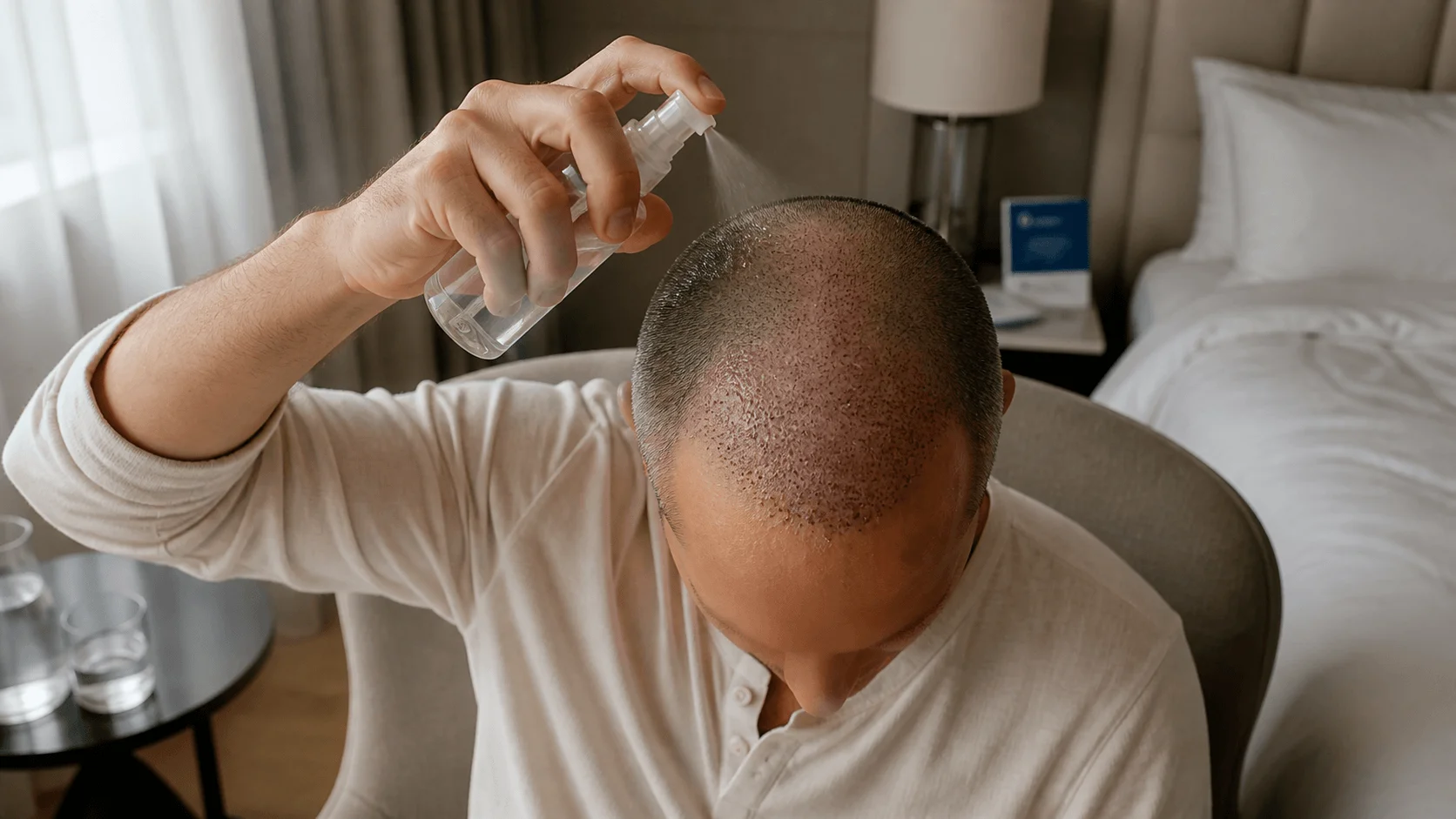
Quick answer
The first 7 days after FUE hair transplant are physically uneventful for most patients but psychologically demanding because the donor and recipient areas look visibly worked-on for the entire week. Day 0 is surgery; days 1–3 are the swelling-and-sleep-upright phase; day 2 is the first wash; day 4 is when most desk-based workers return to office work; day 7 is the first cosmetic milestone, with most surface crusts detached. This guide walks each day in order — what’s normal, what to do, and what to call the clinic about.
Table of contents
- The shape of the first 7 days
- Day 0 — surgery day in brief
- Day 1 — first review
- Day 2 — first wash
- Day 3 — peak swelling
- Day 4 — return to desk work
- Day 5 — itching begins
- Day 6 — crusts detaching
- Day 7 — first cosmetic milestone
- What’s normal vs when to call the clinic
- How BergemHealth manages day 0–7
- What to do next
- Frequently asked questions
The shape of the first 7 days
The first week post-FUE is structured around three priorities, in this order:
- Don’t disturb the new grafts. Days 1–3 are the most fragile period biologically — grafts are establishing their blood supply and can be displaced by physical pressure or rubbing.
- Manage swelling and sleep position. Forehead swelling typically peaks day 2–3 and resolves by day 5; sleeping semi-upright the first 3 nights reduces both swelling and discomfort.
- Follow the wash protocol exactly. Daily wash from day 2 with the issued solution — gentler than most patients expect and essential for crust detachment.
What this looks like as a daily rhythm is below. Specifics vary slightly by clinic; always follow your clinic’s specific instructions over generic guidance.
Day 0 — surgery day in brief
For the procedural detail of what happens in theatre — extraction, channel-opening, implantation, technique-specific differences — see the methods comparison. What matters for recovery starts at the end of day 0: dressings on the donor area, a protective headband, the post-op medication pack (paracetamol or codeine, antibiotic prophylaxis, antihistamine for swelling), verbal and written aftercare instructions, and transfer to hotel (Istanbul pathway) or home (London pathway) — no driving.
Night 0: sleep semi-upright using a travel pillow or stack of pillows. Sleeping flat increases overnight forehead swelling and is best avoided for the first 3–5 nights. Take prescribed medication on schedule. Severe pain warrants a same-day call to the clinicgarg.
Day 1 — first review
First clinic review at 24 hours post-op. The team removes or repositions the headband, examines donor and recipient areas, photographs both for the patient’s case record, and reviews the medication regimen.
Visible appearance day 1:
- Donor area — mild swelling, small punch points visible, slight tenderness
- Recipient area — tiny crusts at each graft site, scalp slightly red between sites, no significant swelling yet (swelling tends to reach the forehead day 2–3 under gravity)
Activities day 1: rest, gentle walking, light food. Avoid bending forward (increases scalp blood flow). Continue sleeping semi-upright. No washing yet — the first wash is tomorrow under clinical supervision. The headband (if issued) typically goes back on for night 1 to keep gentle pressure on the donor area; most clinics remove it permanently by day 2.
Day 2 — first wash
The first wash is performed at the clinic as a demonstration so the patient learns the technique. The format:
- Saline rinse over the recipient area (no rubbing, no fingers in the recipient zone)
- Gentle dabbing of issued lotion or oil to soften crusts (optional, varies by clinic)
- Wait 15–30 minutes for the lotion to soak
- Soft tap-water rinse at slightly cool temperature
- Gentle patting dry with a clean towel — never rubbing
What’s deliberately not in the wash: shampoo lather across the recipient area (that comes from week 2), water pressure from a shower-head onto the recipient area (use a jug or soft cup-pour for the first 7–10 days), or any product not specifically issued by the clinic.
By day 2, the grafts are sufficiently anchored that gentle washing doesn’t displace them. The fear of “knocking grafts out” usually resolves once patients see the demonstration. Forehead swelling may begin or be obvious today.
Day 3 — peak swelling
Forehead and around-the-eyes swelling typically peaks on day 2–3. Causes: residual local anaesthetic, fluid shift under gravity from the surgical area down the front of the face. The swelling is harmless and self-limiting.
What helps:
- Ice pack on the forehead (not on the recipient area) for 15-minute periods through the day
- Continued semi-upright sleep
- Antihistamine if prescribed
- Gentle walking rather than long sitting (improves lymphatic drainage)
What doesn’t help: bending over (worsens swelling), heavy meals (water retention), alcohol (vasodilation increases swelling). The swelling resolves spontaneously by day 5–7 in nearly all cases.
Continue daily wash protocol — typically 1–2 washes per day depending on clinic instructions. Crusts continue to slowly soften.
Visible appearance day 3:
- Donor area — small punch points still visible, redness fading slightly
- Recipient area — tiny crusts at every graft site, scalp underneath red between sites
- Forehead — visible swelling may be obvious; eyelid swelling possible
Day 4 — return to desk work
By day 4, most desk-based workers are physically fit to return to office work. The donor area shows small healing punch points; the recipient area shows tiny crusts and pink scalp — neither is alarming on close inspection, but both are visibly worked-on. A loose-fitting cap covers everything for the commute and most of the workday; many patients work from home for the first week instead. Most patients feel essentially normal by day 4 — mild fatigue from broken sleep and medication is the most common residual symptom.
What to avoid at work day 4: leaning forward over a desk for long periods (slight increase in scalp blood flow), wearing tight-fitting headphones or glasses that press on the donor area, putting pressure on the recipient area (e.g., the headrest of an office chair). Continue daily wash protocol. Forehead swelling should be reducing today.
Day 5 — itching begins
Itching at the donor and recipient areas is very common around day 5–7. It’s a normal sign of healing — the same reaction that any healing skin produces — and is not an indicator that anything is going wrong.
Manage with the issued solution (saline or anti-itch lotion supplied by the clinic), gentle dabbing rather than scratching, and continued daily washing (the wash itself often relieves the itch). Avoid scratching (can dislodge healing crusts), any anti-itch product not approved by the clinic, and hot showers (heat increases itch).
Visible appearance day 5: donor punch sites barely visible from normal distance with mild residual redness; recipient crusts beginning to loosen, some starting to detach; forehead swelling typically reducing or resolved.
Day 6 — crusts detaching
Around days 6–8, crusts at each graft site begin to detach naturally as part of the daily wash. Do not pick or pull at crusts — let them come off on their own with washingsharma. Picking can dislodge underlying grafts.
Detached crusts come away with the original transplanted hair shafts attached — alarming the first time it happens, but the visible hair shafts are the original transplanted ones and the follicle below remains in place. The follicles produce new hair shafts after the shock-loss phase (shock loss explained).
By end of day 6, roughly 60–70% of original crusts have detached. The recipient area underneath looks pink and clean, with transplanted hair shafts visible as short stubble.
Day 7 — first cosmetic milestone
Day 7 is the first major cosmetic milestone. Most surface crusts have detached. Donor area: small healing punch sites, fading from red to pink, not noticeable from normal social distance. Recipient area: pink underlying scalp with short transplanted hair shafts visible — donor-zone-quality hair embedded in its new location, before shock loss begins. Forehead and face: swelling typically resolved. Most pre-op activities resumable from this point.
Still off-limits at day 7: heavy gym (cardio + resistance, wait until week 3); contact sports (6 weeks); chlorinated swimming (week 4); sea/saltwater swimming (week 5–6); saunas and steam rooms (week 4); heavy alcohol (moderate fine; heavy drinking better avoided through month 1).
The clinic schedules a remote review (Istanbul pathway) or in-person check (London pathway) at week 2, with the next milestone review at month 1.
What’s normal vs when to call the clinic
The published complication-rate literature for hair transplant under local anaesthesia in regulated settings reports rates well under 1% for serious adverse eventsgarg. Most concerns patients raise turn out to be normal-but-frightening features of healing rather than complications. Quick triage:
| Symptom | Normal? | Action |
|---|---|---|
| Mild discomfort day 0–2 | Yes | Paracetamol; codeine if prescribed |
| Forehead swelling day 2–4 | Yes | Ice on forehead; semi-upright sleep |
| Mild redness recipient area days 1–14 | Yes | Continue wash protocol |
| Tiny scabs at every graft site days 1–8 | Yes | Don’t pick; let detach naturally |
| Itching days 5–10 | Yes | Issued anti-itch solution |
| Loose hair shafts in shower/on pillow days 14–60 | Yes (shock loss) | See shock loss article |
| Short transplanted hair stubble visible day 7+ | Yes | Reassuring sign |
| Severe pain not controlled by analgesia | No | Same-day call |
| Spreading redness beyond surgical area | No | Same-day call (possible infection) |
| Pus or yellow discharge | No | Same-day call |
| Fever above 38°C | No | Same-day call |
| Bleeding from donor area not stopping with pressure | No | Same-day call |
| Severe swelling beyond pre-described range | No | Same-day call |
The threshold for calling should be low.
How BergemHealth manages day 0–7
BergemHealth’s day 0–7 protocol is the same regardless of pathway. Both Istanbul and London routes issue the same medication pack, the same wash solution, the same written aftercare guide, and the same 12-month aftercare bundle. Istanbul-pathway patients have surgery on day 1 of the in-country week (arrival day 0, surgery day 1, reviews day 2 and 3, fly home day 4 minimum); London-pathway patients have surgery at Harley Street and recover at home from day 0 with a day-1 in-clinic review, a day-2 wash demonstration, and a week-1 in-person check.
Dr. Hamid Aydın leads the surgical pathway at Liv Hospital Ulus (ISHRS member, 25,000+ procedures since 2000)ishrs; Dr. Sumeyye Yuksel leads the London consulting and aftercare teamgmc.
What to do next
For the broader 12-month timeline, see the recovery-aftercare pillar. For the shock-loss phase that begins around week 3, see shock loss explained. For what each subsequent month brings, see month-by-month results.
For surgical-method choice (which affects the day 1–7 picture only modestly — Sapphire FUE typically shows 1–2 days faster surface healing; Direct DHI similar), see the methods comparison and the hair-transplant pillar.
If you want to understand the recovery commitment in more detail, request a free assessment from BergemHealth’s London or Istanbul team. The pre-op consultation walks through day-by-day expectations, the medication pack, the wash protocol, and the 12-month aftercare programme included at both clinics. CQC-registered facility in London. JCI-accredited hospital in Istanbul. ISHRS-member lead surgeon.
Frequently asked questions
Will the first 7 days hurt?
Most patients report mild discomfort for 24–48 hours post-op, manageable with paracetamol or codeine. The donor area can feel tight for 5–10 days. Severe pain is unusual and warrants a same-day call to the clinicgarg.
How do I sleep after a hair transplant?
Semi-upright the first 3–5 nights, supported by a travel pillow or stack of bed pillows. From night 4–5, semi-side-lying is generally safe (avoid lying directly on the recipient area). Most patients are back to normal sleep position by night 7.
When does the swelling go down after hair transplant?
Forehead and around-the-eyes swelling typically peaks day 2–3 and resolves by day 5–7. Caused by residual local anaesthetic and fluid shift under gravity. Ice on the forehead (not on the recipient area), semi-upright sleep, and gentle walking help. Severe swelling beyond pre-described range warrants a clinic call.
When can I shower after FUE?
Body shower from day 1 onward. Head wash using the issued protocol: from day 2 (first wash at the clinic). Normal shower pressure on the recipient area: not until week 2 — until then, use a jug or soft cup-pour to rinse.
What if a graft falls out in the first week?
A crust falling out with hair attached is normal — that’s the surface scab detaching with the original transplanted hair shaft, while the follicle below remains anchored. Genuine graft loss in the first 7 days is uncommon if the wash protocol is followed. If you see actual bleeding or significant tissue loss, call the clinic same-day.
Can I wear a hat after a hair transplant?
A loose-fitting hat that doesn’t press on the recipient area is fine throughout the first week. Avoid tight-fitting hats or baseball caps with a tight back band for the first 10 days. After day 14, normal hat-wearing is fine.
When can I drink alcohol again?
Avoid alcohol entirely for the first 7 days post-op. Resume in moderation from week 2. Heavy drinking is best avoided through month 1.
What if I see redness spreading beyond the surgical area?
Spreading redness beyond the surgical sites is one of the few “call same-day” signals — it can indicate early infection. Folliculitis (small infected follicles) is the most common minor complication of hair transplant, treatable with antibiotics if caught earlygarg.
Sources
- NHS — Hair transplant overview and recovery. https://www.nhs.uk/conditions/cosmetic-procedures/hair-transplant/ ↩
- StatPearls — Hair Transplantation. National Center for Biotechnology Information. https://www.ncbi.nlm.nih.gov/books/NBK547740/ ↩
- Sharma R, Ranjan A. “Follicular Unit Extraction (FUE) Hair Transplant: Curves Ahead.” J Med Life. 2019. https://www.ncbi.nlm.nih.gov/pmc/articles/PMC6795649/ ↩
- Garg AK et al. “Complications in hair transplantation.” J Cutan Aesthet Surg. 2021. https://www.ncbi.nlm.nih.gov/pmc/articles/PMC8719980/ ↩
- International Society of Hair Restoration Surgery — Member directory. https://www.ishrs.org/ ↩
- General Medical Council — The Medical Register. https://www.gmc-uk.org/registration-and-licensing/the-medical-register ↩
BergemHealth bu konuya nasıl yaklaşıyor
Operasyonlar JCI akreditasyonlu Liv Hospital Ulus, İstanbul’da Dr. Hamid Aydın ve bölüm cerrahi ekibi tarafından yapılır. Birleşik Krallık konsültasyonu ve 12 aylık takip CQC denetimli Harley Street ofisimizde. Şeffaf fiyatlandırma ve gerektiğinde ücretsiz touch-up.
Ücretsiz konsültasyon →