FUE vs DHI vs Sapphire FUE: Which Hair Transplant Method Is Right for You? (2026)
Honest 2026 comparison of FUE, Sapphire FUE and DHI hair transplant methods. Side-by-side: cost, density, recovery, scarring and who each method is actually for.
Medical disclaimer. This article is educational and not medical advice. The right method for your scalp depends on factors only a qualified surgeon can assess — donor density, hair calibre, scalp laxity, recipient area and pattern stability. Use this guide to ask better questions, not to self-prescribe.
Quick answer
In 2026, Standard FUE, Sapphire FUE and Direct DHI are the three serious hair transplant methods. They share the same harvest step (a small punch removes follicular units one by one) and differ only in how the recipient site is prepared and how grafts are placed. The NHS lists hair transplantation as a cosmetic surgical procedure with a 1–2 week initial recovery and notes grafts are not secure for the first fortnight.1
- Standard FUE — most flexible, suits all areas, lowest price, slightly slower healing.
- Sapphire FUE — narrower channels allow tighter front-zone packing; 1–2 days faster healing in our experience.
- Direct DHI — best for crown work, women, and unshaven-recipient cases.
The bigger decision is who does your surgery, not which letters they advertise. Peer-reviewed survival rates cluster between 90% and 95% across all three methods in well-run clinics — intra-clinic variance dwarfs inter-method variance.25
Table of contents
- What’s actually the same across all three methods
- What actually differs
- Side-by-side comparison table
- Decision flowchart
- When Standard FUE is the right choice
- When Sapphire FUE is the right choice
- When Direct DHI is the right choice
- The marketing claims to ignore
- Cost compared
- Recovery compared
- How BergemHealth approaches this
- What to do next
- Frequently asked questions
What’s actually the same
FUE, Sapphire FUE and DHI are not completely different operations. They share four fundamentals:
- Donor source. All three take follicles from the back and sides of the scalp — the DHT-resistant zone — using the same 0.7–1.0 mm circular punch.3
- Anaesthesia. Local anaesthetic infiltration of donor and recipient zones. No general anaesthesia.
- Survival biology. Graft survival depends on time out of body, holding-solution temperature, atraumatic handling and recipient blood supply — not on the brand of blade or pen.2
- 12-month timeline. Shock loss in months 1–3, early growth at 4–6 months, density visible at 9–12 months. Identical for all three.
Definition — Follicular unit. The natural grouping of one to four hair follicles that share a single sebaceous gland and erector muscle. Hair grows in clusters, not as single isolated strands.
What actually differs
The differences sit in two surgical steps: how the recipient channels are made, and how the grafts are placed.
Channel opening
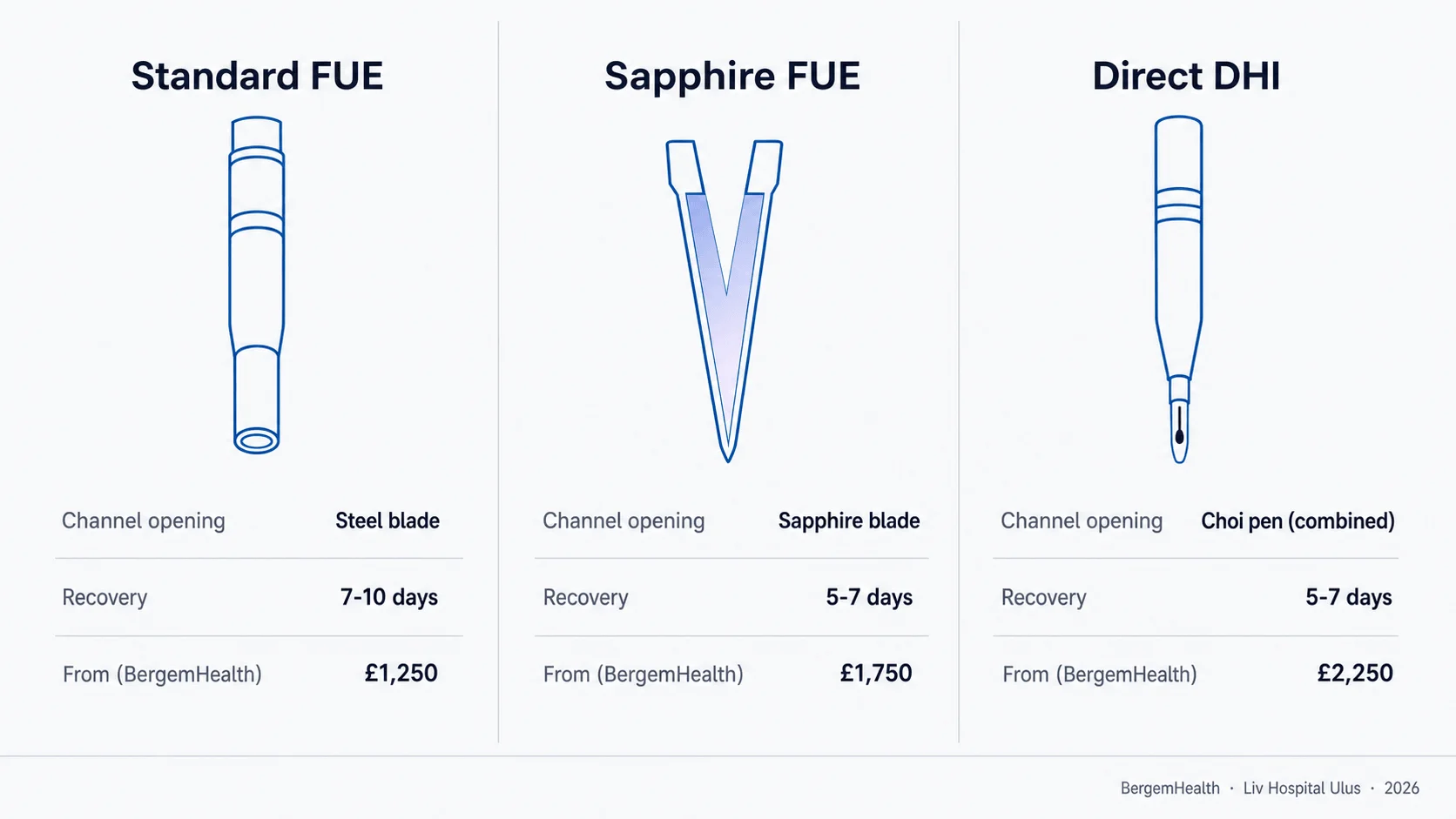
- Standard FUE uses a stainless-steel blade or needle to open each channel. Slits are made first; grafts are then implanted with forceps.
- Sapphire FUE uses a V-shaped sapphire-crystal blade. The crystal edge is sharper and the slit narrower and more uniform — which lets a trained surgeon pack channels closer together in the front zone.
- Direct DHI doesn’t open channels first. The Choi implanter pen creates the channel and inserts the graft in a single motion; time between extraction and implantation can be under 60 seconds.
Graft handling and pre-shave
- FUE and Sapphire FUE sort grafts under microscope, hold them in chilled solution (typically 4°C), then implant with forceps after channels are made. Both require a fully shaved head (or “unshaven FUE” at extra cost and longer session time).
- Direct DHI loads grafts into Choi pens immediately after extraction and implants within minutes — shortest time out of body, lowest bleeding. Only the donor strip needs trimming, so the recipient area can stay unshaven (decisive for women and for patients who cannot fully shave).

Side-by-side comparison table
This is the master comparison. StatPearls reports recipient-site density of roughly 30–45 grafts/cm² as standard, with skilled hands reaching 45–60 grafts/cm² in the front zone and up to 50–70 grafts/cm² in selected cases.4
| Feature | Standard FUE | Sapphire FUE | Direct DHI |
|---|---|---|---|
| Donor harvest | 0.7–1.0 mm punch | 0.7–1.0 mm punch | 0.7–1.0 mm punch |
| Channel opening | Stainless-steel blade or needle | Sapphire V-blade | Choi pen (no separate channel step) |
| Implantation | Forceps into pre-made channels | Forceps into pre-made channels | Choi pen (direct injection) |
| Typical density (2026, grafts/cm²) | 30–45 | 45–60 | 50–70 in skilled hands4 |
| Typical session length | 4–8 hours | 4–8 hours | 6–10 hours |
| Recovery (recipient scabs gone) | Day 8–10 | Day 7–9 | Day 7–9 |
| Best for | All areas, larger sessions, tight budget | Front-zone density, hairline rebuild | Crown, women, unshaven recipient |
| Pre-shave | Full head | Full head | Donor only |
| Bleeding during placement | Standard | Lower | Lowest |
| Time out of body for grafts | Longest | Medium | Shortest |
| Surgeon-skill ceiling | Moderate | High | Highest |
| Max grafts per session | 4,000–4,500 | 3,500–4,000 | 2,500–3,500 |
| Typical UK private cost (2026) | £8,000–£14,000 | £10,000–£16,000 | £12,000–£18,000 |
| BergemHealth all-inclusive (2026, from) | £1,250 | £1,750 | £2,250 |
[Reference pricing per BergemHealth § Cost transparency, May 2026.]
Decision flowchart
Use this as a starting point — final method selection always belongs with the surgeon at consultation.
- Norwood II–III, hairline-led, 1,500–3,000 grafts, modest budget → Standard FUE.
- Norwood II–IV, dense packing the priority, willing to pay a 25–40% surcharge → Sapphire FUE.
- Hairline + temporal points + women’s diffuse thinning + unshaven-recipient priority → Direct DHI.
- Norwood V–VI, mega-session of 4,000+ grafts → Standard or Sapphire FUE (DHI throughput cap makes single-session DHI impractical here).
- Lowest-cost package at or below £1,500 → DECLINE — see our red flags article on graft mills.
When Standard FUE is the right choice
Standard FUE is the right method when:
- You need 3,500–4,500 grafts in one session. Larger sessions favour the standard technique because it is faster per graft once the team is in flow.
- You have a tight budget but want JCI- or CQC-regulated surgical standards. Standard FUE is the lowest-priced of the three at every clinic that does all three.
- Your case is uncomplicated. Norwood III–IV, healthy donor, no previous transplant. The marginal density gains of Sapphire or DHI rarely justify the extra cost.
Read more in our Standard FUE method guide.
When Sapphire FUE is the right choice
Sapphire FUE is the right method when:
- You want maximum visible density at the hairline. Tighter packing matters most in the front 2–3 cm of scalp, where the result is visible to anyone looking at you.
- You want fast cosmetic recovery. In our experience, recipient scabs typically clear 1–2 days sooner than Standard FUE because sapphire channels are narrower and bleed less.
- Your surgeon performs Sapphire FUE routinely, not as a marketing upcharge. In our experience, untrained hands using sapphire blades produce no better result than trained hands using steel — the technique sits in the surgeon, not the crystal.5
Read more in our Sapphire FUE method guide.
When Direct DHI is the right choice
DHI is the right method when:
- You are restoring the crown or temporal points. Choi pen implantation gives the surgeon precise angle control, which matters more in the crown because hair grows in a whorl pattern.
- You are a woman with diffuse thinning who wants to keep your existing hair length. DHI’s unshaven recipient option lets you walk in with shoulder-length hair and walk out with shoulder-length hair plus a trimmed donor strip the rest of your hair will cover.
- Your case is small to medium (≤2,500 grafts). DHI gets slow above this size; the gain in density does not offset the risk of fatigued surgeons in 10+ hour sessions.
Read more in our Direct DHI method guide.

The marketing claims to ignore
Search results and clinic websites are full of method comparisons that overstate the differences. Four claims to be sceptical of:
- “DHI has higher graft survival than FUE.” No high-quality randomised trial supports this. Survival depends mostly on team experience, holding solution and time out of body — surgeon-and-clinic factors, not method factors.25
- “Sapphire FUE causes less scarring.” Donor scarring is identical (same punch). Recipient channels heal in days regardless of blade material.
- “DHI is painless / FUE is painful.” Both use the same local anaesthetic. The first 5–10 minutes of donor anaesthetic injection is uncomfortable for both.
- “Sapphire is the most advanced technique.” Sapphire is a tool, not a technique. The technique is FUE.
Cost compared
The price of the same operation by the same surgeon team varies more between countries than between methods. The largest published comparative dataset on method prevalence and pricing patterns is the ISHRS 2022 Practice Census.5
| Method (2,000 grafts, 2026) | UK private clinics (typical) | Liv Hospital Ulus, Istanbul (BergemHealth, all-inclusive) |
|---|---|---|
| Standard FUE | £8,000–£11,000 | from £2,500 |
| Sapphire FUE | £10,000–£13,000 | from £3,500 |
| Direct DHI | £12,000–£16,000 | from £4,500 |
| Sapphire FUE — 4,000 grafts | £14,000–£18,000 | from £5,500 |
Inside Turkey itself, 2026 prices range from sub-£1,500 graft-mill packages — where 15+ patients per surgeon per day is common and most steps are technician-led — up to £3,500–£5,500 at JCI-accredited hospitals where the surgeon plans the case and opens the channels personally. Industry observers and ISHRS membership criteria flag clinics operating at the high-volume, technician-led end of the market as carrying a higher rate of revision-transplant requirements.5
For a deeper breakdown including hidden costs and what’s included in each tier, see the hair transplant cost guide for 2026 — UK vs Turkey.
Recovery compared
Recovery timelines differ less than marketing suggests:
| Stage | Standard FUE | Sapphire FUE | Direct DHI |
|---|---|---|---|
| First gentle wash | Day 3 | Day 3 | Day 3 |
| Recipient scabs gone | Day 8–10 (2026) | Day 7–9 (2026) | Day 7–9 (2026) |
| Donor pinkness fades | Day 7–10 | Day 6–8 | Day 6–8 |
| Return to office work | Day 7–10 | Day 5–7 | Day 5–7 |
| Return to gym (light) | Day 14 | Day 14 | Day 14 |
| Return to gym (full) | Day 30 | Day 30 | Day 30 |
| Shock loss complete | Month 3 | Month 3 | Month 3 |
| Final density | Month 9–12 | Month 9–12 | Month 9–12 |
Differences in the first 10 days are real but small. Reported folliculitis rates cluster at 10–20% across modern FUE-based methods, again driven more by hygiene and technique than tool choice.6 Differences in final result at 12 months are dominated by surgical planning and graft survival — not by which tool was used.
How BergemHealth approaches this
We don’t sell methods; we sell surgical care. The coordinator’s job before consultation is to gather photos, donor density, hair calibre, expectations and medical history; the surgeon’s job at consultation is to recommend the method and graft count that fit your case.
For many of our patients the recommendation is Standard FUE because the case doesn’t need more — and we don’t upsell to Sapphire or DHI for cases that don’t benefit. Where Sapphire or DHI are the right call, the same surgeon performs the channel-opening or pen implantation personally rather than delegating to technicians, and the schedule is one or two patients per day to keep the team fresh.
Both clinics in our network — Liv Hospital Ulus, Istanbul (JCI-accredited since 2013) and Harley Street Hospital, London (CQC-regulated, GMC-registered) — perform all three methods. The choice between Istanbul and London is usually about budget and travel preference, not technical capability.
What to do next
The most useful next step is a free photo-based consultation. Send four scalp photos (front, top, both sides) and answer six questions about your hair history. Within 48 hours you receive a written plan from the surgical team — method, graft count, realistic expectation, price band — for both clinics. See also the Hair transplant pillar guide.
Book a free photo consultation →
Frequently asked questions
Is DHI better than FUE in 2026?
Not categorically. DHI is better for crown work, unshaven recipient, women and smaller sessions. For full hairline reconstruction with 3,500+ grafts, Sapphire FUE often gives a comparable or better result because larger sessions are more efficient and density ceilings overlap once graft survival is accounted for.4
Is Sapphire FUE worth the extra money over Standard FUE?
For hairline reconstruction in patients who want maximum visible density: usually yes — the typical £200–£500 upcharge buys denser front-zone packing in the most cosmetically visible area. For crown-only cases or smaller sessions: not always. Ask the surgeon to recommend based on your specific area.
Can I combine methods in one operation?
Yes, and it is often the right answer. Many patients have Sapphire FUE on the hairline and front zone for maximum density, with Standard FUE in the mid-scalp where density requirements are lower. DHI is sometimes added for crown areas. Combining methods adds £200–£500 typically.
Which method has the highest graft survival rate?
In well-run clinics with all three methods, peer-reviewed survival rates cluster between 90% and 95% regardless of method.2 Differences between clinics dwarf differences between methods. Choose surgeon and clinic first; method second.
Which method gives the most natural-looking hairline?
All three can produce a natural hairline when the surgeon plans correctly. Naturalness comes from angle, direction, single-graft placement at the front edge, and irregular spacing — not from method. A poorly planned DHI hairline looks no more natural than a poorly planned Standard FUE hairline.
Can DHI be done unshaven for the whole head?
The recipient area can be left unshaven for DHI. The donor area must always be trimmed to roughly 1 mm to allow the punch to grip individual follicles. “Fully unshaven” usually means donor strip trimmed (covered by surrounding hair) plus recipient area natural length. This matters most for women and short-haired men who can comb existing hair over the donor.
What method is best for women?
DHI is most often recommended for women with diffuse thinning because the unshaven recipient option is usually decisive. For women with a stable Ludwig pattern and willingness to trim, Sapphire FUE produces denser results in the front zone. The decision is rarely about technique alone.
I had a previous transplant elsewhere. Which method should I use for the repair?
Repair cases are case-by-case. Donor area is often depleted, and recipient scarring affects channel-opening. DHI is sometimes preferred for repair because the unshaven option preserves any usable hair while the surgeon adds density. Standard or Sapphire FUE is preferred when major redistribution is needed. Send photos for a specific recommendation.
What are the main complications I should know about?
Reported complications across FUE-based methods include folliculitis (10–20%), transient numbness, swelling, ingrown hairs, donor-area shock loss and — rarely — necrosis if recipient density is pushed beyond what the blood supply tolerates.6 Risk is reduced — not eliminated — by surgeon-led planning, conservative density choices and good aftercare.
Sources
Reviewed by BergemHealth member, lead surgeon for hair restoration at Liv Hospital Ulus, Istanbul. 25,000+ procedures since 2000. Last updated 4 May 2026.
How BergemHealth approaches this
Procedures are performed at JCI-accredited Liv Hospital Ulus, Istanbul, by Dr. Hamid Aydın and the resident surgical team. UK consultation and 12-month aftercare at our CQC-regulated Harley Street office. Transparent pricing and a free touch-up if indicated.
Free consultation →