Sapphire FUE Hair Transplant: Full Guide & Cost (2026)
Sapphire FUE hair transplant: what the V-shaped sapphire blade actually changes, how dense packing works, cost in UK vs Turkey (2026), and 12-month results.
Medical disclaimer. This article is educational and not medical advice. Hair restoration outcomes are individual; only a qualified surgeon can assess your case in a personal consultation.
Quick answer
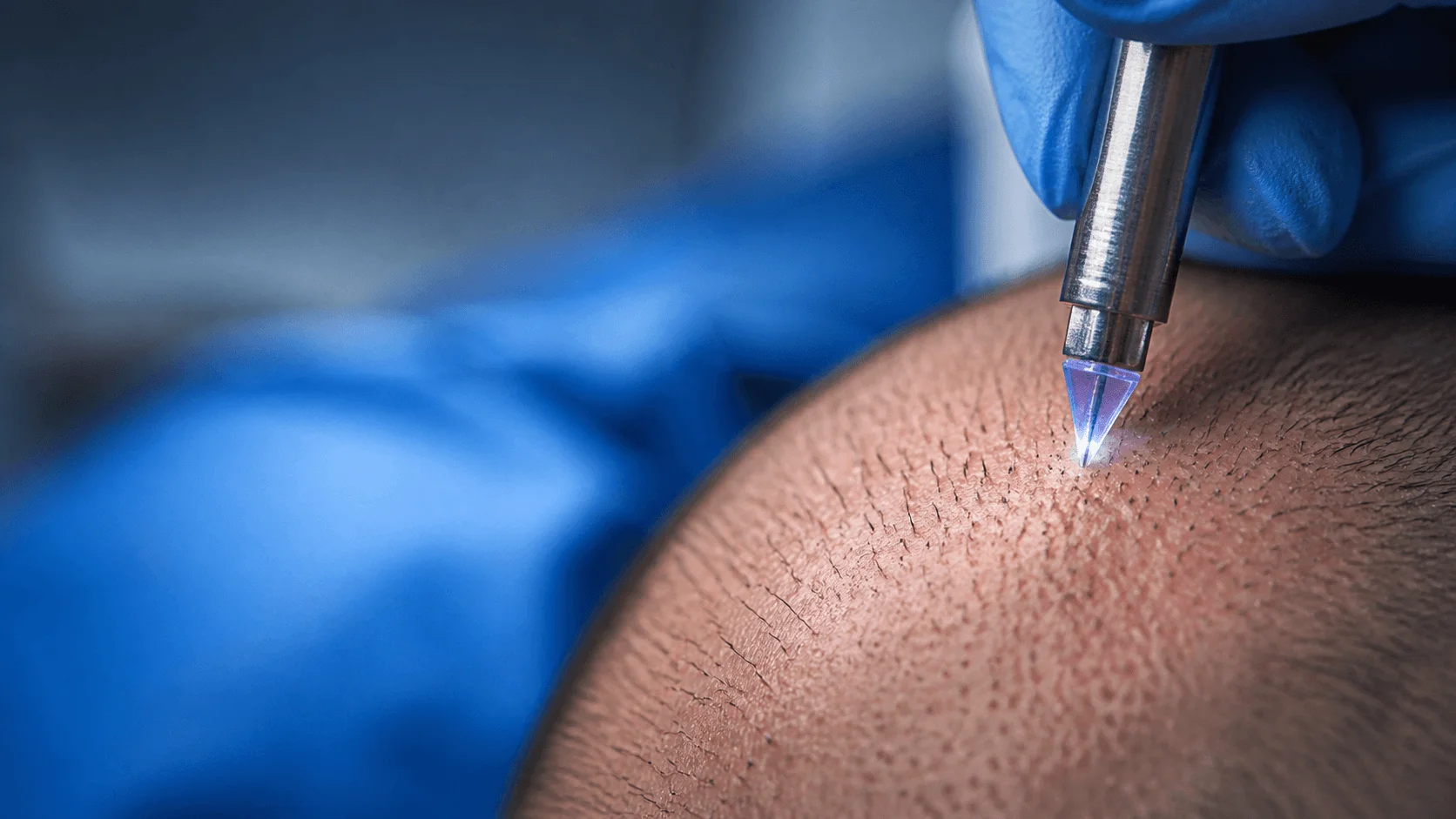
Sapphire FUE is a refinement of standard FUE in which the channels for graft placement are opened with V-shaped sapphire-crystal blades instead of stainless-steel ones. The harvest step (extracting follicular units) is identical to standard FUE. The change is at channel-opening: the sapphire blade produces a smoother, more uniform incision that supports denser graft packing (about 45–60 grafts/cm² in 2026 practice, versus 30–45 with steel) and 1–2 days faster healing. It is the default method at BergemHealth for hairline-led restorations and Norwood II–IV cases.
- From £1,750 (2026) at JCI-accredited Liv Hospital Ulus, Istanbul; £10,000–£18,000 (2026) at UK private clinics for 2,000 grafts.
- Best for: refined hairlines, dense packing in the front third, Norwood II–IV.
- Recovery: 5–7 days back to office work; final density at month 12.
Table of contents
- What Sapphire FUE actually is
- What the sapphire blade changes (and what it doesn’t)
- How the procedure works
- Who is it for
- Sapphire FUE vs Standard FUE vs DHI
- Cost in 2026
- Recovery and 12-month timeline
- Risks and trade-offs
- How BergemHealth approaches this
- What to do next
- Frequently asked questions
What Sapphire FUE actually is
Definition — Sapphire FUE. Follicular Unit Extraction with sapphire-crystal blades for the channel-opening step. Sapphire blades have a V-shaped cross-section, are sharper and stay sharper longer than steel, and produce smoother, more uniform recipient incisions. The harvest, sorting and implantation steps are identical to standard FUE.1
Sapphire FUE is not a separate technique — it is a tool refinement applied at one of the eight steps of an FUE procedure. That refinement is real and clinically meaningful, changing density, healing time and cosmetic finish, but it is not a different surgery. The blades themselves are about 1 mm wide at the cutting edge, made from monocrystalline sapphire (synthetic, not gem-grade), and used single-use per patient. They cost more than disposable steel blades, but the dominant cost driver is still surgeon time, not consumables.
What the sapphire blade changes (and what it doesn’t)
What it changes:
- Density of packing. A smoother, more predictable incision lets the surgeon place channels closer together without compromising graft survival. In published series and in our clinical practice, Sapphire FUE supports denser per-session packing — 45–60 grafts/cm² versus 30–45 with steel.1
- Healing time. Sapphire incisions close 1–2 days faster on average. Crusts are usually gone by day 5–6 instead of day 7.
- Bleeding. Less bleeding during channel-opening, because the sharper edge produces a cleaner cut and less tissue trauma.
- Angle precision in the hairline. A V-shaped tip lets the surgeon control angle to a finer tolerance — important in the first 1.5 cm of the hairline where every graft is a single hair and angle errors are visible.
What it does not change:
- Graft survival rate. This is overwhelmingly determined by harvest quality, time-out-of-body and implantation skill, not by the channel-opening tool. Survival in well-run clinics is 90–95% with either tool.
- The harvest step. Extraction uses the same 0.7–1.0 mm steel micropunch in both methods.
- The need for skilled hands. A bad surgeon with sapphire blades produces worse results than a great surgeon with steel.
This is why a serious clinic will sometimes recommend Standard FUE over Sapphire FUE — for very large sessions where time matters more than the marginal density gain, or for thicker donor skin types where steel performs predictably. The choice is clinical, not promotional.
How the procedure works
A 2,500-graft Sapphire FUE day at Liv Hospital Ulus runs about eight to nine hours.
- Consultation and design (30 min). Hairline drawn in front of a mirror with the patient awake.
- Donor preparation and anaesthesia (45 min). Donor shaved to 1 mm, ring block of lidocaine + tumescent infiltration.
- Extraction (3.5–4 hours). Standard 0.8–0.9 mm micropunch — the same step as in Standard FUE. Grafts sorted under microscopes into ones, twos, threes and fours.
- Lunch break (45 min).
- Channel-opening with sapphire (1.5–2 hours). This is where the method differs. The surgeon makes recipient sites with V-shaped sapphire blades sized to graft calibre — 1.0 mm for ones, 1.2 mm for twos, 1.4 mm for threes. Density is 45–60 channels/cm² in the hairline, tapering down behind. The surgeon does this step personally.
- Implantation (1.5–2 hours). Technicians place each graft into a pre-opened channel.
- Discharge briefing.
The “Sapphire” part of “Sapphire FUE” is, literally, step 5. Everything else is the same as Standard FUE. If a clinic is pricing Sapphire FUE at twice the cost of Standard FUE on the basis of “advanced technology”, that is a marketing premium, not a cost reflection.

Who is it for
Sapphire FUE is the right method when:
- The hairline is the main event. Norwood II–IV cases where the front 1.5 cm of the scalp determines the cosmetic result.
- You want the highest density achievable in a single session — particularly in the front third.
- You want the shortest possible recovery to return to social life. Five to seven days versus seven to ten with Standard FUE.
- Donor skin is medium-thickness (most Northern European and East Asian patients).
It is not the optimal choice for:
- Very large sessions of 5,000+ grafts where a longer channel-opening step matters more than density gain.
- Beard or eyebrow restoration — Direct DHI handles these areas better.
- Patients prioritising lowest cost — Standard FUE saves £500–£1,000 (2026) in Istanbul and £2,000–£4,000 in the UK.
Sapphire FUE vs Standard FUE vs DHI
| Feature | Standard FUE | Sapphire FUE | Direct DHI |
|---|---|---|---|
| Channel opening | Steel blade | Sapphire blade (single-use) | Choi pen (combined) |
| Density (grafts/cm², 2026) | 30–45 | 45–60 | 40–55 |
| Crusts gone by | Day 7 | Day 5–6 | Day 5–6 |
| Recipient shaving | Yes | Yes | Often no |
| Best for | Large sessions, Norwood IV+ | Hairlines, Norwood II–IV | Beard, eyebrow, women |
| From (BergemHealth, GBP, 2026) | £1,250 | £1,750 | £2,250 |
Full comparison: FUE vs DHI vs Sapphire FUE.
Cost in 2026
Sapphire FUE is typically priced £500–£1,000 (2026) above Standard FUE per session at the same clinic.
| Provider | 2,000 grafts (2026) | 3,500 grafts (2026) |
|---|---|---|
| UK private clinic | £10,000–£18,000 | £15,000–£22,000 |
| BergemHealth at JCI-accredited Liv Hospital Ulus | from £1,750 (~£3,000 all-inclusive) | from £1,750 + per-graft (~£5,000 all-inclusive) |
| Istanbul “package” graft mills | £1,500–£2,500 | £2,000–£3,500 |
The “all-inclusive” package at BergemHealth covers operating theatre, anaesthesia, surgeon time, technician team, holding solution, post-op pack, hotel for 4 nights, transfers and 12-month aftercare with photographic review at 6 and 12 months. Touch-up is included if indicated by the surgeon at the 12-month mark.
The price gap between UK private clinics and JCI-accredited Istanbul reflects facility, regulatory, property and overhead differences, not surgical quality. Liv Hospital Ulus is among Istanbul’s highest-volume JCI-accredited international centres.2 Full breakdown: Hair transplant cost 2026 — UK vs Turkey.
Recovery and 12-month timeline
Safety nuance. NHS guidance flags that grafts are not secure during the first 2 weeks after a hair transplant — patients should follow written aftercare carefully and avoid anything that knocks, rubs or pulls the recipient area in this window.3
| Time after surgery | Sapphire-specific notes |
|---|---|
| Day 0 | Smaller, less inflamed channels than Standard FUE; less forehead swelling |
| Day 3 | First gentle wash; crusts thinner |
| Day 5–6 | Crusts fully resolved (vs day 7 with Standard); donor pinkness fading |
| Day 7 | Office return; first 2 weeks remain the most graft-vulnerable window3 |
| Week 2–6 | Shock loss — transplanted hairs shed |
| Month 3 | First fine new growth |
| Month 6 | About 50% of final density |
| Month 9 | Hairline shape established; 70–85% density |
| Month 12 | Final density visible; touch-up review |
Risks and trade-offs
Same overall risk profile as Standard FUE — Sapphire FUE is the same surgery with one different tool. Predictable issues:
- Folliculitis in roughly 10–20% of patients in weeks 4–8.4
- Temporary numbness in donor or recipient — resolves over 3–6 months.
- Shock loss of native hair near the recipient zone — almost always grows back by month 6.
- Donor depletion if the surgeon over-extracts — managed by realistic graft caps.
The specific Sapphire trade-off is price — £500–£1,000 (2026) more per session — versus the gain of denser packing and 1–2 days faster healing. For Norwood II–IV hairline-led cases, that trade-off almost always pays off cosmetically. For a 5,000-graft Norwood VI case, the marginal density gain in the hairline matters less than total volume, and Standard FUE often makes more sense.
How BergemHealth approaches this
Sapphire FUE is the BergemHealth default for Norwood II–IV cases — about 60% of UK patients we treat in our clinical practice. The protocol at Liv Hospital Ulus runs as follows:
- Maximum 2–4 patients per day per surgeon. Dr. Hamid Aydın (ISHRS member, 25,000+ procedures since 2000, former SAÇDER president) performs the channel-opening on every case personally. This is the artistic step and is non-delegable.
- Single-use sapphire blades per patient. No sharing, no reuse between cases.
- Hairline drawing in front of a mirror with the patient awake — never on a stencil, never “we’ll decide once you’re prepped”.
- Post-op review at week 1 (in Istanbul or remotely), month 6 and month 12. UK patients see Dr. Sumeyye Yuksel at Harley Street Hospital (CQC-regulated, GMC-registered consulting team) for the in-person follow-ups.
Many Istanbul “package” Sapphire FUE clinics operate on 15–25 patients per day per surgeon. The named surgeon does the consult and signs the chart; technicians perform the rest, including the channel-opening that supposedly justifies the Sapphire premium. If the surgeon isn’t doing step 5 himself, you are paying for a Sapphire-branded experience, not Sapphire surgery.
What to do next
If you are comparing methods, costs or countries, the safest next step is not to choose a package — it is to get a personal assessment of your donor area, hair-loss pattern, age, health history and goals.
- Free assessment. Send five photos; we’ll return a graft estimate, method recommendation and itemised quote within two working days. → Book a free consultation
- Compare: Standard FUE · Direct DHI · Method comparison · Cost UK vs Turkey
- Pillar: Hair transplant: methods, results, cost
JCI-accredited Liv Hospital Ulus, CQC-regulated Harley Street Hospital, ISHRS member surgeon. Quote in writing, line by line.
Frequently asked questions
Is Sapphire FUE worth the extra cost?
For Norwood II–IV hairline-led restorations, usually yes — the denser packing and sharper hairline angle are visible at the cosmetic finish, and the £500–£1,000 (2026) premium at Liv Hospital Ulus is small relative to the total cost. For very large Norwood VI sessions where total graft volume matters more than front-third density, Standard FUE is often the better economic choice and produces the same long-term result.
Does Sapphire FUE actually heal faster?
Yes — by 1 to 2 days on average. Sapphire incisions are smoother and slightly smaller than steel-blade incisions, so the visible crusting at recipient sites resolves around day 5–6 instead of day 7. The donor area heals at the same rate either way (the harvest is identical).
What’s the difference between Sapphire FUE and standard FUE?
The harvest is identical: a 0.7–1.0 mm steel micropunch extracts each follicular unit. The difference is the channel-opening step. Standard FUE uses a stainless-steel blade; Sapphire FUE uses a V-shaped sapphire-crystal blade that supports denser packing (45–60 vs 30–45 grafts/cm² in 2026 practice) and 1–2 days faster healing. Implantation by hand is the same in both. Read the full Standard FUE guide for context.
How much denser is Sapphire FUE compared to standard FUE?
In published series and in our clinical practice, Sapphire FUE supports recipient density of 45–60 grafts/cm² in the hairline, versus 30–45/cm² with Standard FUE.1 Whether this is visible depends on hair calibre, colour and skin contrast — fine, light hair benefits more from dense packing than coarse, dark hair on light skin (where each graft is more visible).
Is Sapphire FUE less painful than Standard FUE?
Both are equally painless during surgery — local anaesthesia covers the entire scalp. Sapphire patients tend to report slightly less post-op tenderness in the recipient area for the first 48 hours, because the smaller, smoother incisions are less inflamed. The donor area discomfort is the same in both methods.
How much does Sapphire FUE cost in 2026?
UK private clinics charge £10,000–£18,000 for 2,000 grafts (2026). JCI-accredited Liv Hospital Ulus through BergemHealth charges from £1,750 base, approximately £3,000 all-inclusive for 2,000 grafts (hotel, transfers, 12-month aftercare, free touch-up if indicated). Detailed cost comparison: Hair transplant cost 2026 — UK vs Turkey.
How many grafts can Sapphire FUE handle in one session?
Comfortably 1,500–4,500 grafts in a single 8–10-hour day. Beyond 4,500, the channel-opening step becomes time-limiting — a Standard FUE approach with steel blades (which open faster) is sometimes more practical for 5,000+ graft mega-sessions, even with the small density trade-off.
Does Sapphire FUE leave a scar?
No linear scar — it’s still FUE. The donor area heals with thousands of tiny dot scars (each 0.7–0.9 mm) that become invisible to the naked eye once surrounding hair grows in. The recipient area heals scar-free; the V-shaped sapphire incisions close cleanly without visible marks at month 6.
Can Sapphire FUE be used for women?
Yes, Sapphire FUE is suitable for female pattern hair loss (Ludwig I–III). However, women often prefer Direct DHI because it does not require shaving the recipient area — the Choi pen implantation approach works through existing hair. The choice depends on the size of the area being treated.
Why does Sapphire FUE cost more than Standard FUE?
Two main reasons. First, sapphire blades cost more than steel blades (about £15–£25 each in 2026, single-use per patient). Second, the sapphire procedure is positioned as a higher-tier product, so the per-session price reflects perceived value, not just consumable cost. The actual cost difference at honest clinics is £500–£1,000 (2026); larger premiums charged elsewhere are marketing, not surgical.
What should I ask before booking?
Ask who designs the hairline, who extracts the grafts, who opens the channels (the surgeon personally, or technicians?), how many patients the surgeon manages per day, what happens if complications occur, what aftercare is included, and whether the quote is itemised in writing. Honest clinics answer these directly; package mills deflect.
Sources
Additional reading:
- NHS. “Hair loss.”
- ISHRS. Membership and Fellow Designation Criteria.
Reviewed by BergemHealth member, lead surgeon for hair restoration at Liv Hospital Ulus, Istanbul. 25,000+ procedures since 2000. Last updated 4 May 2026.
How BergemHealth approaches this
Procedures are performed at JCI-accredited Liv Hospital Ulus, Istanbul, by Dr. Hamid Aydın and the resident surgical team. UK consultation and 12-month aftercare at our CQC-regulated Harley Street office. Transparent pricing and a free touch-up if indicated.
Free consultation →