Standard FUE Hair Transplant: Method, Cost and Results 2026
Standard FUE hair transplant explained: how it works, what it costs, who it's for, and how it compares to Sapphire FUE and DHI. ISHRS-reviewed.
Medical disclaimer. This article is educational and not medical advice. Hair restoration outcomes are individual; only a qualified surgeon can assess your case in a personal consultation.
Quick answer
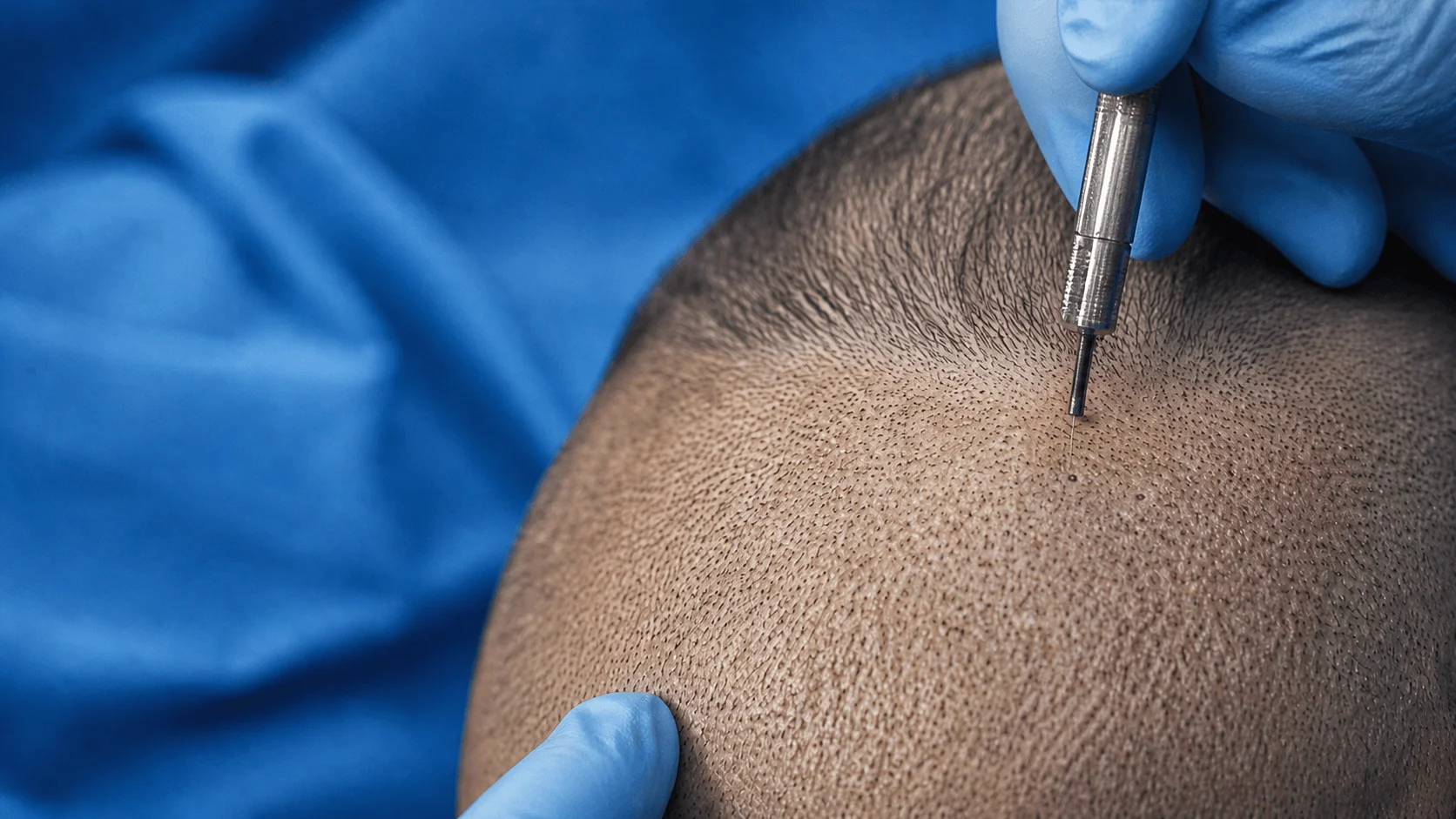
Standard FUE (Follicular Unit Extraction) is the workhorse hair transplant method of the last 15 years. The surgeon extracts each follicular unit individually from the donor area with a 0.7–1.0 mm stainless-steel circular punch. They then open recipient channels with a steel blade. A trained team places the grafts into those channels by hand. The result is a near-undetectable restoration with no linear scar, suits all Norwood stages from III to VI, and remains the most cost-effective FUE variant in 2026.statpearls
- From £1,250 (2026 prices) at JCI-accredited Liv Hospital Ulus, Istanbul; £8,000–£14,000 at UK private clinics for 2,000 grafts.
- Best for: value-conscious patients, large sessions (4,000+ grafts), donor areas with thicker skin.
- Recovery: 7–10 days back to office work; final density at month 12.
Table of contents
- What Standard FUE is
- How the procedure works, step by step
- Who is it for
- Standard FUE vs Sapphire FUE vs DHI
- Cost in 2026
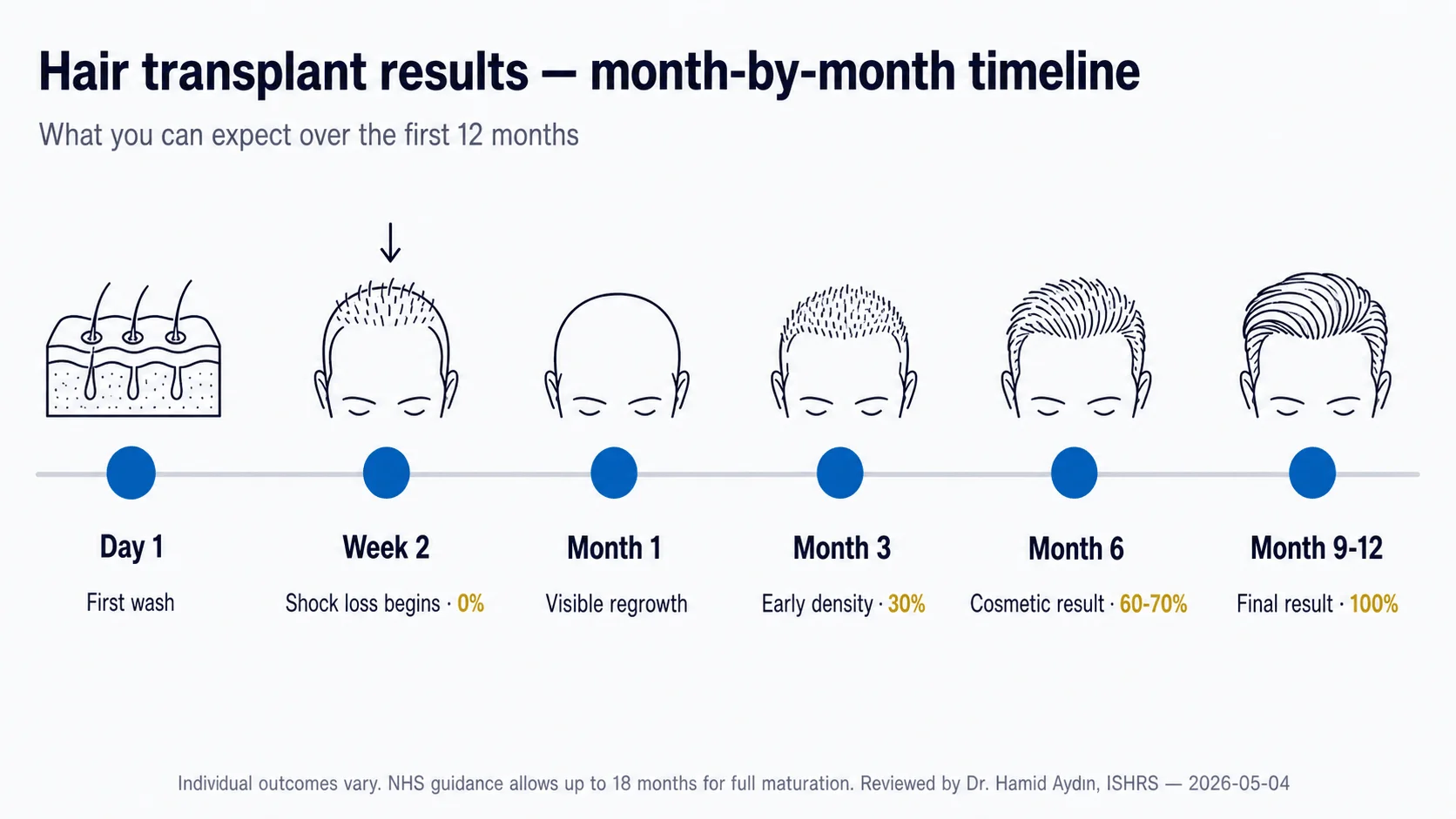
- Recovery and results timeline
- Risks and trade-offs
- How BergemHealth approaches this
- What to do next
- Frequently asked questions
What Standard FUE is
Definition — Standard FUE. Follicular Unit Extraction performed with stainless-steel micropunches (0.7–1.0 mm) for harvest and stainless-steel blades for channel-opening. Grafts are placed by hand by trained technicians under direct surgeon supervision. No strip is removed; no linear scar is left.
Standard FUE has been the dominant hair restoration technique since the late 2000s, when it overtook the older strip method (FUT). The clinical-outcome data set the benchmark every newer technique is measured against. Survival rates of 90–95% are reported in well-run clinics. Scarring is limited to barely-visible 0.8 mm dot patterns in the donor area.sharmaishrs
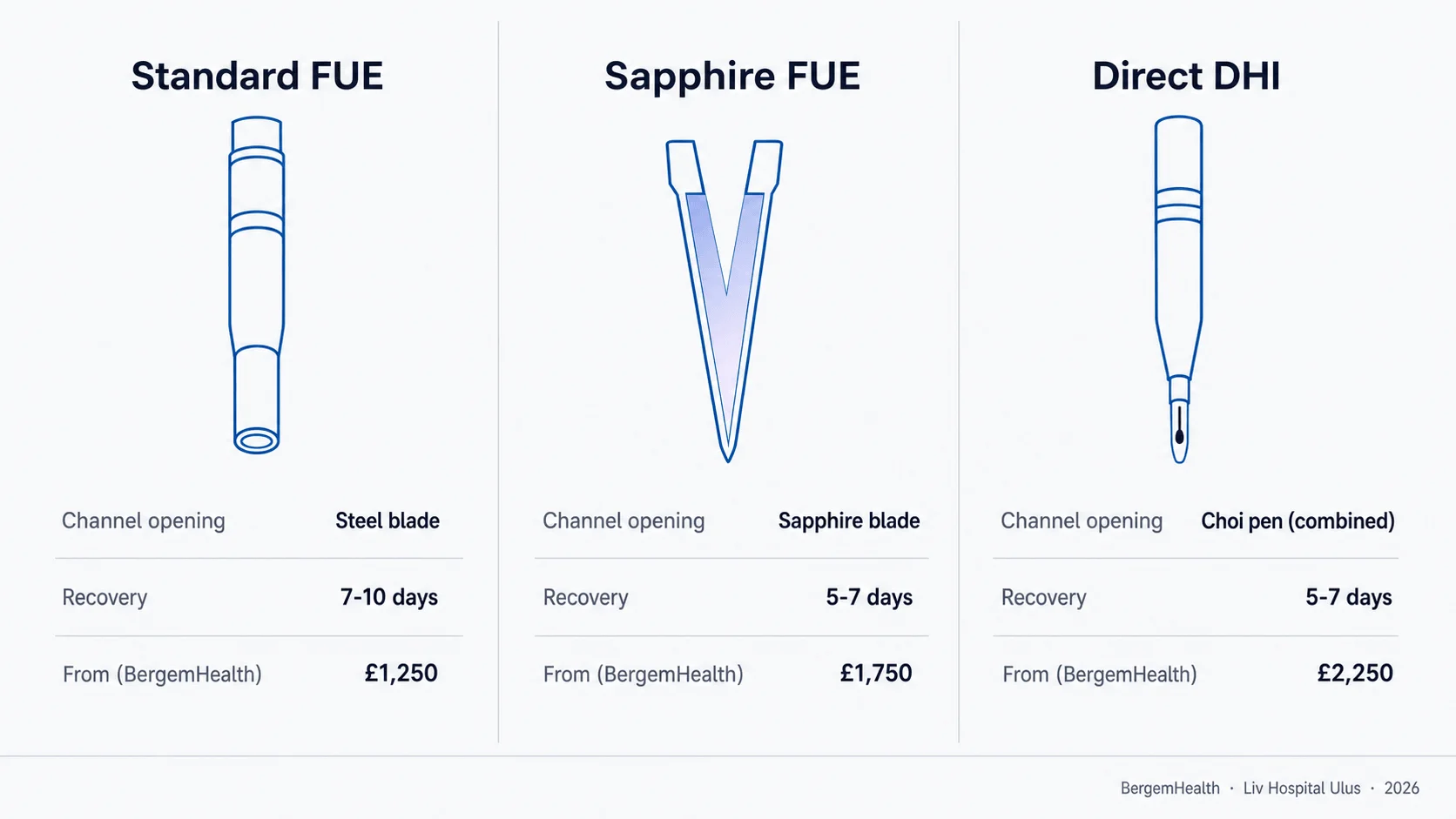
The “Standard” in the name distinguishes it from Sapphire FUE (which uses sapphire-crystal blades for channel-opening) and Direct DHI (which uses the Choi pen instead of opening channels separately). The harvest step — pulling individual follicular units out of the scalp one at a time — is the same in all three.
How the procedure works, step by step
In our practice at Liv Hospital Ulus, a 2,500-graft Standard FUE day runs about eight hours.
- Consultation and design (30 min). The surgeon reviews donor density on a trichoscope and draws the new hairline in front of a mirror with the patient awake. The donor zone is then shaved to 1 mm so individual follicular units are visible for extraction. NHS guidance describes FUE as shaving the back of the head, removing individual hairs one by one, and placing grafts into tiny cuts in the scalp.nhs
- Preparation (45 min). The recipient zone is shaved unless using a “long-hair FUE” protocol. Photographs are taken from five angles. Vitals and consent are confirmed.
- Local anaesthesia (20 min). Lidocaine with adrenaline is injected as a ring block around the donor zone. Tumescent fluid (saline + adrenaline) is then infiltrated to lift the skin away from underlying structures and reduce bleeding.
- Extraction (3–4 hours). The surgeon uses a powered or manual 0.8–0.9 mm punch to score around each follicular unit, then lifts each one out with fine forceps. Grafts are sorted into ones, twos, threes and fours under microscopes. They are stored in chilled HypoThermosol or saline.
- Lunch break (45 min). The patient eats; sorting continues.
- Channel-opening (1.5–2 hours). Recipient sites are made with stainless-steel blades, sized to match graft calibre. Angle, direction and density are controlled by the surgeon — this is the artistic step.
- Implantation (1.5–2 hours). Technicians place each graft into a pre-opened channel with curved jeweller’s forceps. Single-haired grafts go at the front; twos and threes go behind for density.
- Discharge (30 min). Aftercare instructions, photos, headband and saline spray are dispensed. The first-night sleeping protocol is explained.
A clinic that operates on 15–25 patients in parallel cannot give the surgeon time to do steps 1, 6 and supervise step 7 in person on every case. They split the surgeon’s name across cases and hand the tools to technicians. This is the operational difference between a clinic and a graft mill.
Who is it for
Standard FUE is the right method when:
- Total session size is large. For 3,500–5,000-graft sessions, the time saved on channel-opening (steel is faster than sapphire) is meaningful. The marginal density gain from sapphire is less critical at high counts.
- Donor skin is thicker. Mediterranean and South Asian skin types often fall here. Stainless-steel blades penetrate predictably.
- Budget is the constraint. Standard FUE is the most affordable of the three methods per graft.
- The hairline is not the focus. For example, crown-only filling, where artistic channel-opening matters less than total graft volume.
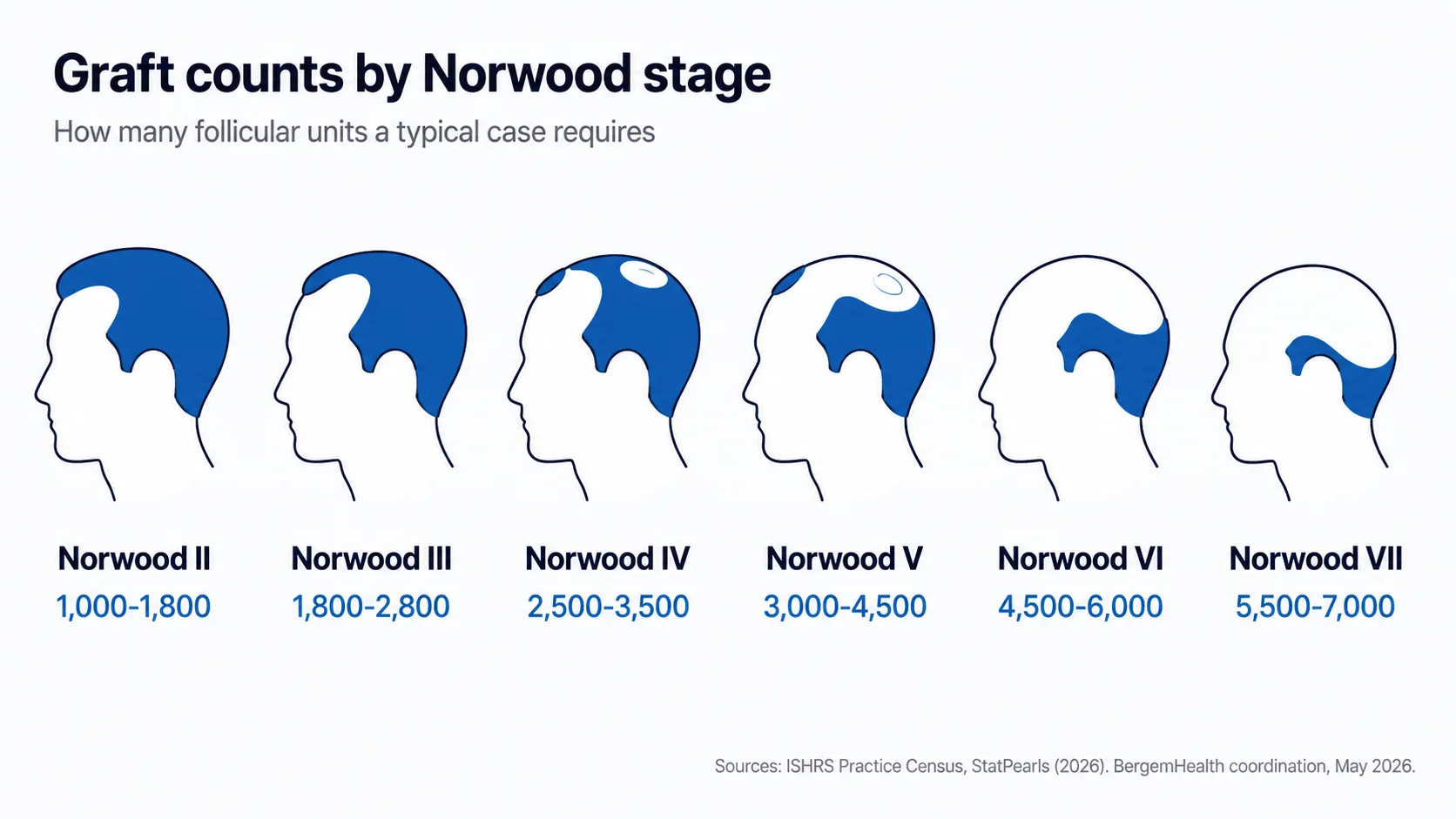
Norwood III–VI cases are typically suitable when donor density is strong enough on trichoscope assessment.statpearls
It is not the optimal choice for:
- A finely-detailed hairline-led restoration in a Norwood II–III patient — Sapphire FUE typically gives a better cosmetic result here. See the Sapphire FUE guide for a side-by-side.
- Female cases or beard/eyebrow restoration — Direct DHI handles unshaven recipient areas and angle-critical placements better.
Standard FUE vs Sapphire FUE vs DHI
| Feature | Standard FUE | Sapphire FUE | Direct DHI |
|---|---|---|---|
| Channel opening | Steel blade | Sapphire blade | Choi pen (combined) |
| Density (grafts/cm², 2026 norms) | 30–45 | 45–60 | 40–55 |
| Typical session | 4–8 hours | 4–8 hours | 6–10 hours |
| Recovery | 7–10 days | 5–7 days | 5–7 days |
| Recipient shaving required | Yes | Yes | Often no |
| Best for | Large sessions, Norwood IV+ | Hairlines, Norwood II–IV | Beard, eyebrow, women |
| From (BergemHealth, GBP, 2026) | £1,250 | £1,750 | £2,250 |
A full side-by-side comparison is in the FUE vs DHI vs Sapphire FUE article.
Cost in 2026
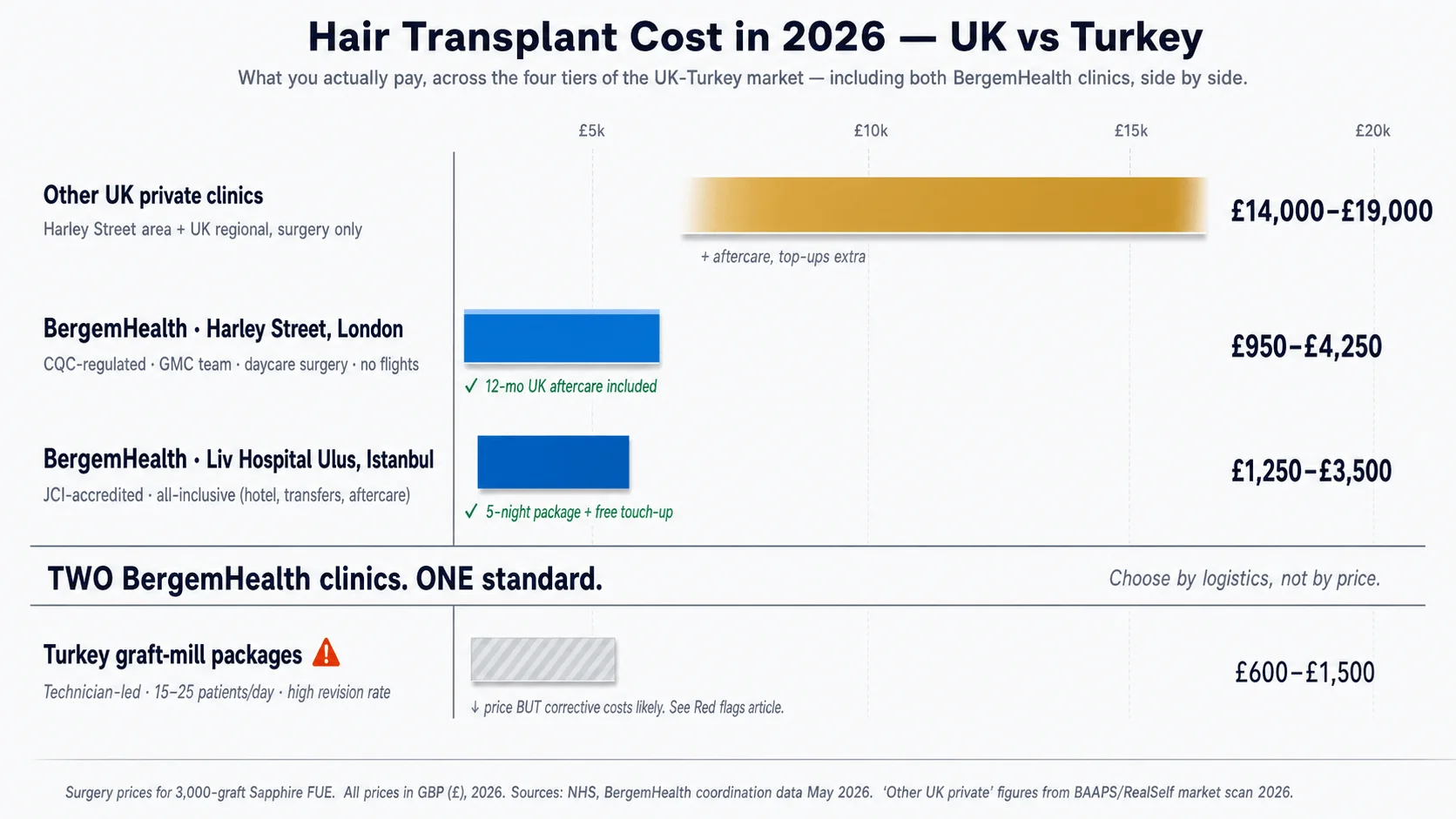
Standard FUE is priced per graft or per session. Per-graft pricing is more transparent for small-to-medium sessions; flat-rate session pricing dominates the Turkish market.
| Provider (2026 prices) | 2,000 grafts | 3,500 grafts |
|---|---|---|
| UK private clinic | £8,000–£14,000 | £12,000–£20,000 |
| Top-tier Istanbul (JCI, single-surgeon) — BergemHealth at Liv Hospital Ulus | £2,500 (from £1,250 base) all-inclusive | £4,375 (£1,250 + grafts) all-inclusive |
| Istanbul “package” graft mills | £1,200–£2,000 | £1,800–£2,800 |
Why is the JCI Istanbul price 50–80% lower than the UK in 2026? Lower facility and overhead costs, higher patient volume, and the absence of UK private-sector overheads such as Harley Street property rents. It is not because Turkish surgical training is inferior. Liv Hospital Ulus is JCI-accredited and currently re-accredited; Dr. Hamid Aydın is an ISHRS member with 25,000+ procedures.jciishrs
Why is BergemHealth’s Liv Hospital pricing higher than the lowest Istanbul prices? Because graft mills at the bottom of the market split a surgeon’s name across 20+ patients per day. The structural differences are detailed in the graft-mills red-flags article. For a fuller country-by-country breakdown, see the hair transplant cost guide for 2026: UK vs Turkey.
A note on long-hair FUE. The unshaven-recipient protocol takes 1–2 hours longer per session because each graft must be sized and angled around existing hair. In our practice at Liv Hospital Ulus, this adds roughly £400–£600 to the 2026 base price.
Recovery and results timeline
| Time after surgery | What happens | Action |
|---|---|---|
| Day 0 | Tiny scabs at every graft site, donor area pink | Sleep upright with neck pillow |
| Day 3 | First gentle wash, donor scabs softening | Use prescribed lotion + saline spray |
| Day 7 | Most scabs gone, donor stubble visible | Office work resumed |
| Week 2–4 | Transplanted hairs shed (shock loss) | Continue medical therapy |
| Month 3 | First fine new growth | Photo for surgeon review |
| Month 6 | About half of final density | Check-in with clinic |
| Month 9 | Hairline shape established | — |
| Month 12 | Final result; touch-up review | Final assessment |
Detailed protocols are in the first 7 days after FUE day-by-day guide and the 12-month timeline article.
Risks and trade-offs
Standard FUE is one of the safer cosmetic procedures, but it is still surgery. Predictable issues include:
- Folliculitis in 10–20% of patients in weeks 4–8. Antiseptic wash usually resolves it.garg
- Donor area numbness — temporary, resolves over 3–6 months.garg
- Visible donor depletion if a surgeon over-extracts. The safe lifetime budget for most donor areas is 6,000–8,000 grafts. Standard FUE in a single session of 4,500+ grafts approaches that limit, so plan future surgery accordingly.sharma
- Graft survival of 90–95% in well-run clinics in 2026. It drops if grafts are out of holding solution too long, or if implantation is rushed.sharma
- Bleeding, infection or allergic reaction to anaesthetic. Uncommon but real. Surgeon-led planning and proper aftercare reduce risk; they do not eliminate it.nhsgarg
Compared to Sapphire FUE, Standard FUE produces slightly less dense channel-packing and a slightly longer healing time (an extra 1–2 days for scab resolution). For most Norwood IV+ patients, this is a non-issue. For a Norwood II patient who wants a hairline-led, refined result, it is worth paying the extra £500 (2026 price) for sapphire.
How BergemHealth approaches this
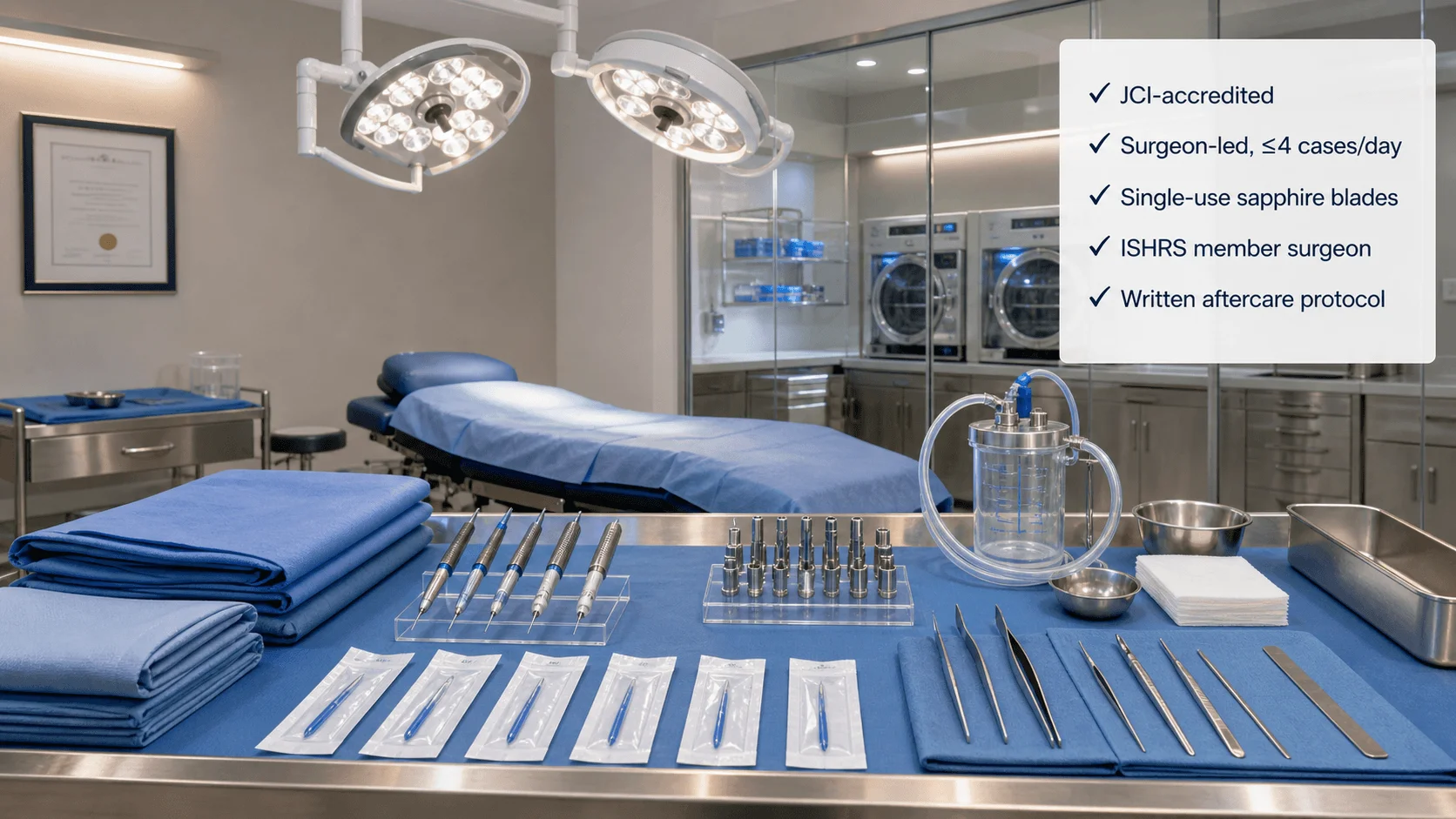
When BergemHealth recommends Standard FUE over Sapphire FUE, it is usually because the patient needs a high graft count (4,000+) or has thicker donor skin where steel performs predictably. The surgical team is the same: Dr. Hamid Aydın at Liv Hospital Ulus performs the channel-opening and supervises implantation directly. In our practice at Liv Hospital Ulus, the clinic operates on a one-to-four-patient-per-day cadence. That is the maximum that allows the surgeon to do the design, channel-opening and implantation supervision personally.
Pricing is transparent. The base session fee covers operating theatre, anaesthesia, surgeon time, technician team, holding solution, post-op pack, hotel for 4 nights, transfers and 12-month aftercare. Grafts beyond the included quota are charged per graft at a published 2026 rate, not as a “you’ll need more than we quoted” upsell on the day.
What BergemHealth will not do: book a patient under 25 with unstable hair loss, operate on someone with active scalp disease, or quote a graft count without seeing photos from five angles. If you do not qualify, we say so. The two-clinic model — Liv Hospital Ulus for surgery, Harley Street Hospital for UK consults — exists so UK patients have a face-to-face clinical relationship in London regardless of where the operation happens.
What to do next
If you are comparing methods, costs or countries, the safest next step is not to choose a package — it is to get a personal assessment of your donor area, hair-loss pattern, age, health history and goals.
- Free assessment. Send five photos of your scalp; we will return a graft estimate, method recommendation (Standard vs Sapphire vs DHI) and an itemised quote within two working days. Start with a free photo-based consultation.
- Compare methods. Sapphire FUE guide · Direct DHI guide · Method comparison
- Back to the pillar guide. Hair transplant: methods, results, cost
JCI-accredited Liv Hospital Ulus, CQC-regulated Harley Street Hospital, ISHRS member surgeon. Quote in writing, line by line.
Frequently asked questions
Does Standard FUE leave a scar?
There is no linear scar — that is the whole point of FUE. The donor area heals with thousands of tiny dot scars, each 0.7–1.0 mm wide. They become invisible to the naked eye once the surrounding hair grows in to about 3–5 mm length. A linear scar is the signature of the older strip method (FUT), which Standard FUE replaced.
How does Standard FUE differ from Sapphire FUE?
The harvest step (extracting grafts) is identical in both. A stainless-steel 0.7–1.0 mm punch removes each follicular unit. The difference is the channel-opening step. Standard FUE uses a stainless-steel blade. Sapphire FUE uses a V-shaped sapphire-crystal blade that produces a smoother incision, allowing 15–20% denser graft packing and 1–2 days faster healing. For Norwood II–IV hairline cases, Sapphire is usually preferred. For very large sessions (4,000+ grafts), Standard FUE is often more practical.
How long does a Standard FUE session take?
A 2,000-graft session runs 6–8 hours including breaks. A 3,500-graft session runs 8–10 hours. The full day, from arrival to discharge, is typically 9–11 hours.
Will I need a second Standard FUE session?
Norwood II–IV cases with stable hair loss usually achieve a complete result in a single session of 1,800–3,500 grafts. Norwood V–VII cases often need two sessions, 12 months apart, because a single donor harvest cannot supply enough grafts safely without thinning the donor visibly.sharma A small touch-up of 500–1,200 grafts at month 12 is sometimes elected to refine the hairline or boost density in a specific zone.
What is the success rate of Standard FUE?
In well-run clinics in 2026, graft survival is 90–95%, meaning 90–95% of transplanted follicles produce a permanent terminal hair. ISHRS practice census data and peer-reviewed studies converge on this range.sharmaishrs Survival drops if grafts spend too long out of holding solution (over 4–6 hours), if implantation is rushed, or if recipient sites are made too tightly together. Modern clinic protocols address all three.
Can Standard FUE be used for beard or eyebrow transplants?
Technically yes, but Direct DHI is usually preferred for beard and eyebrow work. The Choi pen gives finer control over the angle and depth of each implanted hair. That control matters more in facial hair (where individual hairs are visible at close distance) than on the scalp.
Do I need to shave my head for Standard FUE?
The donor area must be shaved to 1 mm so the surgeon can see follicular units clearly during extraction. The recipient area is usually shaved as well unless a “long-hair FUE” protocol is used. Long-hair FUE is technically more demanding and takes 1–2 hours longer. In our practice at Liv Hospital Ulus, long-hair FUE adds roughly £400–£600 (2026 price) to the base session fee, and is offered for patients who cannot have visible shaving for social or professional reasons. Direct DHI offers an unshaven-recipient option more naturally.
How much does Standard FUE cost in the UK vs Turkey?
In 2026, a 2,000-graft Standard FUE in a UK private clinic costs £8,000–£14,000. The same procedure at JCI-accredited Liv Hospital Ulus through BergemHealth costs about £2,500 all-inclusive (hotel, transfers, aftercare, free touch-up). Cheaper Istanbul package clinics quote £1,200–£2,000 but operate at 15–25 patients per surgeon per day with technicians performing most of the work — that price reflects volume, not value. Full breakdown in the 2026 cost guide.
Is Standard FUE permanent?
The transplanted follicles come from the DHT-resistant donor area and retain that resistance for life, so they continue to grow indefinitely. Native hair around the transplanted zone can still recede over time. That is why long-term hair-loss management usually combines transplant with maintenance medication such as finasteride. Read the finasteride article for details.
What is the recovery like in the first week?
Day 0–3: tiny scabs at every graft site, mild forehead swelling, sleep semi-upright. Day 3: first gentle wash with prescribed lotion and saline. Day 4–7: scabs soften and start to fall away; donor area pinkness fades. Most office workers return on day 7–10. Detailed daily protocol in the first 7 days guide.
How many grafts do I need?
The number depends on Norwood stage, donor density, hair calibre, hairline design and whether the crown is treated. Norwood III–VI cases typically fall between 2,000 and 4,500 grafts in a single session, with Norwood VI and VII often staged across two sessions.statpearls A photo assessment can estimate this, but final planning needs clinical review.
Sources
Reviewed by BergemHealth member, lead surgeon for hair restoration at Liv Hospital Ulus, Istanbul. 25,000+ procedures since 2000. Last updated 4 May 2026.
How BergemHealth approaches this
Procedures are performed at JCI-accredited Liv Hospital Ulus, Istanbul, by Dr. Hamid Aydın and the resident surgical team. UK consultation and 12-month aftercare at our CQC-regulated Harley Street office. Transparent pricing and a free touch-up if indicated.
Free consultation →