Direct DHI Hair Transplant: Choi Implanter Pen, Full Guide & Cost (2026)
Direct DHI hair transplant explained: how the Choi implanter pen works, when to choose DHI over FUE or Sapphire FUE, cost UK vs Turkey in 2026, and the 12-month recovery timeline.
Medical disclaimer. This article is educational and not medical advice. Hair restoration outcomes are individual; only a qualified surgeon can assess your case in a personal consultation.
Quick answer
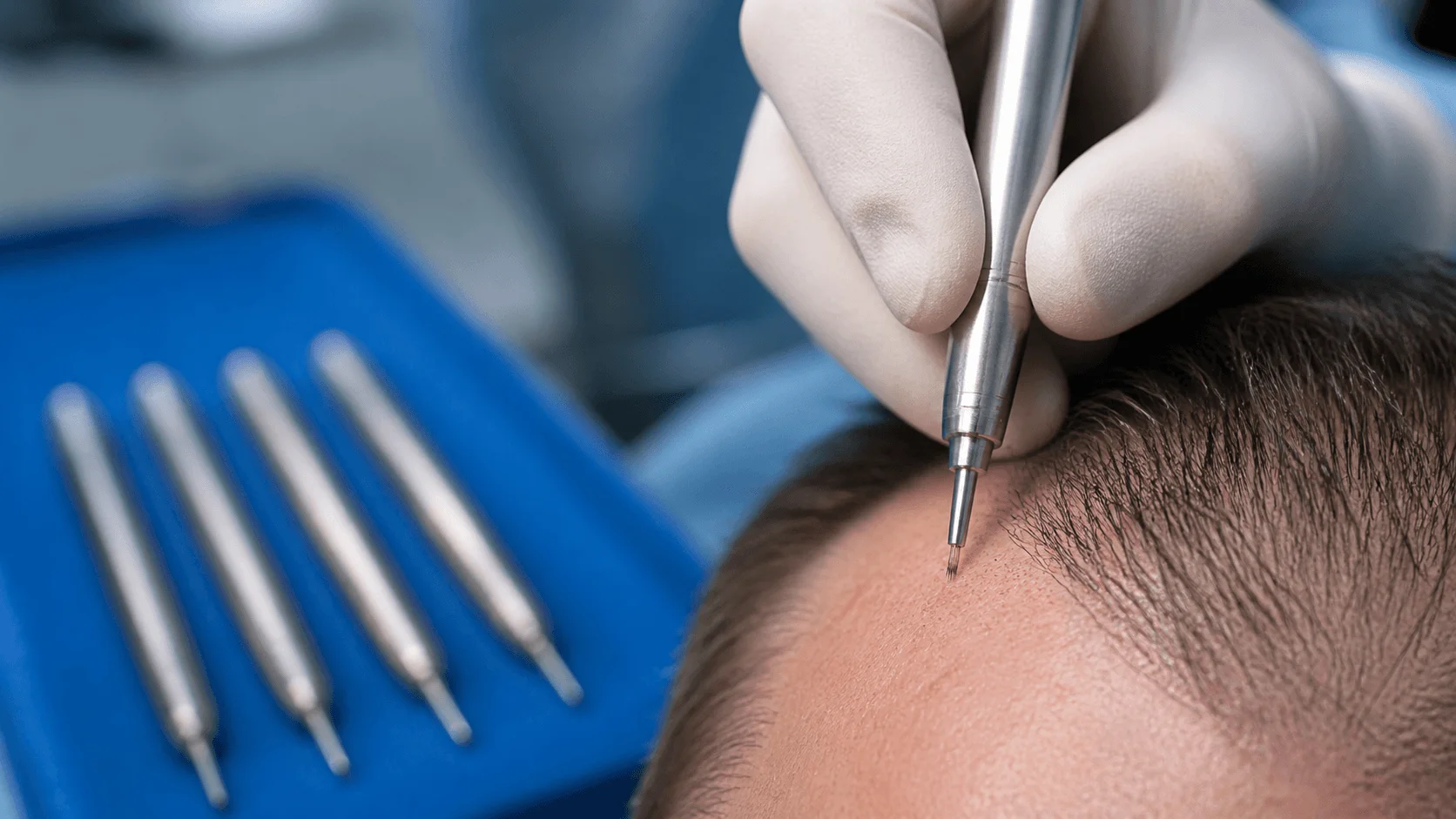
Direct DHI (Direct Hair Implantation) is a hair transplant method that uses the Choi implanter pen — a hollow needle device — to place each follicular unit directly into the scalp at a chosen angle and depth, in a single step. It does not use pre-opened channels. Compared with Standard FUE and Sapphire FUE, DHI offers tighter angle control on each graft, particularly for hairline detail, beard transplants, eyebrow restoration, and women’s diffuse cases where shaving the recipient area is undesirable.
- From £2,250 (2026) at JCI-accredited Liv Hospital Ulus, Istanbul; £12,000–£20,000 (2026) at UK private clinics for 2,000 grafts.
- Best for: beard, eyebrow, female pattern thinning, refined hairline angle, unshaven-recipient cases.
- Recovery: 5–7 days back to office work; final density visible at month 12.
Table of contents
- What Direct DHI actually is
- How the Choi pen works
- Hairline angle and native direction
- How the procedure works, step by step
- Who is it for
- DHI vs Standard FUE vs Sapphire FUE
- Cost in 2026
- Recovery and 12-month timeline
- Risks and trade-offs
- How BergemHealth approaches this
- What to do next
- Frequently asked questions
What Direct DHI actually is
Definition — Direct DHI. A hair transplant method in which each follicular unit is loaded into a Choi implanter pen — a hollow stainless-steel or sapphire-tipped needle — and pressed directly into the recipient site. Channel-opening and implantation happen as a single combined step, eliminating the separate channel-opening phase used in FUE.
DHI was developed in South Korea in the early 1990s and standardised by the Choi family of implanter pens originating from Kyungpook National University; the Choi pen has been in clinical use since 1992.1 It is now one of three mainstream implantation approaches recognised internationally, alongside steel-blade and sapphire-blade FUE workflows.2
The harvest step is identical to FUE — individual follicular units are removed from the donor area with a 0.7–1.0 mm circular punch.3 The difference is what happens next. In FUE, recipient channels are opened first (with steel or sapphire blades) and grafts are placed by hand into those pre-opened channels. In DHI, the graft is loaded into the Choi pen at the moment of placement, and the pen does both jobs at once: it cuts the channel and deposits the follicle in one motion, at a controlled angle and depth. Use of single-step implanter devices has grown across the field in recent ISHRS practice census data.2
How the Choi pen works
A Choi implanter pen is a hollow needle, typically 0.6–1.0 mm in diameter, mounted in a finger-trigger handle.1 The technician loads a follicular unit into the back of the needle so that it sits inside the lumen with the bulb (the growing root) flush at the tip. The surgeon (or trained DHI technician) then presses the tip into the scalp at the chosen angle, presses the trigger, and the follicle is pushed into the dermis as the needle withdraws.
The Choi pen can reduce the separation between channel creation and graft placement; this can help with angle control but also makes the procedure slower and more operator-dependent than steel-blade FUE.
The advantages of this combined step:
- Angle control to a fine tolerance. The pen tip is angled before insertion; once inserted, the graft is delivered along that angle. This matters most where every hair is visible — the leading hairline edge, the eyebrow, the beard.
- The graft is out of holding solution for a shorter time. A graft loaded into the Choi pen is implanted within seconds. In FUE, grafts wait in chilled holding solution while channels are opened, then are picked up with forceps. The total out-of-body time is broadly comparable in well-run clinics, but in our clinical experience the Choi-pen workflow shortens the handling step.2
- Recipient shaving is often unnecessary. Because no separate channel-opening phase is required, the pen can be inserted between existing hairs without needing to shave them. In our practice this is the main reason we default to DHI for female diffuse thinning.
The disadvantages:
- Slower per graft. A trained team typically places 600–1,000 grafts per hour with DHI versus 1,200–1,800 per hour with FUE. In our practice at Liv Hospital Ulus, a 2,500-graft DHI day runs 9–10 hours; the same FUE day runs 7–8.
- More technician training required. Loading and operating the Choi pen well takes 18–24 months of supervised practice. In a clinic where only the surgeon can do it well, throughput is low.
- Higher consumable cost. Choi pen tips are single-use per case; a 2,500-graft session uses 6–10 pens.
Hairline angle and native direction
The hairline is not a straight line. It curves, has irregular soft edges, and the hairs that emerge from it follow a native angle that is rarely a uniform 30–40°. Most patients have at least one cowlick where the angle reverses; many have a frontal whorl or crown swirl that propagates micro-direction changes into the temporal points; and the leading hairline edge typically exits the scalp at a flatter angle (10–25°) than the hair sitting one centimetre behind it. The Choi pen gives the surgeon physical access to the angle decision at the moment the graft enters the scalp, rather than committing to a channel angle minutes earlier and then trying to match it during placement. In our practice this is where DHI earns its premium — particularly in patients with cowlicks, whorls or asymmetric hairlines where every graft has to follow native angle.2
How the procedure works, step by step
In our practice at Liv Hospital Ulus, a 2,500-graft Direct DHI day runs nine to eleven hours.
- Consultation and design (30 min). Hairline drawn in front of mirror with patient awake. For women, the recipient area is examined under magnification with existing hair in place.
- Donor preparation and anaesthesia (45 min). Donor area shaved to 1 mm. Recipient area is not shaved in most cases. Local anaesthesia is administered in line with standard hair-restoration protocols.4
- Extraction (3–4 hours). Standard 0.7–0.9 mm micropunch — same as FUE. Grafts sorted under microscopes and held in chilled storage solution.
- Lunch break (45 min).
- Loading and implantation (4–5 hours). Each graft is loaded into a Choi pen (typically 4–6 pens cycled by the technicians). The surgeon places the first 200–400 grafts of the hairline personally; trained DHI technicians handle the bulk under direct supervision, with the surgeon directing angle and density throughout.
- Discharge briefing. Wash schedule, swelling expectations, week-1 review and aftercare contact.
The DHI implantation phase is structurally different from FUE. Where FUE has a “channel-opening” step the surgeon does largely alone (1.5–2 hours of intense, artistic work), DHI integrates that work into the implantation phase. The surgeon’s hands-on role in DHI is concentrated on the first 1.5 cm of the hairline and on supervision throughout, rather than on a discrete blade phase.

Who is it for
Direct DHI is the right method when:
- Beard or eyebrow transplant. Angle control on every implanted hair is critical at this distance — DHI is the standard of care for facial hair restoration.
- Female pattern hair loss (Ludwig I–III). Recipient area can usually be left unshaven; the pen places grafts between existing hairs. In our practice, DHI is our default for female diffuse cases.
- Refined hairline angle in male cases. Particularly when the patient has an unusual hair-growth direction (cowlicks, crown swirl, frontal whorl) where every graft has to follow native angle.
- Patients who cannot have visible shaving for social or professional reasons (and prefer to avoid the cost premium of long-hair FUE).
Direct DHI is not the optimal choice for:
- Very large male sessions of 4,000+ grafts. Throughput is too slow and the unit cost too high; Sapphire FUE is structurally better suited.
- Patients prioritising lowest cost — DHI is the most expensive of the three methods.
- Crown-only restorations where pure volume matters more than angle precision.
- Patients with marginal donor density, where the priority is maximising graft survival rather than refining placement angle.4
- Norwood VI–VII cases requiring repeated sessions, where total yield is donor-limited.
DHI vs Standard FUE vs Sapphire FUE
| Feature | Standard FUE | Sapphire FUE | Direct DHI |
|---|---|---|---|
| Channel + implant | Two steps | Two steps | One step (Choi pen) |
| Density (grafts/cm², 2026) | 30–45 | 45–60 | 40–55 |
| Typical session | 4–8 h | 4–8 h | 6–10 h |
| Recipient shaving | Yes | Yes | Often no |
| Best for | Large sessions, Norwood IV+ | Hairlines, Norwood II–IV | Beard, eyebrow, women, refined angle |
| Throughput (grafts/hr) | 1,200–1,800 | 1,200–1,500 | 600–1,000 |
| From (BergemHealth, GBP, 2026) | £1,250 | £1,750 | £2,250 |
Note: Sapphire FUE typically achieves the highest per-session density of the three methods because the narrow sapphire blade allows tighter channel spacing. DHI prioritises angle precision and unshaven access, not raw per-cm² density.
Full side-by-side: FUE vs DHI vs Sapphire FUE.
Cost in 2026
DHI is the most expensive of the three modern methods, primarily because of slower throughput (more surgeon and technician hours per graft) and higher consumable cost.
| Provider (2026) | 2,000 grafts | 3,500 grafts |
|---|---|---|
| UK private clinic | £12,000–£20,000 | £18,000–£28,000 |
| BergemHealth at JCI-accredited Liv Hospital Ulus | from £2,250 (~£3,500 all-inclusive) | ~£5,500 all-inclusive |
| Istanbul “package” graft mills | £1,800–£3,000 | £2,500–£4,500 |
A note on graft-mill DHI pricing: the cheapest end of the Istanbul market sometimes quotes “DHI” prices that are not much higher than FUE. This usually reflects either (a) the use of a Choi pen for only the first 100–200 grafts of the hairline while the rest is placed by FUE, or (b) heavy reliance on technicians without surgeon supervision. Both produce results that are not what a properly conducted DHI procedure delivers. Read the graft-mill red flags article for what to ask before booking.
The full UK vs Turkey breakdown is in the hair transplant cost in 2026 article.
Recovery and 12-month timeline
| Time after surgery | DHI-specific notes |
|---|---|
| Day 0 | Tiny scabs at recipient sites; donor pinkness. Recipient area often not shaved, so existing hair partly conceals scabs |
| Day 3 | First gentle wash; scabs softening |
| Day 5–6 | Most scabs gone (broadly similar to Sapphire FUE) |
| Day 7 | Office return |
| Week 2–6 | Shock loss — transplanted hairs shed; native shock loss can also occur (typically resolves by month 6)4 |
| Month 3 | First fine new growth |
| Month 6 | About 50% of final density |
| Month 9 | Hairline angle and direction visible |
| Month 12 (2026) | Final result; touch-up review |
The recovery profile is broadly the same as Sapphire FUE — the difference is mostly in social visibility during week 1 (DHI patients with unshaven recipient areas can return to work earlier with less obvious evidence of surgery). Read the 12-month timeline.
Risks and trade-offs
The DHI risk profile is the same overall as FUE — DHI is the same harvest, different placement. The Choi pen does not introduce new categories of risk; it shifts where the operator-skill bottleneck lives.
- Folliculitis in 10–20% of patients, typically weeks 4–8 post-op; usually self-limiting and managed with antibacterial wash.5
- Temporary numbness in donor or recipient — resolves over 3–6 months.
- Shock loss of native hair — particularly relevant in DHI female cases where surrounding native hair is dense. Almost always grows back by month 6.4
- Graft survival 90–95% (2026) in well-run clinics.3 In our experience, DHI outcomes are more sensitive to operator skill than steel-blade FUE because each graft is handled inside the Choi pen.
- Slower throughput, longer day — relevant for patient comfort, not safety.
- Donor-density and facility limits. Safe extraction is bounded by safe-zone density (typically 65–85 FU/cm² occipital); infection risk depends on facility standards and aftercare.46
The DHI-specific trade-off is cost (£500–£1,000 more than Sapphire FUE per session in 2026) and session limits (practical ceiling around 3,500 grafts in a single day). For the cases DHI is optimal for — beard, eyebrow, female, refined hairline — the cost is justified. For a 4,500-graft Norwood V case, FUE almost always makes more sense.
How BergemHealth approaches this
DHI is the BergemHealth default for:
- All beard and eyebrow restorations.
- All female pattern hair loss cases (Ludwig I–III).
- Male hairline cases in patients with unusual growth direction or who cannot have visible shaving.
Surgical leadership. All cases are led by Dr. Hamid Aydın (ISHRS member, former SAÇDER president, 25,000+ procedures since 2000). Dr. Aydın personally draws the hairline in front of a mirror with the patient awake, and personally places the first 200–400 grafts at the leading edge of the hairline before handing the remaining placements to the technician team under his direct supervision.
Technician team. Our DHI technicians have an average tenure of eight years on the same team, with a structured training pipeline that takes a new technician 18–24 months from observation to independent Choi-pen placement under supervision. Continuity matters more in DHI than in FUE because the loading and trigger-pressure technique is what determines graft survival inside the pen; we do not rotate freelance technicians in and out.
Caseload limit. A maximum of two DHI patients per day per surgical team. The DHI throughput limit makes parallel cases impractical for serious work, and we will not compromise on supervision time per patient. Many graft-mill clinics in Istanbul run 4–8 patients per surgeon per day; we do not.
Sterility and consumables. Single-use Choi pen tips. No reuse, no sharpening between cases. JCI-accredited Liv Hospital Ulus operating environment for the procedure itself.
UK aftercare pathway. For UK patients, post-op review at week 1 (in Istanbul or remotely), and in-person follow-ups at month 6 and month 12 at Harley Street Hospital in London with Dr. Sumeyye Yuksel (GMC-registered, CQC-regulated facility). Touch-up assessment at month 12 is included; a touch-up procedure, if clinically indicated, is performed at no additional surgical fee.
What to do next
If you are comparing methods, costs or countries, the safest next step is not to choose a package — it is a personal assessment of your donor area, hair-loss pattern, age, health history and goals.
- Free assessment. Send five photos; we will return a graft estimate, method recommendation (Standard FUE / Sapphire FUE / DHI) and an itemised quote within two working days. → Book a free consultation
- Compare: Standard FUE · Sapphire FUE · Method comparison
- Pillar: Hair transplant: methods, results, cost
JCI-accredited Liv Hospital Ulus, CQC-regulated Harley Street Hospital, ISHRS member surgeon. Quote in writing, line by line.
Frequently asked questions
What is the difference between FUE and DHI?
The harvest step is identical: a 0.7–1.0 mm circular punch removes each follicular unit from the donor area. The difference is how grafts are placed into the recipient area. FUE uses two steps — channels are opened first with a blade (steel or sapphire), then grafts are placed into the pre-opened channels by hand. DHI uses one step — each graft is loaded into a Choi implanter pen and pressed directly into the scalp, which cuts the channel and deposits the follicle in one motion. Angle control on each individual graft is tighter with DHI; per-session density tends to be higher with Sapphire FUE.
Is DHI better than FUE?
Neither is universally better. DHI is better for beard, eyebrow, female cases, and refined hairline angle where unshaven access matters. FUE — and especially Sapphire FUE — is better for large male sessions, value-sensitive cases, and Norwood V+ restorations where total volume and per-session density matter more than angle precision on each graft. The right method is the one that suits your case, not the most expensive one.
Do I have to shave my head for DHI?
The donor area must be shaved to 1 mm for the harvest. The recipient area often does not need shaving — this is one of DHI’s main advantages, particularly for women and for male patients who want to return to social life quickly. Whether your specific case can be done unshaven depends on the density of your existing hair in the recipient zone, which the surgeon assesses at consultation.
How much does DHI cost in 2026?
UK private clinics charge £12,000–£20,000 for a 2,000-graft DHI in 2026. JCI-accredited Liv Hospital Ulus through BergemHealth charges from £2,250 base, approximately £3,500 all-inclusive (hotel, transfers, 12-month aftercare, free touch-up if clinically indicated). Istanbul prices below £1,800 should prompt questions about whether the procedure is genuinely DHI, what the surgeon’s role is, and how many patients are operated on per day.
Is DHI more painful than FUE?
No — both are equally painless during surgery, because the entire scalp is under local anaesthesia. DHI patients sometimes report slightly more post-op tenderness in the recipient area for the first 24–48 hours, but the donor area discomfort (which is most patients’ main complaint) is comparable between the two methods.
How many grafts can DHI handle in one session?
The practical ceiling is around 3,500 grafts per day, with 2,000–3,000 the typical range. Beyond 3,500, the implantation step (slower than FUE because each graft is loaded into a pen) extends the day past comfortable limits. For 4,500+ graft sessions, FUE is structurally more practical.
Can DHI be combined with FUE?
Yes, and some clinics do this routinely. A common combined approach is DHI for the first 800–1,500 grafts of the hairline (where angle control is most critical) and FUE or Sapphire FUE for the remainder. This is a legitimate clinical choice, not a cost-cutting workaround — provided the surgeon explicitly explains the plan in writing. If a clinic quotes “DHI” but actually does a hybrid without disclosing it, that is a red flag.
Is DHI permanent?
The transplanted follicles come from the DHT-resistant donor area and retain that resistance for life, so they continue to grow indefinitely. Native hair around the transplanted zone can still recede over time, which is why long-term hair-loss management usually combines transplant with maintenance medication such as finasteride. Read the finasteride article.
Can DHI be used for women?
Yes — DHI is widely used for female pattern hair loss (Ludwig I–III) precisely because the recipient area can usually be left unshaven. The Choi pen places grafts between existing hairs without disturbing them. Female cases are typically smaller (1,500–2,500 grafts) and well within DHI’s session limits. In our practice, DHI is our default for female diffuse thinning.
What is the success rate of DHI?
In well-run clinics in 2026, graft survival is 90–95% — comparable to FUE. The Choi pen does not improve survival rate (which is mostly determined by harvest quality and time-out-of-body), but it does improve placement precision and angle control. Survival drops sharply if pens are operated by undertrained technicians or if pens are reused between patients (which they should never be).
Sources
Additional reading:
- ISHRS. Membership and Fellow Designation Criteria.
- Joint Commission International. About JCI Accreditation.
- NHS. “Hair loss.”
Reviewed by BergemHealth member and former SAÇDER (Turkish Society of Hair Restoration Surgeons) president, lead surgeon for hair restoration at Liv Hospital Ulus, Istanbul. 25,000+ procedures since 2000. Last updated 4 May 2026.
How BergemHealth approaches this
Procedures are performed at JCI-accredited Liv Hospital Ulus, Istanbul, by Dr. Hamid Aydın and the resident surgical team. UK consultation and 12-month aftercare at our CQC-regulated Harley Street office. Transparent pricing and a free touch-up if indicated.
Free consultation →