JCI vs CQC vs GMC: Hair Transplant Accreditation Explained (2026)
JCI accredits hospitals. CQC registers UK clinics. GMC licenses UK doctors. They are not interchangeable — here's what each does and doesn't cover.
Medical disclaimer. This article is educational and not medical advice. Hair restoration outcomes are individual; only a qualified surgeon can assess your case in a personal consultation.
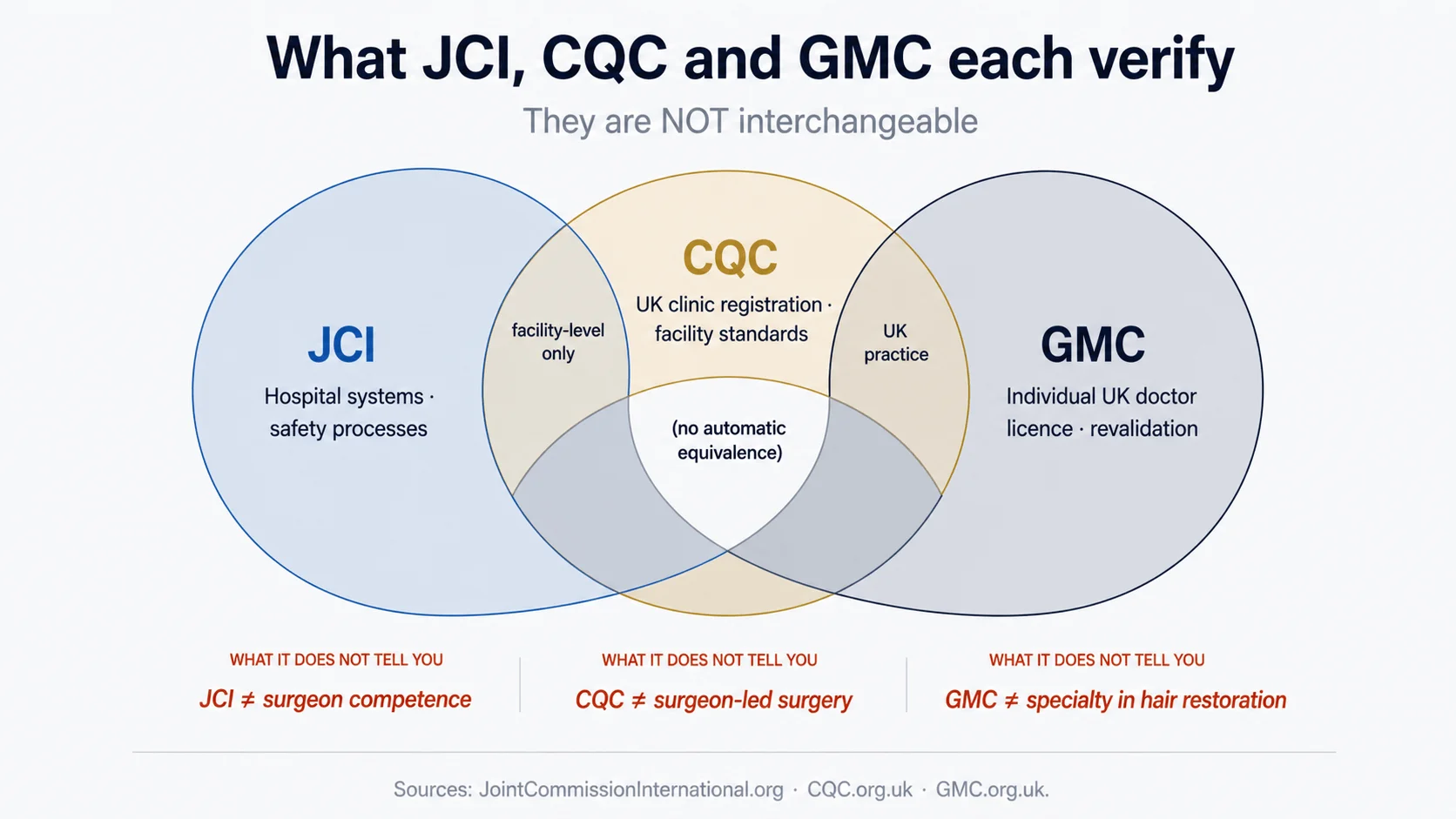
Quick answer
JCI, CQC and GMC are three different regulatory bodies that accredit three different things, and patients routinely confuse them. JCI (Joint Commission International) accredits hospitals against international quality-system standards. CQC (Care Quality Commission) registers UK clinics and care providers for minimum-standard compliance. GMC (General Medical Council) licenses individual UK doctors to practise medicine. A clinic can be impressive on one of these and silent on another. This article explains what each badge actually covers, what it does not, and which combination is meaningful for choosing a hair transplant clinic.
Table of contents
- The three bodies, in one sentence each
- JCI: what hospital accreditation actually means
- CQC: what UK clinic registration actually means
- GMC: what UK doctor registration actually means
- The gaps these badges leave
- What a defensible accreditation stack looks like
- How BergemHealth approaches this
- Frequently asked questions
The three bodies, in one sentence each
| Body | What it accredits | Frequency | Public lookup |
|---|---|---|---|
| JCI (Joint Commission International) | The hospital as a system | Re-inspected every 3 years | Online directory of accredited organisationsjci |
| CQC (Care Quality Commission) | UK-based clinics and care providers | Inspections at varying intervals (typically 1–4 years) | CQC provider registercqc |
| GMC (General Medical Council) | Individual UK doctors’ right to practise | Annual revalidation | GMC online registergmc |
Each operates at a different level (institution vs facility vs individual), in different jurisdictions (international vs UK vs UK), against different criteria. None of them is a substitute for the other two. A defensible hair-transplant clinic clears the relevant one for its country and gives you ways to verify the others by extension (e.g., named ISHRS-member surgeon at a JCI-accredited hospital; named GMC-registered doctor at a CQC-registered clinic).
JCI: what hospital accreditation actually means
Definition. JCI (Joint Commission International) is the global division of the United States Joint Commission, the body that accredits most US hospitals. JCI accredits hospitals outside the US against the same Joint Commission International Standards — a 1,000+ page set of measurable criteria covering patient safety, infection control, medication management, anaesthesia, surgical safety, emergency response, and continuous-improvement processes.
What JCI accreditation tells you:
- Patient identification protocols (two-identifier verification before any procedure)
- Surgical safety checklists are in use (a WHO-style time-out before incision)
- Infection-control programmes are documented, monitored, and audited
- Medication management has documented dispensing and reconciliation processes
- Emergency response capability exists for the procedures the hospital performs
- A continuous-improvement infrastructure (incident reporting, root-cause analysis, mortality reviews)
The accreditation is awarded after a multi-day on-site survey and is renewed every three yearsjci. Several Istanbul hospitals carry continuous JCI accreditation, including Liv Hospital Ulus (since 2013)liv-jci.
JCI is hospital-system accreditation. It says the building is run to international standards. It says nothing direct about whether the specific surgeon you’re booking has the experience or volume to do your specific operation well. ISHRS membership at the surgeon level fills this gapishrs.
CQC: what UK clinic registration actually means
Definition. The Care Quality Commission is the independent regulator of health and adult social care services in England. Hair transplant clinics that perform surgical procedures must register with CQC under the Health and Social Care Act 2008. (Wales, Scotland and Northern Ireland have parallel regulators: HIW, HIS, RQIA.) CQC inspects against five Key Lines of Enquiry — Safe, Effective, Caring, Responsive, Well-Led — and publishes inspection reports publiclycqc.
What CQC registration tells you:
- The clinic has registered with CQC as a regulated activity provider
- It meets the Fundamental Standards (cleanliness, dignity, person-centred care, safeguarding, complaints handling)
- It is subject to routine and reactive inspection
- Inspection reports are publicly searchable at cqc.org.uk
CQC registration is a floor, not a ceiling. A CQC-registered clinic has demonstrated minimum compliance; it has not necessarily demonstrated surgical excellence. The CQC report itself is worth reading — look for the rating (“Outstanding”, “Good”, “Requires improvement”, “Inadequate”) and the date of the most recent inspection.
The other gap to be aware of: CQC does not register individual doctors. A CQC-registered clinic can employ a doctor whose surgical skill the CQC has not assessed, because that’s not what CQC does. Individual doctor competency is the GMC’s remit.
GMC: what UK doctor registration actually means
Definition. The General Medical Council maintains the UK Medical Register — the public list of every doctor licensed to practise medicine in the UK. GMC registration is required for anyone using the title “doctor” in a clinical context within the UK; without it, practising medicine is a criminal offence under the Medical Act 1983. The register lists each doctor’s primary medical qualification, registration status, specialty (where applicable), and any restrictions or conditionsgmc.
What GMC registration tells you:
- The named individual is legally entitled to practise medicine in the UK
- Their primary medical qualification has been verified
- They have completed (or are in) the revalidation process — a 5-year cycle of appraisals demonstrating continuing competence
- Any restrictions, undertakings, or conditions are publicly visible on the register
- Specialty registration (where the doctor has completed UK specialty training) is publicly listed
A GMC-registered doctor at a non-CQC-registered location is operating in a regulatory grey area. A non-GMC-registered “doctor” in the UK is operating illegally — it’s a criminal offence, not a regulatory irregularity. Always verify GMC status directly at gmc-uk.org.
The gaps these badges leave
Even a clinic that holds JCI (hospital), CQC (UK clinic), and employs GMC-registered doctors leaves three knowable gaps. These are the variables you have to verify separately, and each maps onto something the regulator simply doesn’t inspect.
Gap 1: Surgeon-specific competence in hair restoration. None of the three bodies certifies hair-restoration sub-specialty. JCI inspects the hospital, CQC inspects the clinic, GMC verifies the qualification — none assesses whether this doctor is good at this operation. The closest international benchmark is ISHRS membership, which requires verified medical qualification, a minimum number of hair-restoration cases, annual continuing education, and code-of-ethics adherenceishrs.
Gap 2: Operating-model transparency (surgeon-led vs technician-led). A JCI-accredited hospital can host a high-volume technician-led model and remain accredited because that’s not what JCI inspects. CQC inspection of UK cosmetic clinics rarely covers technician-vs-surgeon division of labour. GMC’s remit ends at the individual doctor. Whether the named surgeon performs the surgery personally is a question the patient has to ask directly, in writing. (Detailed in the main pillar and red-flags article.)
Gap 3: Pricing transparency and outcome accountability. None of the three bodies certifies pricing models. The defensible-quote line items (graft count, technique, surgeon, anaesthesia, aftercare duration, touch-up threshold in writing) are entirely outside their scope.
These gaps are why “the clinic is JCI-accredited” or “the clinic is CQC-registered” cannot, by itself, be the basis of your decision. They’re necessary signals; they aren’t sufficient ones.
What a defensible accreditation stack looks like
For a UK patient researching a hair transplant clinic in 2026, the meaningful accreditation stack looks like this:
| Layer | Question | Where to verify |
|---|---|---|
| Facility | Is the hospital JCI-accredited (Turkey) or the clinic CQC-registered (UK)? | jointcommissioninternational.org or cqc.org.uk |
| Doctor | Is the named surgeon GMC-registered (UK) or ISHRS-member (international)? | gmc-uk.org or ishrs.org |
| Operating model | Does the named surgeon perform extraction or channel-opening personally on every case? | Direct question to the clinic, in writing |
| Pricing model | Is the quote itemised by graft count, technique, surgeon, anaesthesia, and aftercare duration? | Defensible written quote |
| Outcome accountability | Is the touch-up policy defined in writing with a specific density threshold? | Booking documentation |
Three of the five (the regulatory ones) are public-register lookups taking 30 seconds each. The other two are clinic-direct questions answered in writing as part of the consultation. A clinic that resists answering rows 3, 4, or 5 has told you something — even if rows 1 and 2 look impressive. (For surgical-method differences underlying row 4 — Standard FUE, Sapphire FUE, Direct DHI — see the method comparison.)
How BergemHealth approaches this
BergemHealth’s accreditation stack is designed to clear all five rows of the table above, not just the first two.
Facility: Liv Hospital Ulus has held continuous JCI accreditation since 2013liv-jcijci. 99 Harley Street is CQC-registered as a healthcare provider in Englandcqc. Both are publicly verifiable in their respective registers.
Doctor: Dr. Hamid Aydın (lead surgeon, Istanbul) is an ISHRS member with over 25,000 procedures performed since 2000 and was previously president of SAÇDER, the Turkish Hair Restoration Associationishrs. Dr. Sumeyye Yuksel (lead consulting team, London) is GMC-registeredgmc and oversees the UK-side patient pathway.
Operating model: Dr. Aydın limits his Istanbul surgical schedule to 2–4 patients per day so he can personally perform the entire extraction or channel-opening phase — verifiable because the booking confirmation lists his name as the operator-of-record for the surgical day, and the same name appears on the operative report afterwards.
Pricing model: Quotes are itemised by graft count range, technique, surgeon, anaesthesia, accommodation (Istanbul pathway), and 12-month aftercare programme. Standard FUE from £1,250, Sapphire FUE from £1,750, Direct DHI from £2,250 — published, identical between the two clinics.
Outcome accountability: The touch-up policy is defined in the booking documentation with a specific density threshold; if month-9 density falls below the agreed level, a corrective procedure is performed at no surgeon fee.
That’s the five-row stack. None of those rows is exotic. They’re each a 30-second verification or a one-question request to a clinic. The reason most clinics don’t clear them all is operational, not regulatory — running an operator-of-record discipline, an itemised pricing model, and a defined touch-up policy is more expensive than not doing so.
What to do next
If you want the wider context of choosing a clinic — surgeon questions, “package” pricing, what to ask before booking — start with the main Choosing-a-Clinic pillar. The patterns of clinics that don’t clear this accreditation stack are explained in detail in the red flags guide. The Istanbul-vs-London logistics decision is in its own article.
If you’ve already done the verification and want a per-case quote, request a free assessment from BergemHealth’s London or Istanbul team. The consultation includes the accreditation paperwork as part of the booking pack — JCI certificate copy, CQC registration confirmation, surgeon GMC or ISHRS member ID, operator-of-record commitment, and the itemised quote. CQC-registered facility in London. JCI-accredited hospital in Istanbul. ISHRS-member lead surgeon.
Frequently asked questions
Is JCI accreditation more important than CQC registration?
They regulate different things, so “more important” isn’t the right framing. JCI accredits the hospital as a system — theatres, infection control, emergency response. CQC registers UK clinics for minimum-standard compliance. A defensible clinic clears the relevant body for its country: JCI matters in Istanbul, CQC matters in London. Neither replaces individual surgeon credentialsjcicqc.
Can a hair transplant clinic be JCI-accredited and still be a graft mill?
In principle yes — JCI accredits the hospital as a system, not the operating model of any specific department within it. A JCI-accredited hospital can host a hair-transplant department running technician-led high-volume surgery without losing accreditation, because daily-load and operating-model questions aren’t part of JCI’s inspection scope. This is why ISHRS membership and direct questions about surgeon caseload matter alongside JCI.
Does CQC inspect every UK hair transplant clinic?
Hair transplant clinics performing surgical procedures must register with CQC, and CQC inspects them. Inspection frequency varies (typically 1–4 years between inspections, more frequent if concerns are raised). CQC inspection reports are publicly searchable at cqc.org.uk; check the rating and date of the most recent inspection before booking. “CQC-registered” alone is the floor, not the ceiling — read the report.
How do I check a doctor’s GMC registration?
Go to gmc-uk.org/registration-and-licensing/the-medical-register and search by name or GMC number. The register confirms whether the doctor is currently licensed, their primary medical qualification, specialty registration, and any restrictions or conditions. The lookup takes about 30 seconds. A doctor who’s not on the register but advertises in the UK is operating illegally, not just unprofessionally.
What’s ISHRS and why does it matter?
The International Society of Hair Restoration Surgery is the international professional body for hair-restoration surgeons. ISHRS membership requires verified medical qualifications, a minimum number of hair-restoration cases, annual continuing education credits, and code-of-ethics adherenceishrs. ISHRS is the surgeon-level signal that JCI, CQC and GMC don’t deliver — none of those three certifies hair-restoration-specific competence.
Is a CQC-registered clinic safer than a JCI-accredited Istanbul hospital?
Not necessarily. CQC registration is a UK regulatory floor; JCI accreditation is an international quality-system standard. A JCI-accredited hospital is typically a multi-specialty institution with greater immediate medical backup than a stand-alone CQC-registered cosmetic clinic. For elective hair transplant under local anaesthesia both are clinically appropriate; the differences are in scope and infrastructure rather than safety per se.
What if a clinic claims accreditations I can’t verify?
Accreditation claims that don’t appear in the relevant public register should be treated as unverified. JCI publishes its accredited organisations openly. CQC publishes its full register and inspection reports. GMC publishes its register. ISHRS publishes its member directory. If a clinic says “we are accredited by [body]” and the body’s register doesn’t list them, the claim is wrong, the body is informal, or the clinic is using marketing language loosely. Press for specifics.
Are there UK accreditations beyond CQC for hair transplant?
The relevant UK ones are CQC (regulator) and the surgeon’s specialty body if applicable (e.g., BAAPS for plastic surgeons, the British Association of Dermatologists for dermatology-trained hair surgeons)baaps. There is no UK-specific hair-transplant sub-specialty accreditation as of 2026; ISHRS membership remains the most relevant international benchmark for surgeons.
Sources
How BergemHealth approaches this
Procedures are performed at JCI-accredited Liv Hospital Ulus, Istanbul, by Dr. Hamid Aydın and the resident surgical team. UK consultation and 12-month aftercare at our CQC-regulated Harley Street office. Transparent pricing and a free touch-up if indicated.
Free consultation →