Hair Transplant Red Flags: Graft Mills and Technician-Led Surgery
How to spot a graft-mill hair transplant clinic in 2026: pricing patterns, surgeon-load math, technician-led extraction, untraceable photos.
Medical disclaimer. This article is educational and not medical advice. Hair restoration outcomes are individual; only a qualified surgeon can assess your case in a personal consultation.
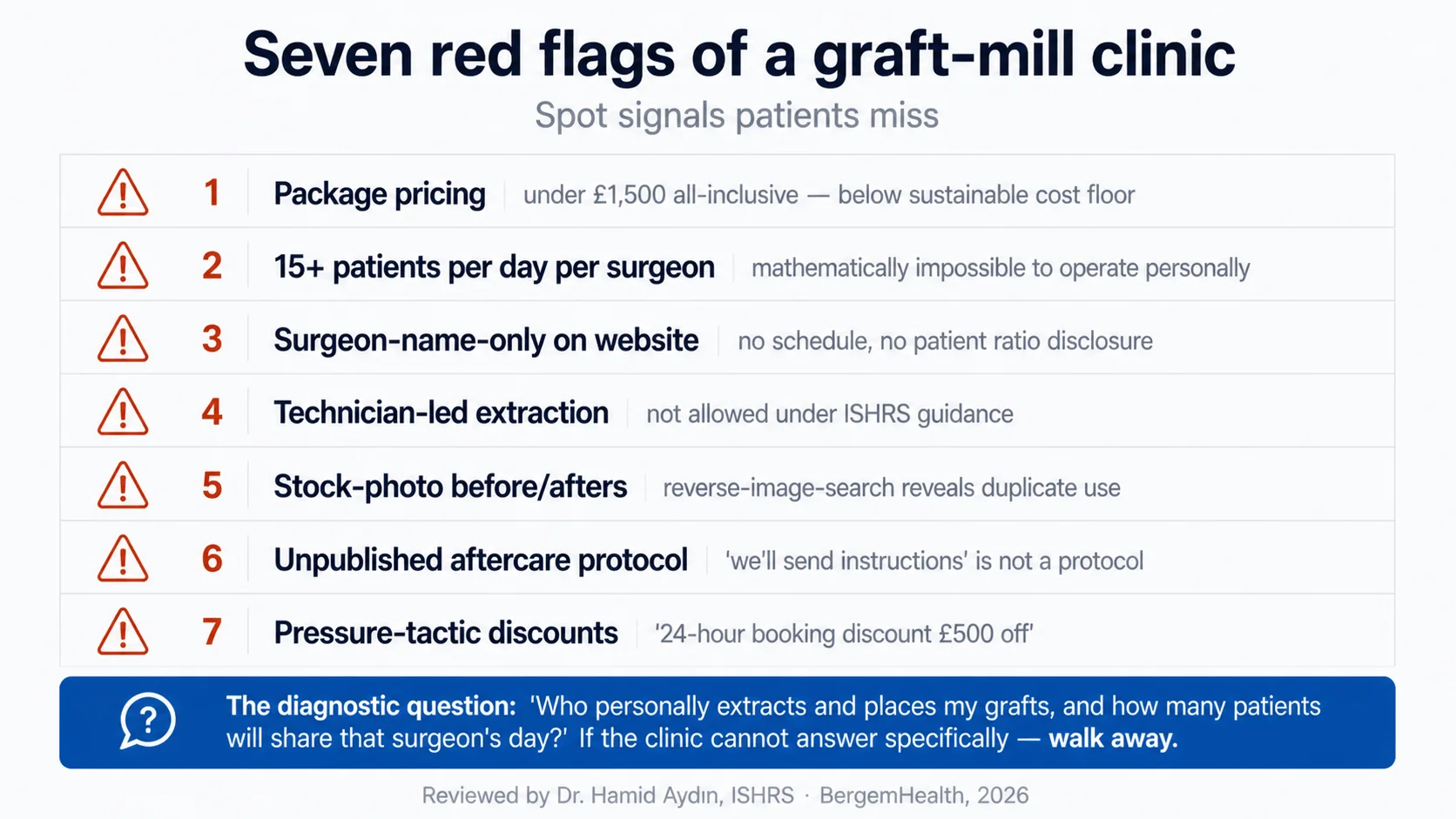
Quick answer
A “graft mill” is a category of hair-transplant clinic that runs surgery as a high-volume technician-led production line: 15–25 patients per day per “named surgeon” who performs only the consultation and the hairline drawing, with extraction and implantation handled by trained technicians. The category isn’t defined by any single clinic — it’s defined by a recognisable cluster of signals: package pricing under £1,800, opaque per-graft cost, untraceable before-and-after photos, ambiguous aftercare commitments, and a refusal to itemise quotes. This article names the patterns so you can spot them. Graft mills exist in both Turkey and the UK; the patterns are what matter.
Table of contents
- What “graft mill” actually means
- Red flag 1: package pricing under £1,800
- Red flag 2: surgeon-load math that doesn’t add up
- Red flag 3: surgeon name on the website only
- Red flag 4: technician-led extraction
- Red flag 5: untraceable before-and-after photos
- Red flag 6: aftercare ends at week 2
- Red flag 7: same-day-arrival surgery
- The diagnostic question that beats all seven
- How BergemHealth approaches this
- Frequently asked questions
What “graft mill” actually means
Definition. A graft mill is a hair transplant operation organised around volume rather than per-case clinical attention. The “named surgeon” performs consultation and hairline drawing only; technicians execute extraction, channel-opening, and implantation. Patient throughput is typically 15–25 cases per day per surgeon-of-record. Flat all-inclusive package pricing exists because the unit economics demand high throughput.
The category isn’t a moral judgment — it’s a description of an operating model. Some technicians are well-trained; some graft-mill clinics produce acceptable outcomes for a meaningful fraction of patients. The patient-side problem is that the model has structurally weaker quality control, pricing transparency is absent by design, and outcome variance is wider than the marketing photos suggest.
The 2024 ISHRS practice census flagged technician-led, surgeon-supervised hair transplantation as a growing share of unregulated medical-tourism segmentsishrs. The model itself doesn’t violate hospital-level accreditation standards (so JCI or CQC don’t catch it) — but it produces outcomes that surgeon-led practice does notbaapsgarg.
Red flag 1: package pricing under £1,800
The price floor is the single highest-information signal. A defensible hair transplant — JCI-accredited hospital, surgeon-led, ISHRS-member operator, 12-month aftercare — has a hard cost floor of £1,200–£1,500 per case at Istanbul wage levels before surgeon margin or aftercare cost. Add 4 nights of clinic-arranged hotel, transfers, and a defensible 12-month aftercare programme, and the all-inclusive floor sits at roughly £1,800–£2,100. Below £1,800 the math doesn’t work without operational compromise — usually technician-led extraction at high volumes, plus aftercare that ends at week 2.
“Package pricing” means a single round number covers everything, the number doesn’t change with graft count (1,500 vs 4,000 grafts: same price), and line items aren’t itemised on request. A defensible quote names every variable separately: graft count range, technique, surgeon name, anaesthesia, hospital, hotel, transfers, aftercare duration, touch-up policy threshold.
Red flag 2: surgeon-load math that doesn’t add up
Manual FUE extraction takes a trained surgeon 3–4 hours for a 2,500–3,500-graft casesharma. Sapphire channel-opening adds 2–3 hours. Direct DHI takes longer still because the Choi pen combines channel-opening and implantation. A 10-hour day at 2–4 patients with the surgeon doing his own extraction and channel-opening is possible. A 10-hour day at 15+ patients per surgeon is not. When a clinic publicly states or implies 10+ patients per surgeon, what they’re telling you is that the named surgeon is supervising, not operating.
Ask the clinic in writing: “On the day of my surgery, what percentage of the procedure (extraction, channel-opening, implantation) will be performed personally by Dr. [name], and what percentage will be performed by technicians?” A defensible answer is specific. “Dr. X supervises the entire procedure” typically means he’s in the building, not necessarily holding the punch.
Red flag 3: surgeon name on the website only
This is the marketing-vs-reality test. A clinic features a named surgeon prominently — biography, credentials, photos in scrubs — but when you press for the specifics of who will operate on you, the answer becomes vague.
Specific patterns:
- No GMC or ISHRS member ID published alongside the surgeon’s name
- The surgeon’s name doesn’t appear in the booking confirmation as the operator-of-record
- The clinic uses “our team” language when discussing the surgical day rather than naming an individual
- The before-and-after photos are credited to “the clinic” rather than to a named surgeon
Verify the surgeon directly: GMC register lookup for UK doctors (gmc-uk.org), ISHRS member directory for international hair-restoration surgeons (ishrs.org). A surgeon who appears on the website but not on either register, while marketing in the UK or to UK patients, has a verification gap that no marketing copy fills.
Red flag 4: technician-led extraction
Hair transplant has three operative phases: extraction, channel-opening, and implantation. Extraction is the most technically demanding — the angles, depth, and torque of each punch determine donor-area quality and graft survival. Variance in graft transection rates is substantially higher in technician-led settingsgarg.
Spot signals: the clinic answers “who performs extraction?” with “our trained team”, marketing photos show multiple technicians working on the patient simultaneously, the clinic markets a “team approach” as a feature rather than as a description of who does what. Channel-opening — particularly Sapphire FUE, where blade angle determines graft direction — is the parallel concern.
Red flag 5: untraceable before-and-after photos
Defensible photo evidence has four properties: patient name or initials (with consent); procedure date; number of grafts and technique; clearly identified photo dates (pre-op, day-of-surgery, month 1, 6, 12). Generic “before/after” pairs without these cannot be cross-checked.
A second test: ask for a complete patient gallery for one specific named case — pre-op through month 12. A defensible clinic produces it; a graft-mill clinic produces selected snapshots. Watch for patterns: identical lighting and angle across “different patients”, obvious skin-tone or hairline edits, photos credited to image libraries.
Red flag 6: aftercare ends at week 2
The first 14 days post-op are the easy part. The aftercare that matters runs from month 1 (when shock loss begins) through month 12 (when the final result is visible). Spot signals:
- Aftercare not defined in writing beyond the in-country period
- Month 1, 3, 6, 9, 12 reviews not named as part of the package
- No touch-up policy defined — or the policy is “we’ll see how it looks”
- Email or message replies become slow once the patient has returned home
A defensible aftercare programme is structured: scheduled reviews at fixed intervals, a defined density-threshold for touch-up, and a named clinical contact who responds within 24 hours.
Red flag 7: same-day-arrival surgery
Some clinics schedule surgery on the day of patient arrival. This is presented as efficient; it is structurally a clinical compromise. A defensible pre-op consultation involves donor area assessment in person, hairline drawing with the patient awake and consenting, blood work review, and a final discussion — 30–60 minutes that need to happen before sedation. Compressing it into the morning of surgery — when the patient is jet-lagged, anxious, and committed — turns it into a formality.
The exception: a substantive advance video consultation, with the in-person consultation collapsed into a checklist exercise on surgery morning. That’s a reasonable middle ground if the video consultation has been substantive — but it should be the patient’s choice, not the clinic’s default.
The diagnostic question that beats all seven
If you can only ask one question of a hair-transplant clinic before booking, ask this:
“Please send me, in writing: the named surgeon, their GMC or ISHRS ID, the percentage of the procedure they will perform personally, the per-graft itemised cost, and the month-1-to-12 aftercare programme with the touch-up policy threshold.”
This single sentence asks the clinic to confirm five things the graft-mill model can’t deliver simultaneously: a named verifiable surgeon, surgeon-led operating discipline, transparent pricing, structured aftercare, and outcome accountability. A defensible clinic answers in writing within 48 hours. A graft-mill clinic deflects, partial-answers, or says “we’ll discuss this in your consultation”.
What the clinic sends back is the booking decision.
How BergemHealth approaches this
BergemHealth’s answer to the graft-mill problem is a different operating model that sits on the right side of every red flag above.
Pricing: Per-graft itemised quotes, published from £1,250 (Standard FUE), £1,750 (Sapphire FUE), £2,250 (Direct DHI). All-inclusive variants exist with hotel and transfers separately specified. No flat package pricing.
Surgeon load: Dr. Hamid Aydın limits his surgical schedule to 2–4 patients per day at Liv Hospital Ulusliv-jci, personally performing the entire extraction or channel-opening phase. 25,000+ procedures since 2000, ISHRS member, former president of SAÇDERishrs. The named surgeon is the operating surgeon, confirmed in the booking documentation.
Surgeon verification: ISHRS member directory listing plus lookup links on every booking pack. Same for the GMC-registered London consulting team led by Dr. Sumeyye Yukselgmc.
Photo evidence: Patient case galleries dated, named (with consent), with graft count and technique. Complete case sequences (pre-op through month 12) on request.
Aftercare: 12-month structured programme with reviews at month 1, 3, 6, 9, 12 — in person at Harley Street if the London pathway is selected, remote if the Istanbul pathway is selected. Touch-up policy in writing with a defined density threshold below which the corrective procedure is performed at no surgeon fee.
Pre-op consultation: Separate from surgery day — at Harley Street, at Liv Hospital Ulus the day before surgery, or by video call before any travel is booked. Same-day-arrival surgery is not offered as a default.
What to do next
The main Choosing-a-Clinic pillar puts these red flags into broader context. Accreditation gaps that allow some graft mills to look legitimate are explained in JCI vs CQC vs GMC. The Istanbul-vs-London logistics decision is its own piece. Surgical-method specifics underlying the operator-of-record question are in the methods comparison.
If you’ve been quoted by a clinic and want a sanity check, request a free assessment from BergemHealth’s London or Istanbul team. The consultation includes a per-case quote you can compare against any other quote, and the booking pack includes the seven-row defensibility check answered in writing.
Frequently asked questions
Are all cheap hair transplants graft mills?
No. A defensible Istanbul hair transplant has a cost floor around £1,800–£2,100 all-inclusive, which is “cheap” by UK private-clinic standards but legitimate by structural-cost-driver math. Below £1,800, the unit economics become very tight. The signal isn’t the headline price — it’s whether the price is itemised, the surgeon is named and verifiable, and the aftercare runs to 12 months.
Is technician-assisted hair transplant always bad?
Technician assistance is normal and standard — well-trained technicians sort grafts, prepare the surgical field, and assist with implantation under direct surgeon supervision. The concern is technician-led extraction and channel-opening, where the technical skill that determines outcome is delegated to a non-surgeonishrs. The defensible question is “what percentage does the surgeon perform personally” rather than “are technicians involved at all”.
How can I tell if a clinic’s photos are real?
Ask for a complete sequence on a single named patient — pre-op, surgical day, week 1, month 1, 3, 6, 9, 12. A defensible clinic produces it (with patient consent). A graft-mill clinic produces selected images. Reverse image search (right-click → Google) on a few “before” photos sometimes catches stock-image use. Stock-image patterns: identical lighting and angle across “different patients”, impossibly clean before-states.
What if a clinic refuses to itemise the quote?
That’s the clinic giving you information. A clinic confident in its pricing structure publishes per-graft costs, line-itemises hotel and transfers separately, and names the surgeon’s work as a separate item. A clinic that refuses to itemise is operating a model where the patient is meant to compare to other clinics on a single round number, not on the underlying unit economics. Take the refusal as a “no, this clinic isn’t for me” answer.
How do I check ISHRS membership?
Go to ishrs.org and use the member directory search. Type the surgeon’s name; the directory returns membership status, country, and any practice details. ISHRS membership requires verified medical qualifications, a minimum number of hair-restoration cases performed, annual continuing education, and code-of-ethics adherenceishrs. A surgeon advertising in international hair-restoration markets without ISHRS membership doesn’t have to be unqualified, but the burden of proof shifts to the clinic.
Is a graft mill always cheaper than a defensible clinic?
Often, but not always. Some graft mills price at mid-tier — £2,500–£3,500 all-inclusive — to look more credible. The other red flags (surgeon load, photo provenance, aftercare definition, operator-of-record) are independent of the headline price. A clinic at £2,800 can have all the operating-model concerns of a clinic at £1,499. Use the seven-row defensibility check, not the price.
What if I’ve already booked a clinic that has some red flags?
Press the clinic in writing for the diagnostic question above (named surgeon, ID, personal-percentage, per-graft pricing, 12-month aftercare, touch-up threshold). Their written response gives you a clearer picture than the marketing site. If the response is reassuring, the booking might still be fine; if the response is evasive, weigh the deposit cost against the cost of a poor outcome on a one-shot donor area, and consider whether rebooking with a defensible clinic is the better answer for your case.
Do UK private clinics ever have these red flags?
Yes — graft mills are a category of operation, not a country. Some UK private clinics charge £8,000+ while running technician-led models with minimal surgeon-led extraction. The £8,000 price doesn’t itself guarantee surgeon-led discipline; the operator-of-record question applies in London as much as in Istanbul. Verify the surgeon’s GMC registration, the clinic’s CQC inspection report, and ask for the personal-percentage answer in writinggmccqc.
Sources
How BergemHealth approaches this
Procedures are performed at JCI-accredited Liv Hospital Ulus, Istanbul, by Dr. Hamid Aydın and the resident surgical team. UK consultation and 12-month aftercare at our CQC-regulated Harley Street office. Transparent pricing and a free touch-up if indicated.
Free consultation →