Why UK Patients Travel to Turkey for Hair Transplant in 2026
Why UK patients increasingly choose Turkey for hair transplant: real cost drivers (wages, VAT, indemnity), JCI hospital safety, and what to look for vs avoid.
Medical disclaimer. This article is educational and not medical advice. Hair restoration outcomes are individual; only a qualified surgeon can assess your case in a personal consultation.
Quick answer
UK patients travel to Turkey for hair transplant because the same surgical standard at a JCI-accredited Istanbul hospital costs roughly 60–80% less than the equivalent procedure at most UK private clinics — and the gap is real, not a quality compromise. The cost difference is driven by structural factors (wages, real estate, indemnity, VAT) unrelated to surgical skill, and the same Istanbul-trained network now operates in London at parity pricing. This article unpacks the cost drivers and explains when going to Turkey still makes sense.
Table of contents
- The 60–80% cost gap is real, but it’s not about cheap surgery
- The four structural cost drivers
- Turkey’s regulatory framework: JCI, ISHRS, health-tourism licence
- What UK patients tend to misjudge
- The two-clinic alternative
- How BergemHealth approaches this
- Frequently asked questions
The 60–80% cost gap is real, but it’s not about cheap surgery
The headline UK patients see is something like: “Hair transplant £1,500 in Turkey vs £8,000 in the UK.” Both numbers can be true, and the gap can be entirely legitimate, while also being the entry point into the graft-mill segment of the market. The trick is separating the cost gap that’s structural from the cost gap that’s a quality compromise.
Three things sit underneath that 60–80% headline:
- Real structural cost difference — wages, rent, VAT, indemnity insurance, hospital overhead — that exists at every tier of Turkey’s hair-restoration market, JCI hospitals included.
- A high-volume technician-led model that exists in some Turkey clinics but not all, which compresses price further by reducing surgeon labour per case.
- Currency dynamics: GBP-denominated patients buying TRY-denominated services have benefited as the lira has weakened against sterling, though this third factor moves around and shouldn’t be relied on year over year.
The first driver is permanent and applies even to JCI-tier hospitalsjciliv-jci. The second is a quality compromise to avoid. The third is volatile but currently in the patient’s favour. UK patients who don’t separate these three end up either over-paying in the UK (assuming the price is the quality) or under-paying in Turkey (assuming the price is fine because everyone else is paying it).
The four structural cost drivers
Definition. Structural cost drivers are the unavoidable input costs of running a surgical facility — staff wages, building rent, regulatory overhead, taxes — that exist independently of surgical skill or volume. These differ substantially between London and Istanbul.
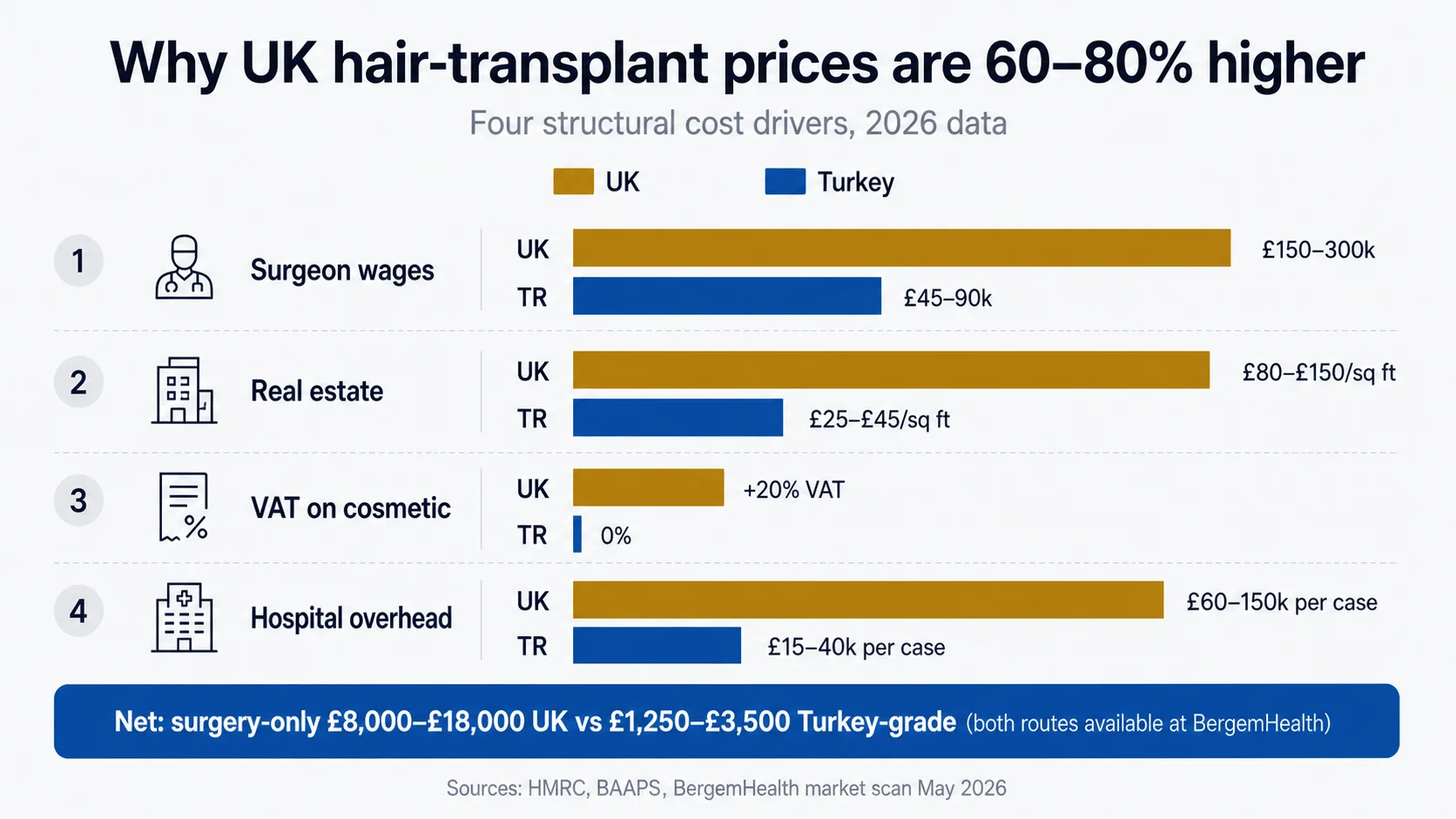
The cost gap between a UK private clinic and an Istanbul JCI hospital comes down to four input variables. None of them are about the surgery being any cheaper to perform clinically.
1. Wages. A consultant-level surgeon in the UK private sector typically earns £150,000–£300,000+ per year; the equivalent surgeon in Istanbul, even at JCI-accredited Liv Hospital Ulus, earns roughly 30–50% of that figure when measured in GBP. The same compression applies to nurses, theatre staff, and admin teams.
2. Real estate. Theatre-grade clinical space in central London costs £80–£150 per square foot per year; equivalent space in Istanbul’s medical-corridor districts (Etiler, Ulus, Acıbadem) costs roughly £25–£45 per square foot. A 3,000-square-foot multi-theatre clinic in London has a baseline rent of £240,000+ per year before any surgeon walks in; the same footprint in Istanbul runs £75,000–£135,000.
3. VAT and indemnity. UK cosmetic surgery is subject to 20% VAT in most caseshmrc. UK surgeons carry indemnity insurance premiums of £15,000–£40,000 per year for cosmetic-surgery practice. Both pass through to the patient. Turkey applies a different VAT structure to medical-tourism patients (often 0% on the surgical service itself when invoiced under the health-tourism licence) and indemnity premiums are roughly a third of UK figures.
4. Hospital overhead. A JCI-accredited hospital amortises the cost of accreditation, infection-control infrastructure, and continuing-education programmes across its full case mix — cardiology, oncology, cosmetic procedures, transplantation. A standalone UK cosmetic clinic spreads similar overhead across a much smaller case base, so the per-procedure allocation is higher.
Add these four together and you have a defensible Istanbul cost base of roughly £1,200–£1,700 per case at the surgical floor (i.e., before surgeon margin and aftercare). That’s before anything is compromised on quality.
Turkey’s regulatory framework: JCI, ISHRS, health-tourism licence
The UK reader’s quiet worry is usually some version of “yes, but is it actually safe?” The honest answer is: it depends entirely on which Turkey clinic, because the regulatory floor is much wider than the UK market.
There are roughly three regulatory tiers in the Turkey hair-restoration market:
| Tier | What it looks like | Patient implication |
|---|---|---|
| JCI-accredited hospital with ISHRS-member surgeon | Full hospital infrastructure, audited every 3 years against international standards | Comparable to UK private hospital tier |
| Polyclinic with health-tourism licence | Stand-alone clinic registered for international patients, not hospital-grade | Wide quality range; surgeon credentials become primary signal |
| Unregistered “guesthouse” surgery | No real-time hospital backup, package-pricing model | Avoid — this is the graft-mill tier |
JCI accreditation is the same standard whether the hospital is in Istanbul, Singapore, or Miami; the Joint Commission International publishes its full criteria and inspects every three yearsjci. As of 2024, several Istanbul hospitals carry continuous JCI accreditation including Liv Hospital Ulus (since 2013)liv-jci. ISHRS membership for the named surgeon is the parallel international standard at the individual-doctor levelishrs.
The Turkey-specific addition is the Health Tourism Authorisation Certificate (Sağlık Turizmi Yetki Belgesi), introduced in 2017. It requires the providing facility to register with the Ministry of Health, demonstrate language-capable staff for international patients, and maintain incident-reporting protocols. It’s a compliance floor, not a quality ceiling — but a clinic without one isn’t legally entitled to advertise to international patients.
A realistic Istanbul hair-transplant trip is not a holiday. The sensible minimum in country is 4 days; comfortable is 6–7. Total cost (everything in) typically runs £1,800–£3,200 at the JCI tier including return flights, 4 nights in a 4-star hotel, transfers and 12-month aftercare — if the clinic prices defensibly. Below £1,800 you’re almost certainly buying a graft-mill product. (Day-by-day timeline in Istanbul vs London.)
What UK patients tend to misjudge
Treating “Turkey” as a single tier. The clinic at £1,499 and the clinic at £2,800 in Istanbul are different categories of operation, not slight variations of the same product. A defensible JCI-hospital procedure has a hard cost floor.
Discounting the aftercare gap. A clinic well-run on surgery day but slow to return calls three months later when shock loss anxiety hits has solved 80% of the problem and left the most stressful 20%. Aftercare duration in writing matters as much as the surgical-day standard.
Assuming UK private = automatically safe. UK CQC-registered cosmetic clinics span a wide quality range. A CQC certificate at the door doesn’t tell you whether the clinic operates surgeon-led or technician-heavycqc. The same questions in the main pillar apply to UK clinics as much as to Istanbul ones.
Over-weighting language barrier risk. At the JCI hospital tier, English-language clinical staff are universal. At the polyclinic tier variable; at the graft-mill tier often a single coordinator handling 30+ patients. The risk distribution maps onto the regulatory tier, not onto “Turkey” in general.
The two-clinic alternative
The framing this article has been pointing at is that the Turkey-vs-UK question used to be a price-vs-proximity trade-off, and is increasingly not. As of 2024–2026, BergemHealth and a small number of similar networks have built two-clinic models where the Istanbul cost base is shared with a UK consulting facility. The patient who can’t, won’t, or doesn’t want to fly gets the same surgical network — same per-graft pricing, same surgeon-of-record, same aftercare programme — at a CQC-registered UK clinic instead of a JCI-accredited Istanbul hospital.
This is structurally different from “the UK clinic that has a Turkey partnership and marks up 200% for the Harley Street postcode”. It only works when the UK pricing is anchored to the Istanbul cost base, which requires the network to share overhead across both sides — not run them as a domestic UK practice with a Turkey marketing arm.
For UK patients researching the question, the right comparison framework in 2026 is no longer “Turkey vs UK” but “two-clinic provider vs single-location provider”. The two-clinic provider gives you a logistics choice; the single-location provider gives you a financial trade-off.
How BergemHealth approaches this
BergemHealth’s structural answer is a shared-network two-clinic model: Liv Hospital Ulus in Istanbul (JCI-accredited since 2013)liv-jci and 99 Harley Street in London (CQC-registered). Both are priced at the Istanbul cost base — Standard FUE from £1,250, Sapphire FUE from £1,750, Direct DHI from £2,250 — because the surgical network is shared, not because the London side is loss-leading.
Operationally: Dr. Hamid Aydın’s surgical schedule (ISHRS member, 25,000+ procedures since 2000)ishrs runs at Liv Hospital Ulus in Istanbul; Dr. Sumeyye Yuksel’s GMC-registered consulting team handles UK-side consultations, post-op reviews and minor procedures at Harley Streetgmc. Patients who fly to Istanbul get the JCI hospital, 4 nights in a clinic-vetted hotel, transfers, and 12-month aftercare with free touch-up at month 9 if density warrants. Patients who choose the London pathway get the same pricing and the same aftercare programme — performed at Harley Street.
The reason a UK patient might still travel to Istanbul, even with the parity-priced London option available, comes down to patient-side preference: hospital over clinic environment, a single 5-day block off work, recovery in a quiet hotel rather than a busy household, the focused-on-the-surgery feel of medical travel. None of those are about budget. That’s the point.
What to do next
If you’re weighing Turkey-vs-UK as a primary decision, the better next step in 2026 is to check whether parity-priced two-clinic providers are available — and if they are, switch your decision frame to logistics rather than budget. Istanbul-vs-London logistics in its own cluster, accreditation detail in JCI vs CQC vs GMC, warning signs in the red-flags guide, and method differences in the hair-transplant pillar and method comparison.
If you’re ready for a per-case quote, request a free assessment from BergemHealth’s London or Istanbul team — same surgeon-network, same pricing, two recovery options. CQC-registered facility in London. JCI-accredited hospital in Istanbul. ISHRS-member lead surgeon. Defensible itemised quote in writing within 48 hours.
Frequently asked questions
Is hair transplant in Turkey actually safe for British patients?
At the JCI-accredited hospital tier with an ISHRS-member surgeon, yes — the regulatory standard is comparable to UK private hospitals. At the unregulated polyclinic tier, no — that’s where the package-pricing graft-mill model operates. The “is Turkey safe” question is really an “is this clinic in Turkey safe” question, and the same verification checklist (JCI, ISHRS, defensible quote, traceable photos) appliesjciishrs.
Why is hair transplant so much cheaper in Turkey?
Four structural drivers: lower surgeon and staff wages (roughly 30–50% of UK levels in GBP), lower real estate cost in Istanbul’s medical corridors, different VAT and indemnity-insurance regimes, and JCI hospitals’ ability to amortise overhead across a much larger case mix than a standalone UK cosmetic clinichmrc. None of these are about cheaper surgery — they’re about cheaper inputs.
How long do I need to stay in Turkey for a hair transplant?
Minimum 4 days (arrival day, surgery day, day-1 wash, fly-home day). Comfortable: 6–7 days, which gives you a rest day before flying and a clinic review on day 3. Anyone offering same-day-arrival surgery is skipping the pre-op consultation and that itself is a warning sign.
Will my GP follow up after a Turkey hair transplant?
UK GPs are not contracted to provide cosmetic-surgery aftercare and typically won’t routinely review hair transplant patients post-operatively. Aftercare needs to be built into the clinic’s programme. With a two-clinic provider like BergemHealth, post-op reviews at 1, 3, 6 and 12 months happen at the UK Harley Street facility under GMC-registered supervision; with a single-location Istanbul clinic, aftercare is remote (photo and video reviews).
What are the Turkey-specific risks I should know about?
The serious risks are not Turkey-specific — they’re clinic-tier-specific. At the graft-mill tier: technician-led extraction quality, opaque post-op antibiotic protocols, weak follow-up. At the JCI tier: comparable to UK private. The Turkey-specific logistical risks are flight-related (don’t fly within 48 hours of surgery) and consumer-rights-related (cross-border legal redress is harder than domestic). Verify the clinic’s complaints and refund policy in writing before booking.
Do I get a refund if the surgery doesn’t work?
Defensible clinics do not refund surgery, because the surgical labour has been performed regardless of outcome. What they offer instead is a touch-up policy: a free corrective procedure if density at month 9–12 falls below a pre-agreed threshold. This is the consumer protection that matters. A clinic offering blanket money-back assurances is using marketing language; a clinic offering a defined touch-up policy in writing is offering meaningful consumer protection.
Can I get a hair transplant in Turkey if I’m on finasteride or minoxidil?
Yes — being on finasteride or minoxidil is generally compatible with hair transplant and most surgeons recommend continuing both. Tell the surgical team during the pre-op consultation. Some surgeons advise pausing minoxidil for 2 weeks before surgery to reduce intraoperative scalp blood flow; finasteride is typically continued without interruption.
What documentation should I bring?
Passport (six months’ validity from travel date), printed booking confirmation, recent blood-test results if you have them, a list of current medications including doses, and your GP’s contact details. The clinic typically performs basic pre-op blood work on arrival regardless.
Is the surgery painful?
The local anaesthetic injection at the start of the procedure is the most uncomfortable part — typically a 2–3 minute series of small injections into the scalp. Once the local takes effect, the procedure itself is not painful, though it is long (6–10 hours including breaks). Most patients report mild post-op discomfort for 24–48 hours, managed with paracetamol or codeine; severe pain is unusual and warrants a same-day call back to the clinicstatpearls.
How does a Turkey hair transplant compare to one in Harley Street?
At BergemHealth’s two-clinic pricing, the cost doesn’t differ — both pathways price at the Istanbul cost base. What differs is the recovery setting (Istanbul hotel vs UK home), the post-op review channel (in-person at Harley Street vs remote photos from Istanbul), and the time off work (single 5-day block vs appointments spread across months). Surgical outcome should not differ when the same surgical network operates both sides. Full breakdown in Istanbul vs London.
Sources
How BergemHealth approaches this
Procedures are performed at JCI-accredited Liv Hospital Ulus, Istanbul, by Dr. Hamid Aydın and the resident surgical team. UK consultation and 12-month aftercare at our CQC-regulated Harley Street office. Transparent pricing and a free touch-up if indicated.
Free consultation →