Hair Transplant Month-by-Month Results: 1, 3, 6, 9, 12, 18
What hair transplant results look like at month 1, 3, 6, 9, 12, and 18. The realistic milestones, when to judge, and how to photograph yourself honestly.
Medical disclaimer. This article is educational and not medical advice. Hair restoration outcomes are individual; only a qualified surgeon can assess your case in a personal consultation.
Quick answer
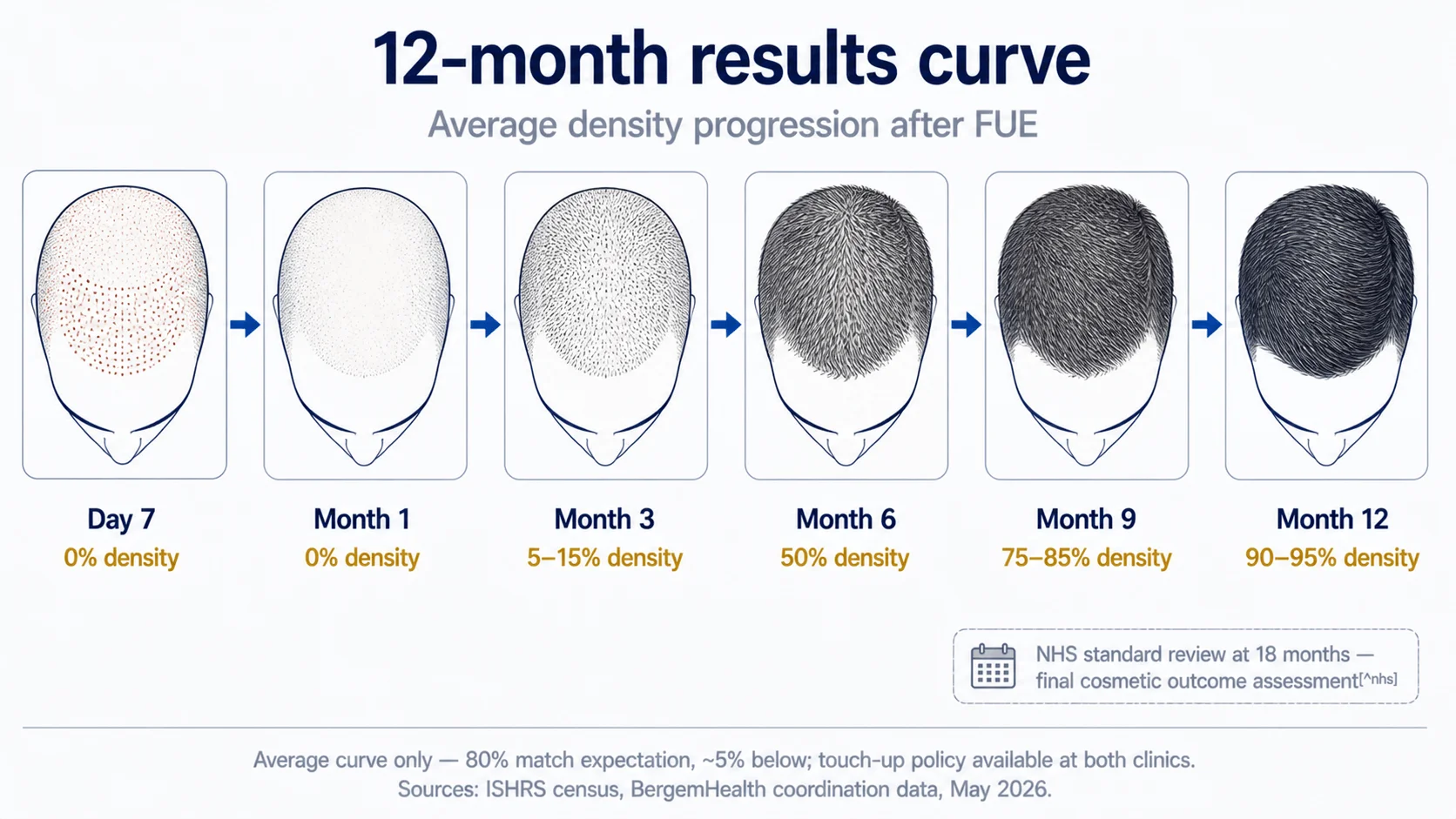
The 12-month hair transplant timeline has six recognised milestones: month 1 (shock loss begins, surface healed); month 3 (new growth emerging, recipient area at its lowest cosmetic point); month 6 (50% of final density visible); month 9 (75–85% of final density, the touch-up assessment point); month 12 (90–95%+, the standard outcome assessment point); month 18 (NHS cosmetic-surgery formal review end-point — small additional density only). Patients who judge their result before month 9 are reading the curve at its steepest. This article walks each milestone with what’s realistic to expect and how to track honestly.
Table of contents
- The 12-month curve isn’t smooth
- Month 1 — surface healed, shock loss begins
- Month 3 — the ugly duckling stage
- Month 6 — 50% of final density
- Month 9 — touch-up assessment point
- Month 12 — 90% or above, the standard outcome
- Month 18 — reconciling 9–12 vs the NHS frame
- Reviews schedule across the 12 months
- How to photograph yourself for honest tracking
- When the result isn’t tracking expectation
- What to do next
- Frequently asked questions
The 12-month curve isn’t smooth
Definition. The recovery curve describes the visible density at the recipient area as a function of time post-surgery. It has three distinct phases — surface recovery (days 0–14), shock loss and dormancy (weeks 2–12), and progressive regrowth (months 3–12) — and crosses through a low cosmetic point around month 2 before climbing toward final density. Judging the result before month 9 over-weights the steep part of the curve.
The shape of the recovery curve matters because it predicts when patient anxiety peaks (month 2 — at the low point) and when the result becomes valid for assessment (month 9–12, after the curve has flattened near the upper plateau). Most patient regret is generated between month 1 and month 4, when visible density is at its lowest and the patient hasn’t yet seen meaningful regrowth beginstatpearls.
This is also why “average results at month 6” — a phrase that appears in lots of marketing — is an unhelpful frame. At month 6, average density is 50%; at month 12, average is 90%+. The same surgery looks half-finished at month 6 and complete at month 12. It hasn’t gotten more successful in those 6 months — the curve has just continued.
Month 1 — surface healed, shock loss begins
By month 1 the surface picture is essentially normal: donor area shows small healing punch points on close inspection (not noticeable from normal social distance); recipient area shows short transplanted hair stubble at the start of month 1, with much of this shedding by the end of month 1; post-op swelling fully resolved; nearly all pre-op activities resumable except contact sports, sea swimming, and hot saunas.
What patients see by end of month 1: the recipient area starts to look closer to its pre-surgery appearance because transplanted hair shafts are shedding via shock loss. This is biologically normal (covered in the shock-loss article) but visually disappointing. The month-1 photo is more useful as a baseline for month 3 comparison than as an outcome assessment.
Month 3 — the ugly duckling stage
Month 3 is often the most psychologically difficult milestone. Most original transplanted hair shafts have shed; the recipient area looks at or near its pre-surgery appearance; and the new growth that’s beginning is fine, often colourless, and not yet visible to casual inspection.
What’s actually visible at month 3:
- Recipient area: looks similar to pre-surgery from a normal social distance
- Up-close: very fine, light, often colourless new hair shafts emerging from many of the transplanted follicles
- Density: in our experience roughly 5–15% of expected final result is visible from normal distance, with much more present microscopically
Patient psychology at month 3: this is when most “the surgery has failed” anxiety hits. Patients compare their month-3 photo to others’ month-12 photos online and conclude something is wrong. The comparison is the wrong one — every successful transplant looked like this at month 3.
What helps at month 3: comparison to your own month-1 photo (the shock-loss-shed picture is similar, but trichoscopy or close inspection reveals the new fine hairs that weren’t there at month 1); trust in the timeline (month 3 is mid-curve, not end-of-curve).
The new hairs emerging at month 3 are biologically full follicles producing thin, fine first-cycle hair shafts. They will thicken and lengthen progressively over months 4–12.
Month 6 — 50% of final density
Month 6 is when the picture becomes recognisably better. New hair shafts have thickened toward adult thickness, taken on adult pigmentation, and reached 3–5 cm in length. Density visible from normal distance is roughly 50% of what’s expected at month 12. The recipient area is clearly fuller than month 3; distribution is somewhat uneven (different follicles emerged from telogen at different times); hair quality is closer to adult thickness with full or near-full pigmentation. All pre-op activities including contact sports, sea swimming, and hot saunas have been safely resumable since month 4.
What month 6 isn’t: the final result. By month 12 the density will be roughly 1.8–2x what’s visible at month 6.
Month 9 — touch-up assessment point
Month 9 is the formal assessment point at which clinics with a written touch-up policy review whether a corrective procedure is needed. Density has reached roughly 75–85% of expected final result; full adult thickness and pigmentation; the unevenness of month 6 has substantially evened out; clinical density mapping typically shows 75–85% of agreed target density.
The touch-up question at month 9: a written policy defines a density threshold below which a corrective procedure is performed at no additional surgeon fee. If month-9 density falls below that threshold in any zone, the touch-up is scheduled — typically at month 10–11 so the touch-up follicles can mature alongside the original ones, both reaching final density in roughly the same window. In our experience, roughly 5–10% of cases use the touch-up policy.
Month 12 — 90% or above, the standard outcome
Month 12 is the standard outcome-assessment point. Density is at 90%+ of final result, the recipient area looks effectively complete, and the surgical outcome can be honestly evaluated. Recipient area: full density across the agreed target zones. Donor area: punch points fully healed; donor density slightly reduced but cosmetically intact. Hair quality: full adult thickness and pigmentation. Comparison to pre-op: a clear and visible result.
A small portion of additional density continues to develop between month 12 and month 18 (around 5%); many patients consider month 12 the practical end-point. The hairs visible at month 12 are biologically the donor-zone follicles, retaining their DHT-resistance and continuing to grow throughout life — that’s why hair transplant produces durable results. The recurring caveat: native hairs in the surrounding AGA-affected zone can still recede, which is the case for continuing finasteride and/or minoxidilnice-mpb.
Month 18 — reconciling 9–12 vs the NHS frame
Two timeframes appear in patient information and they can look contradictory: 9–12 months for “final result” in clinical and surgical literature, and 18 months in NHS cosmetic-surgery guidancenhs. They aren’t in conflict.
Most patients see effectively their final result by month 9–12 — at that point density is 90–95%+ and the picture is stable enough for honest assessment. NHS guidance allows up to 18 months for full maturation and uses 18 months as the formal end-point for cosmetic-surgery review. The extra 6 months delivers a small additional percentage of density (around 5%) and lets donor-area healing and any native-hair shock-loss recovery fully stabilise.
For practical purposes: month 12 is when the surgical outcome can be honestly evaluated; month 18 confirms durability. After month 18, no further surgical-result improvement happens — subsequent changes are due to native AGA progression around the transplant zones (which is why continuing finasteride and minoxidil matters) or natural ageing.
Reviews schedule across the 12 months
The standard review cadence — used at both BergemHealth clinics — is month 1, 3, 6, 9 and 12: month 1 confirms shock-loss is consistent with normal pattern; month 3 confirms new-growth onset (with trichoscopy if needed); month 6 documents 50%-density mapping; month 9 is the touch-up assessment; month 12 is the formal outcome assessment with comprehensive photographic record. London-pathway patients attend in-person at 99 Harley Street; Istanbul-pathway patients send high-resolution photos and join a video call, with optional in-person Harley Street review as a no-additional-fee service.
How to photograph yourself for honest tracking
Self-photography is one of the most useful things a patient can do across the 12-month journey, provided it’s done consistently. A useful protocol:
- Same location and lighting: a fixed spot at home with the same overhead light, ideally daylight from a fixed window angle.
- Same angles: front, top-down, back-of-crown, and 3/4 left and right. Five photos is enough.
- Same hair state and camera: dry, recently washed, no styling product; phone camera in default mode (no portrait/beauty filters).
- Same frequency: every 4 weeks for the first 6 months, every 6–8 weeks thereafter. Include the date in the filename.
What not to do: comparing yourself to others’ “before/after” photos online. Different surgeries, different starting stages, different lighting. The only fair comparison is your month-X photo to your month-Y photo.
When the result isn’t tracking expectation
The realistic distribution of outcomes, in our experience:
- ~80% of patients: month-12 result matches or exceeds the pre-op expectation
- ~10–15%: result at the low end of the expected range — touch-up policy applies
- ~5%: result below the expected range, or specific zones haven’t regrown
- <1%: a complication (infection, donor-area scarring, alopecia areata triggered by surgery)garg
If at month 9 or month 12 the result isn’t tracking expectation, the questions to work through: is the regrowth genuinely below threshold, or is the patient’s expectation higher than the pre-op target; are specific zones lagging, or is it whole-area density; has the patient been continuing finasteride and minoxidil; has the touch-up policy threshold been triggered.
Touch-up policy is included in the BergemHealth booking documentation at both Liv Hospital Ulus and 99 Harley Street: an agreed density threshold below which a corrective procedure is performed at no additional surgeon fee. Dr. Hamid Aydın leads the surgical pathway at Liv Hospital Ulus (ISHRS member, 25,000+ procedures since 2000)ishrs; Dr. Sumeyye Yuksel leads the London consulting and aftercare teamgmc.
What to do next
For the broader 12-month timeline overview, see the recovery-aftercare pillar. For the day-by-day picture of week 1, first 7 days after FUE. For why month 1–3 looks the way it does, shock loss explained. For why native hair around the transplant may need ongoing protection, the AGA article. For methods themselves, the methods comparison and hair-transplant pillar.
If you want to understand the realistic 12-month expectation before committing, request a free assessment from BergemHealth’s London or Istanbul team. The pre-op consultation includes expected density progression at each milestone, the touch-up policy in writing, and the structured review schedule. CQC-registered facility in London. JCI-accredited hospital in Istanbul.
Frequently asked questions
When do hair transplant results show?
First new growth emerges around month 3. Visible improvement on previous-month photos starts at month 4. 50% of final density at month 6. 75–85% at month 9. 90%+ at month 12. The curve isn’t smooth — month 2 is the lowest cosmetic point, then steady improvement to month 12.
What do hair transplant results look like at 3 months?
At month 3, the recipient area looks similar to pre-surgery from normal social distance, but very fine, often colourless new hair shafts are emerging from many follicles on close inspection. Density visible from normal distance is roughly 5–15% of expected final. This is the “ugly duckling” stage when most anxiety peaks.
Is 6 months too early to judge a hair transplant?
Yes. At month 6, density is roughly 50% of final. The picture continues to improve substantially through months 7–12. Month 9 is the first reasonable assessment milestone; month 12 is the standard one.
When are hair transplant results final?
Month 12 is the standard assessment point. NHS cosmetic-surgery formal review uses month 18 as the end-pointnhs. A small portion of additional density develops between month 12 and month 18, but the difference is modest. For practical purposes, month 12 is when the result is “final”.
How much regrowth at 9 months?
Roughly 75–85% of expected final density at month 9. This is the touch-up assessment milestone — if density at month 9 falls below the agreed threshold defined in pre-op documentation, the touch-up procedure is performed at no additional surgeon fee in clinics with a written policy.
What does month 12 look like compared to month 6?
Roughly 1.8–2x the visible density. At month 6 the recipient area looks half-filled and somewhat uneven. At month 12 it looks full, even, and stable. Photographs in identical lighting between month 6 and month 12 show the difference clearly.
Will my hair continue to thicken after 12 months?
Slightly. Roughly 5% additional density typically develops between month 12 and month 18. After month 18, no further surgical-result improvement happens — subsequent changes are due to native AGA progression around the transplant zones or natural ageing.
What should I do if I’m at month 9 and not happy with the result?
Schedule the formal month-9 review with your clinic. The conversation should compare actual density at the recipient area to the pre-defined target density in your booking documentation. If the threshold is not met, a touch-up procedure should be offered at no additional surgeon fee in clinics with a written policy. Bring photographs in your standard self-photography protocol.
Sources
- NHS — Hair transplant overview and recovery. https://www.nhs.uk/conditions/cosmetic-procedures/hair-transplant/ ↩
- StatPearls — Hair Transplantation. National Center for Biotechnology Information. https://www.ncbi.nlm.nih.gov/books/NBK547740/ ↩
- Sharma R, Ranjan A. “Follicular Unit Extraction (FUE) Hair Transplant: Curves Ahead.” J Med Life. 2019. https://www.ncbi.nlm.nih.gov/pmc/articles/PMC6795649/ ↩
- Garg AK et al. “Complications in hair transplantation.” J Cutan Aesthet Surg. 2021. https://www.ncbi.nlm.nih.gov/pmc/articles/PMC8719980/ ↩
- NICE Clinical Knowledge Summary — Male pattern baldness. https://cks.nice.org.uk/topics/male-pattern-baldness/ ↩
- International Society of Hair Restoration Surgery — Member directory. https://www.ishrs.org/ ↩
- General Medical Council — The Medical Register. https://www.gmc-uk.org/registration-and-licensing/the-medical-register ↩
Как BergemHealth подходит к этому
Операции выполняются в Liv Hospital Ulus (Стамбул) с аккредитацией JCI доктором Hamid Aydın и резидентной хирургической командой. Консультация в Великобритании и 12-месячный уход в нашем офисе на Harley Street с регулированием CQC. Прозрачные цены и бесплатная корректировка при необходимости.
Бесплатная консультация →