PRP for Hair Loss: A Realistic 2026 Guide
PRP for hair loss explained: how it works, the mixed RCT evidence (Gentile, Mapar, Giordano meta-analysis), session protocols, realistic results, and when it's worth it.
Medical disclaimer. This article is educational and not medical advice. Hair restoration outcomes are individual; only a qualified clinician can assess your case in a personal consultation.
Quick answer
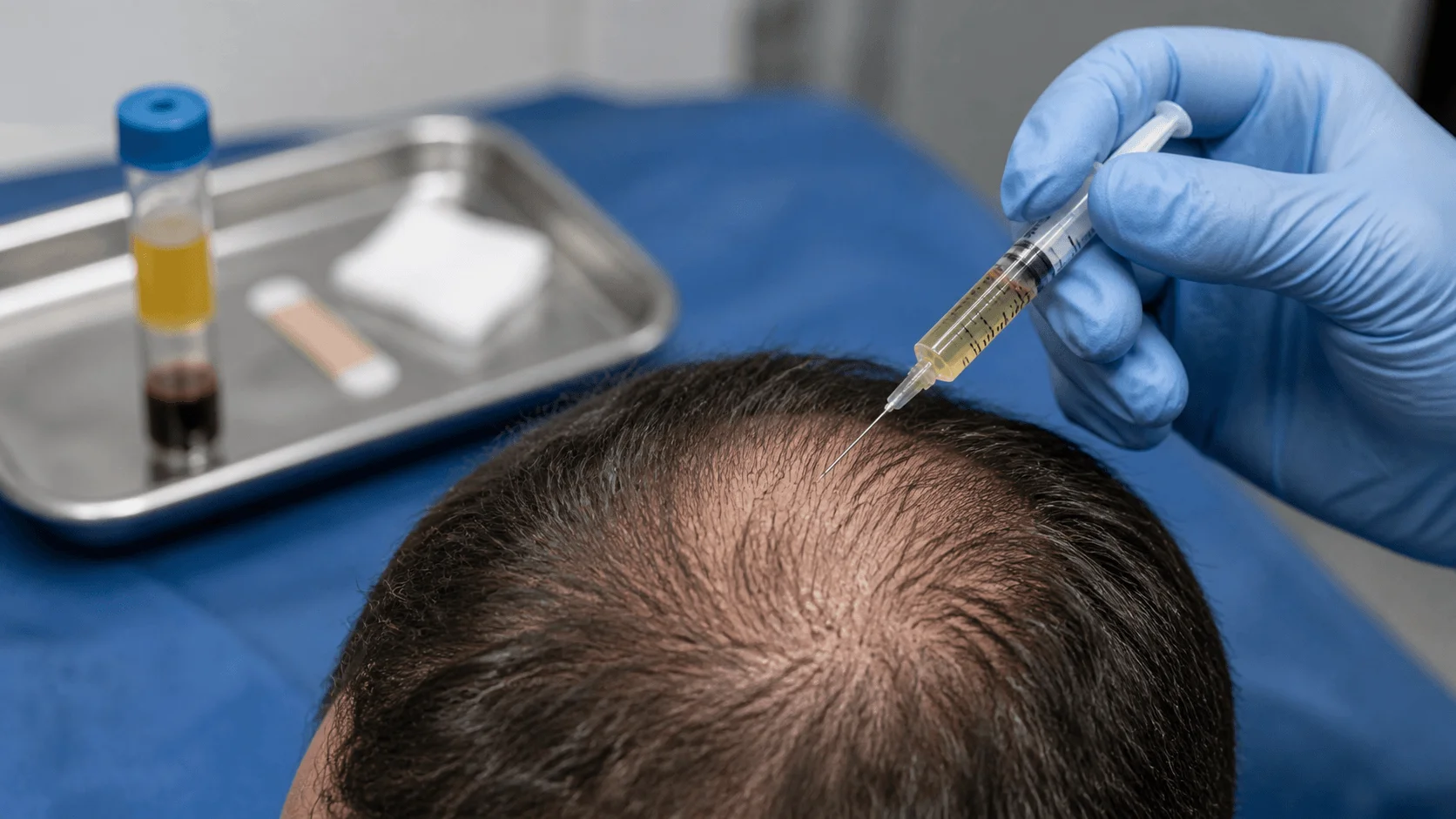
PRP (platelet-rich plasma) therapy for hair loss involves drawing the patient’s own blood, centrifuging it to concentrate platelets and growth factors, and injecting the resulting plasma into the scalp. The evidence is genuinely mixed — Gentile et al. (2015) showed measurable density gains versus placebo; Mapar et al. (2016) showed no significant effect; the Giordano et al. (2018) systematic review pooled the literature and found a small-to-moderate benefit overall. The honest synthesis: PRP probably has a modest positive effect for some patients, the response is unpredictable, and it works best as an adjunct to finasteride and minoxidil, not as a replacement. Typical 2026 protocol: 3 sessions across the first 3 months followed by 6-monthly maintenance; typical cost £700–£1,500 for the initial series in UK private practice.
Table of contents
- What PRP actually is
- The proposed mechanism
- The evidence: Gentile, Mapar, Giordano meta-analysis
- Realistic effect size
- The standard PRP protocol
- Who is and isn’t a good PRP candidate
- PRP vs minoxidil vs finasteride: where it fits
- Side effects and risks
- How BergemHealth approaches PRP
- What to do next
- Frequently asked questions
What PRP actually is
Definition. Platelet-rich plasma (PRP) is a fraction of the patient’s own blood, separated by centrifugation, that contains a higher concentration of platelets than whole blood. The plasma layer carries growth factors (PDGF, VEGF, EGF, IGF-1, TGF-β) released by activated platelets. PRP is autologous (patient-derived) so does not carry the immunological or infectious risks of donor blood products.
The procedure mechanically:
- Blood draw: 10–20 ml of the patient’s blood collected from a vein
- Centrifugation: the blood is spun in a benchtop centrifuge for 5–10 minutes, separating into layers — red blood cells at the bottom, a thin “buffy coat” of white blood cells and platelets in the middle, and clear plasma at the top
- PRP extraction: the plasma layer (with concentrated platelets) is drawn off into a syringe
- Activation (varies by protocol): some protocols add calcium chloride to activate the platelets; others rely on physiological activation post-injection
- Injection: 30–60 micro-injections to the scalp at multiple sites in the affected zones, typically 1–2 cm apart, at intra-dermal and sub-dermal depths
The whole procedure takes 45–60 minutes including the centrifugation wait. Local anaesthesia is sometimes applied to the scalp before injection to reduce discomfort; some clinics use ice pack or vibration distraction instead.
The proposed mechanism
Platelets, when activated, release growth factors that influence the hair follicle cycle. The proposed effects on follicles include:
- Extension of the anagen (growth) phase, similar in result to minoxidil
- Increased follicle stem-cell proliferation
- Enhanced microvasculature around the follicle, supporting blood supply
- Potential anti-inflammatory effects that may protect against follicle miniaturisation
The mechanism is plausible and consistent with platelet biology, but the clinical effect — translation into measurable density gains in real patients — is where the evidence gets variable. A plausible mechanism doesn’t guarantee a clinically meaningful effectstatpearls.
The evidence: Gentile, Mapar, Giordano meta-analysis
The PRP literature illustrates why the evidence is genuinely mixed.
Gentile et al. (2015) — published in Stem Cells Translational Medicine — was a randomised half-head study in male AGA. Each patient received PRP injections on one side of the scalp and placebo (saline) on the other, with three sessions over 90 days. At 6 months: statistically significant improvements on the PRP side — increased follicle density, increased terminal hair density, and increased anagen-to-telogen ratio (roughly 30 follicles/cm² density gain in the PRP zone)gentile.
Mapar MA et al. (2016) — Iranian Journal of Dermatology — was also a randomised half-head study with similar protocol. Result: no statistically significant difference between PRP and placebo at the primary outcome timepointmapar.
Giordano et al. (2018) — systematic review and meta-analysis pooling multiple RCTs of PRP for AGA — concluded that PRP produces a small-to-moderate increase in hair density relative to controls, with significant heterogeneity in protocolprp-meta. The key sources of variability across studies:
- PRP preparation: different centrifugation protocols produce widely varying platelet concentrations (some “PRP” preparations have only modestly elevated platelet counts; others reach 5–7× baseline)
- Activation method: calcium-activated vs physiologically-activated produces different growth-factor release profiles
- Injection volume and pattern: more sessions, more sites per session, and deeper injections all affect outcome
- Patient population: earlier-stage AGA tends to respond better than advanced
- Outcome measurement: trichoscopy density vs photo-grading vs investigator-assessment all give different sensitivity
The honest reading: PRP probably produces a modest positive effect when prepared and injected with adequate technique, but the magnitude is variable and the response in any individual patient is hard to predict. This is different from the finasteride or minoxidil literature, where the effect is more robust and predictablemella-fincochrane-min.
Realistic effect size
At the end of a 3-session PRP series in defensible technique, in a patient with early-to-moderate AGA on continued finasteride and minoxidil:
- Modest density gain in the treated areas — typically a fraction of what finasteride+minoxidil delivers
- No regrowth in zones with no remaining follicles — PRP acts on follicles that are alive but underperforming, not on follicles that have already disappeared
- Effect duration variable — many patients need maintenance sessions every 6 months to sustain
- Subjective improvement reported by many patients, but objective trichoscopy gains are smaller than subjective perception
- Compounding effect with concurrent medical management — PRP plus finasteride plus minoxidil performs better than PRP alone
What PRP is not: a substitute for hair transplant in advanced AGA. The mechanism only acts on existing follicles. A Norwood V patient with substantial bald areas (no remaining follicles) won’t see those areas regrow with PRP. Patients in the moderate-to-advanced AGA range are usually better served by combined medical-management-plus-surgery pathways than by PRP alone.
The standard PRP protocol
The 2026 standard PRP protocol in UK private practice and most international clinics:
Initial series (months 1–3): Session 1 at month 0; Session 2 at month 1 (4 weeks later); Session 3 at month 2 or 3.
Maintenance: Session 4 at month 6; Session 5 at month 12; then every 6–12 months as needed.
Each session: Pre-procedure blood draw, centrifugation, PRP preparation (~20 minutes); local anaesthesia or ice/vibration distraction (~5–10 minutes); 30–60 injections per session at multiple scalp sites (~15–25 minutes); brief observation, then patients drive home and return to normal activity the same day.
Cost in UK private practice:
- Single session: £200–£400
- 3-session initial series: £600–£1,200
- 12-month total cost including maintenance: £900–£1,800
PRP performed at the lowest end of this range is sometimes a quality concern (cheap PRP often means inadequate centrifugation or smaller volumes injected). PRP at the higher end isn’t always associated with better outcomes.
Who is and isn’t a good PRP candidate
Good PRP candidates:
- Early-to-moderate AGA (Norwood II–IV) where most follicles are alive but miniaturising
- Already on or starting finasteride and minoxidil — PRP works best as adjunct
- Realistic about effect size — willing to view PRP as a modest contributor, not primary therapy
- Comfortable with injections and able to commit to multi-session protocol
- No coagulation disorders or anticoagulant medications
Less suitable:
- Advanced AGA (Norwood VI–VII) where most follicles are already lost
- Active scarring alopecia or alopecia areata — different conditions need different management
- Patients on anticoagulants (warfarin, DOACs) — relative contraindication
- Patients with bleeding disorders or platelet dysfunction
- Patients seeking PRP as transplant substitute at moderate-to-advanced stages
PRP vs minoxidil vs finasteride: where it fits
| Intervention | Evidence quality | Typical effect size | Cost | Convenience |
|---|---|---|---|---|
| Finasteride 1mg | Strong RCT meta-analysismella-fin | Stabilisation in 80–90%, modest density gain | Low (£10–£20/month) | Daily tablet |
| Topical minoxidil 5% | Strong RCT supportcochrane-min | Modest density gain | Low (£15–£25/month OTC) | Twice-daily |
| Low-dose oral minoxidil | Growing evidence base | Comparable to topical | Low (£15–£25/month) | Daily tablet |
| PRP | Mixed RCTs; meta-analysis pooled small-to-moderate benefitprp-meta | Modest, variable | High (£700–£1,500/year) | 3–6 clinic visits/year |
| LLLT | Modest evidence | Small | Medium (~£500 device) | 20–30 min/day at home |
Finasteride plus minoxidil is the high-evidence, low-cost foundation. PRP is a higher-cost adjunct with less robust evidence. For a patient asking “where should I start?” — finasteride and minoxidil first; PRP as add-on if more intervention is wanted or the foundation hasn’t produced the desired result. PRP-first or PRP-only is rarely the right pathway for diagnosed AGA.
Side effects and risks
PRP side effects are typically minor:
- Injection site discomfort during the procedure — managed with local anaesthesia or distraction
- Transient redness or mild swelling at injection sites — resolves in 24–48 hours
- Occasional temporary headache — typically mild
- Bruising at injection sites — minor, fades over 3–5 days
- Very rare infection risk — PRP uses patient’s own blood; localised injection-site infection is rare with sterile techniquestatpearls
- Vasovagal reaction during the blood draw in needle-sensitive patients
Significant or lasting side effects are uncommon. The main “risk” patients should weigh isn’t medical — it’s the cost-versus-benefit calculation. PRP is the most expensive line on most patients’ hair-loss treatment budget for the most uncertain effect size.
How BergemHealth approaches PRP
PRP is offered as part of the non-surgical pathway at both 99 Harley Street (London) and Liv Hospital Ulus (Istanbul). The protocol is standardised across the network so that a patient can begin a PRP series in one location and continue in the other if their travel changes:
- Validated centrifugation protocol producing consistent platelet concentration
- Standard initial series of 3 sessions at months 0, 1, and 2–3
- Standard maintenance at month 6, then every 6–12 months
- Standardised injection density and depth across affected zones
- Explicit framing that PRP works best alongside finasteride and minoxidil, not as standalone therapy
UK-side PRP pricing (2026): single session ~£300; 3-session initial series ~£800; 12-month combined series and maintenance ~£1,200. Istanbul-side pricing roughly equivalent at the Turkish cost base when bundled with surgical pathway aftercare.
The consultation conversation includes: (1) what stage of AGA you’re at, (2) whether finasteride and minoxidil are already in place, (3) what realistic effect size to expect, and (4) whether the cost-benefit makes sense for you. Some patients leave the consultation having decided not to pursue PRP, and we consider that an honest outcome.
Dr. Sumeyye Yuksel leads the GMC-registered consulting team at Harley Street where PRP is performed in Londongmc. The Istanbul-side procedure runs under Dr. Hamid Aydın’s surgical teamishrs, who reviews the PRP protocol clinically as part of the procedure-led pathway.
What to do next
For the broader non-surgical framework, see the hair-treatment pillar. For the medical-management foundation that PRP works alongside, see the finasteride article and the minoxidil article. For surgical alternatives at moderate-to-advanced stages, see the hair transplant pillar.
For diagnosis if you’re not yet sure what kind of hair loss you have, the hair loss pillar has the diagnostic decision tree. For androgenetic alopecia specifically, the underlying biology PRP is intervening on.
If you’re considering PRP and want a personalised assessment, request a free assessment from BergemHealth’s London or Istanbul team. The consultation includes a discussion of where you are in the medical-management pathway, whether PRP is appropriate at your stage, and what realistic effect size to expect. CQC-registered facility in London. JCI-accredited hospital in Istanbul. ISHRS-member lead surgeon.
Frequently asked questions
Does PRP actually work for hair?
PRP probably has a modest positive effect for some patients with early-to-moderate AGA, but the RCT evidence is genuinely mixed (Gentile 2015 positivegentile, Mapar 2016 nullmapar; Giordano 2018 meta-analysis reports small-to-moderate pooled benefitprp-meta) and the response is unpredictable. PRP works best as an adjunct to finasteride and minoxidil, not as a replacement. It’s not a substitute for surgery in advanced AGA — the mechanism only acts on follicles that are still alive.
How many PRP sessions do I need?
The standard initial series is 3 sessions across the first 3 months (typically month 0, month 1, month 2 or 3). Maintenance sessions every 6 months thereafter to sustain effect. Some clinics propose 4–6 sessions in the initial series; the evidence base for additional sessions beyond 3 is weaker.
Is PRP painful?
The injections themselves are mildly to moderately uncomfortable — described as a series of small pricks. Local anaesthesia at the injection sites or ice/vibration distraction reduces this substantially. Most patients tolerate sessions without significant difficulty. Mild scalp tenderness for 24–48 hours after a session is common.
How much does PRP cost in the UK?
Single sessions: £200–£400 in UK private practice. 3-session initial series: £600–£1,200. 12-month total including maintenance: £900–£1,800. Significant variation by clinic. Lower-end pricing sometimes reflects abbreviated protocols or smaller injection volumes; higher-end pricing isn’t always associated with better outcomes.
How long do PRP results last?
The effect of an initial 3-session series typically peaks 3–6 months after the third session and gradually declines without maintenance. Most patients on a maintenance schedule (every 6–12 months) sustain the effect. Patients who stop maintenance lose the gain within 12–18 months.
Can PRP regrow hair?
Partially, in zones where follicles still exist but are miniaturising or under-performing — PRP can extend their anagen phase and increase follicle size. PRP cannot restore follicles that have been completely lost (advanced AGA zones with no remaining follicles). The realistic frame is “improving the performance of follicles that are already there” rather than “regrowing hair where none exists”.
What are PRP side effects?
Mild and typically transient: injection-site discomfort during the procedure, transient redness or swelling lasting 24–48 hours, occasional mild headache, rare bruising. Severe side effects are uncommon. PRP is autologous so systemic infection risk is essentially nil; localised injection-site infection is rare with sterile techniquestatpearls.
Can I do PRP and finasteride together?
Yes — and this is the recommended approach in most cases. PRP works best as an adjunct to finasteride (and minoxidil) rather than as standalone therapy. The combination produces additive effects. There are no significant interactions between PRP and either oral medication.
Is PRP better than minoxidil?
Different mechanism, different evidence base, different cost-convenience profile. Topical minoxidil has stronger RCT support, lower cost, and easier adherence; PRP has more variable evidence, higher cost, and requires clinic visits. For most patients, minoxidil is the more cost-effective starting point, with PRP as add-on if more intervention is wanted. PRP doesn’t replace minoxidil; it complements it.
Sources
- StatPearls — Platelet-Rich Plasma. National Center for Biotechnology Information. https://www.ncbi.nlm.nih.gov/books/NBK507773/ ↩
- Gentile P et al. “PRP for androgenetic alopecia: randomised controlled trial.” Stem Cells Transl Med. 2015. DOI: 10.5966/sctm.2015-0107 ↩
- Mapar MA et al. “Efficacy of platelet-rich plasma for hair regrowth: a placebo-controlled study.” Iran J Dermatol. 2016. ↩
- Giordano S, Romeo M, Lankinen P. “Platelet-rich plasma for androgenetic alopecia: a systematic review and meta-analysis.” Plast Reconstr Surg Glob Open / Dermatol Surg. 2018. https://pubmed.ncbi.nlm.nih.gov/29649029/ ↩
- Mella JM, Perret MC, Manzotti M, et al. “Efficacy and safety of finasteride therapy for androgenetic alopecia: a systematic review.” Arch Dermatol. 2010;146(10):1141-1150. DOI: 10.1001/archdermatol.2010.256 ↩
- Gupta AK, Charrette A. “Topical minoxidil for androgenetic alopecia.” Cochrane Database Syst Rev. DOI: 10.1002/14651858.CD007628 ↩
- International Society of Hair Restoration Surgery — Member directory. https://www.ishrs.org/ ↩
- General Medical Council — The Medical Register. https://www.gmc-uk.org/registration-and-licensing/the-medical-register ↩
BergemHealth bu konuya nasıl yaklaşıyor
Operasyonlar JCI akreditasyonlu Liv Hospital Ulus, İstanbul’da Dr. Hamid Aydın ve bölüm cerrahi ekibi tarafından yapılır. Birleşik Krallık konsültasyonu ve 12 aylık takip CQC denetimli Harley Street ofisimizde. Şeffaf fiyatlandırma ve gerektiğinde ücretsiz touch-up.
Ücretsiz konsültasyon →