Topical vs Oral Minoxidil: A Clinician’s 2026 Comparison
Topical vs oral minoxidil compared: doses, evidence base (Sinclair protocol, Vañó-Galván), side-effects, who should choose which.
Medical disclaimer. This article is educational and not medical advice. Oral minoxidil is a prescription medication. Decisions about starting, switching, or stopping should be made with a clinician.
Quick answer
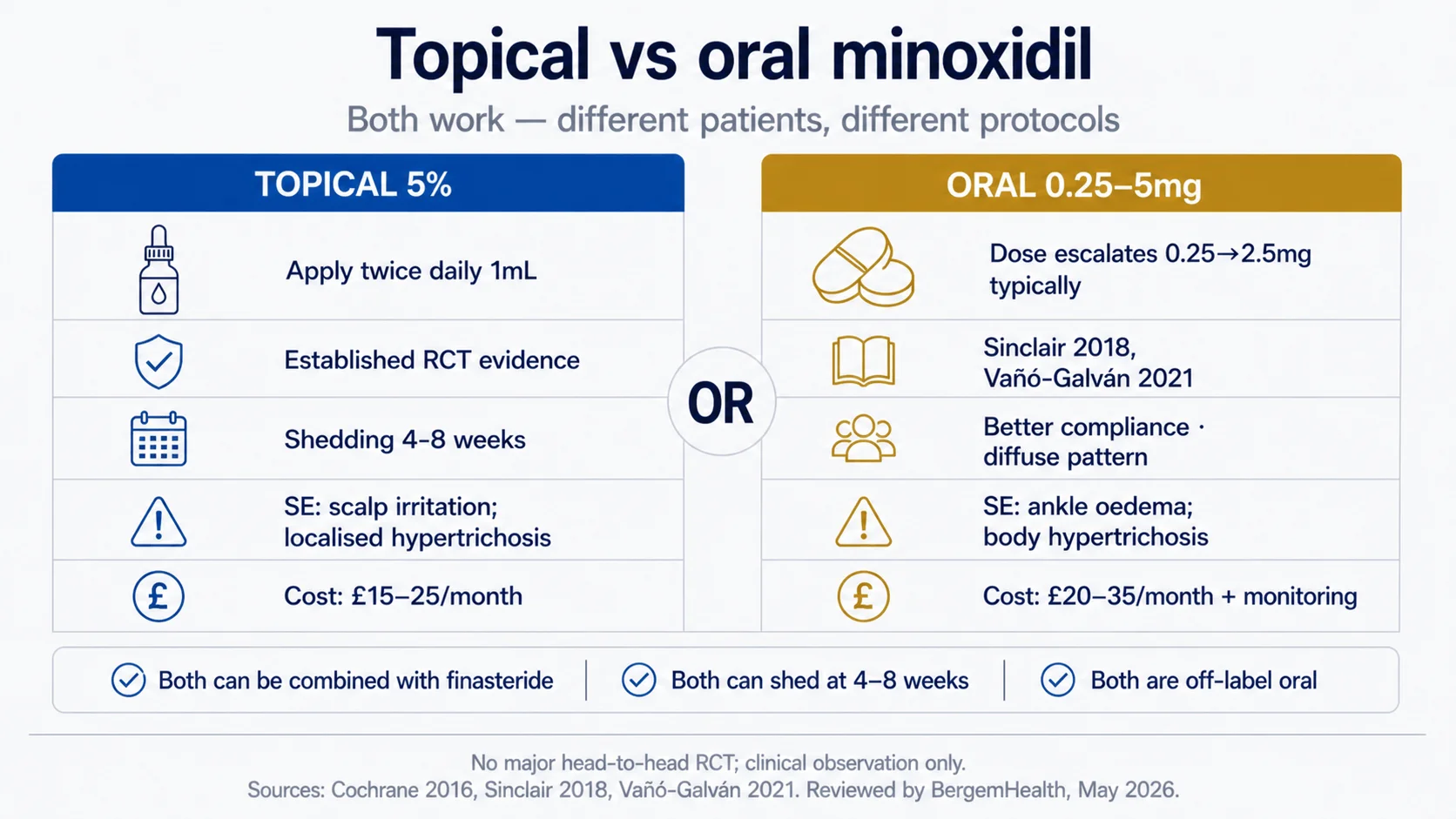
Minoxidil for hair loss now exists in two practical forms in 2026: topical 5% solution or foam (over-the-counter, twice daily, established Cochrane-level evidence) and low-dose oral minoxidil at 0.25–5mg daily (prescription-only, growing dermatology evidence base from Sinclair, Vañó-Galván, and others). Both work via mechanisms that extend the anagen growth phase. Topical is the standard starting point — accessible, well-evidenced, side-effects mostly limited to scalp irritation. Oral is an increasingly mainstream alternative with better compliance, no scalp dryness, and modest hypertrichosis (extra body hair) as the main consideration.
Table of contents
- What minoxidil is and how it works
- Topical minoxidil — the established standard
- Oral minoxidil — the growing-evidence alternative
- Direct comparison
- Who should choose topical
- Who should choose oral
- The shedding phase (both forms)
- Side effects and monitoring
- How BergemHealth approaches minoxidil prescribing
- What to do next
- Frequently asked questions
What minoxidil is and how it works
Definition. Minoxidil is a small-molecule drug originally developed in the 1970s as an oral antihypertensive. Its hair-growth effect was discovered as a side-effect in patients taking it for high blood pressure — they grew extra body and scalp hair. The drug was subsequently developed in topical formulation specifically for hair loss (FDA approval 1988 for 2%, 1997 for 5%).
The proposed mechanisms:
- Potassium channel opening in dermal papilla cells around the hair follicle, increasing local blood flow
- Extension of the anagen (growth) phase of affected follicles
- Possible direct effect on follicle stem cells via prostaglandin pathway modulation
- No effect on DHT or androgen pathways — different mechanism from finasteridecochrane-min
Both topical and oral forms work via the same fundamental mechanisms. The main difference is route of delivery and resulting systemic exposure: topical produces high local concentration with low systemic levels; oral produces lower-but-systemic concentration that reaches all follicles equally.
Topical minoxidil — the established standard
Topical minoxidil is available over-the-counter in the UK as 5% solution or foam (brand names include Rogaine internationally and Regaine in the UK). Application is twice daily to the affected scalp areas; 1ml per application typically.
The evidence: Cochrane-level systematic review supports modest-to-meaningful density gains in both men and women with AGA over 6–12 months of consistent usecochrane-min. The pivotal studies showed:
- Density gain in roughly 60% of treated men at 12 months
- Effect size modest — typically 7–15% increase in hair count
- Most pronounced at vertex (crown), smaller effect at frontal hairline
- Sustained effect with continued use; gain lost within 3–6 months of stopping
Practical use:
- 2% solution sometimes used for women to reduce hypertrichosis risk; 5% is standard for men
- Foam formulation preferred by some patients (less greasy, faster drying, less alcohol-based irritation)
- Twice-daily application is critical to efficacy; once-daily produces meaningfully smaller effect
- Apply to dry scalp, work into affected areas, avoid washing out for at least 4 hours
- Cost: generic 5% solution available in UK pharmacies for £15–£30 per month
Common practical issues: greasy or sticky scalp (foam reduces this); initial irritation, redness, or dryness in roughly 5–10% of users (often resolves with continued use or switch to foam); twice-daily compliance is the single biggest variable affecting whether topical works for any individual; some patients find it incompatible with morning hair-styling routines.
For most patients with diagnosed AGA who can manage twice-daily application without significant scalp irritation, topical minoxidil is the appropriate starting point.
Oral minoxidil — the growing-evidence alternative
Low-dose oral minoxidil (0.25–5mg daily, depending on indication and patient) has emerged as a standard of care in specialist dermatology centres since the late 2010s. The dose is well below those used for hypertension treatment (10–40mg daily), where cardiovascular side-effects become significant.
The evidence base:
- Sinclair RD (2018) — pilot study in female pattern hair loss demonstrating effect of low-dose oral minoxidilsinclair
- Vañó-Galván S et al. (2021) — multicentre safety study of 1,404 patients receiving low-dose oral minoxidil (0.25–5mg daily) for various hair loss indications, with manageable side-effect profile across the cohortvano
- Subsequent dermatology literature from Australia, Spain, and increasingly the UK supporting oral minoxidil as a routine alternative or adjunct to topical
- No major RCT comparing oral to topical head-to-head — practical comparison comes from clinical experience and observational data
Typical dosing protocol (Sinclair-style):
- Start dose: 0.25–1mg daily for 1–2 weeks; assess tolerability
- Standard dose: 1.25–2.5mg daily for most patients
- Higher doses (5mg) reserved for cases not responding to standard dose, with closer cardiovascular monitoring
- Once-daily administration simplifies compliance vs twice-daily topical
- Long-term continuous use, similar to topical
Practical advantages: once-daily compliance vs twice-daily topical; no scalp residue or styling interference; suitable for patients with topical irritation; reaches all follicles uniformly; often combined with finasteride for additive effects.
Practical disadvantages: prescription-only in the UK (and most jurisdictions); hypertrichosis (increased body hair, mostly cheeks and forearms) is the most common visible side-effect — modest in most patients but can be more noticeable in women; rare cardiovascular effects at 1mg+ doses warrant baseline blood pressure monitoring; cost typically £15–£40 per month.
Direct comparison
| Variable | Topical 5% | Oral 0.25–5mg |
|---|---|---|
| Evidence quality | Cochrane-level RCT supportcochrane-min | Growing dermatology evidence base, no major RCTsinclairvano |
| Application | Twice daily, applied to scalp | Once daily, oral tablet |
| Cost (UK) | £15–£30/month OTC | £15–£40/month prescription |
| Compliance | Variable; twice-daily is the challenge | Easier; once-daily oral |
| Irritation/scalp issues | 5–10% of users | Not applicable |
| Hypertrichosis (extra body hair) | Minimal (low systemic) | Mild-to-moderate in most users |
| Cardiovascular monitoring | Not needed | Baseline BP; periodic check-ins |
| Hairline targeting | Local high concentration | Uniform follicle coverage |
| Who can prescribe | OTC | UK GP or private dermatology |
The decision between topical and oral isn’t either-or — many patients start with topical and switch to oral if they don’t tolerate topical or don’t get adequate compliance, or vice versa.
Who should choose topical
Topical minoxidil is appropriate for:
- First-line patients with diagnosed AGA without contraindications
- Patients comfortable with twice-daily application as part of routine
- Patients without significant scalp irritation history
- Cost-sensitive patients preferring OTC purchase without prescription appointment
- Patients with localised AGA pattern (e.g., specifically vertex thinning) where local concentration is useful
- Female pattern hair loss as first-line non-prescription option
Topical is the standard starting point because the evidence is more robust, the cost is lower, and the side-effect profile is essentially limited to local scalp issues. For many patients, topical produces adequate response and the oral conversation never becomes necessary.
Who should choose oral
Oral minoxidil is appropriate for:
- Topical-intolerant patients (irritation, dryness, greasiness)
- Patients with poor compliance on topical — once-daily oral typically achieves better adherence
- Patients who want simpler integration with morning routine (no scalp residue or styling interference)
- Diffuse AGA pattern rather than localised — uniform follicle coverage is helpful
- Female pattern hair loss when topical is inadequate or not tolerated
- Patients on concurrent finasteride seeking additive effect via different mechanism
Oral is appropriate as starting point in some clinical contexts (particularly in specialist dermatology), though the more typical pathway is topical first, oral as alternative. Patient preference and clinical judgment combine to determine which is right.
The shedding phase (both forms)
A practical detail patients should know: minoxidil starts often produce a temporary increase in shedding during the first 8–12 weeks of use. This is sometimes called the “minoxidil shedding phase” and reflects synchronisation of follicles into a new cycle.
The mechanism: minoxidil pushes follicles in telogen (resting) into anagen (growth). As they enter anagen, the existing telogen-phase shafts are released. This looks like increased shedding for 4–8 weeks, then resolves as new growth begins.
What to expect: onset typically weeks 2–8; duration 4–8 weeks of increased shedding; resolution by week 12; visible density improvement at 4–6 months.
Patients who stop minoxidil during the shedding phase tend to attribute the shedding to the drug “not working” and lose the chance for the subsequent benefit. Continuing through the shedding phase is the right move in nearly all cases. The shedding phase is more common with topical (sudden local concentration change) than with oral (more gradual uptake), but both can produce it.
Side effects and monitoring
Topical — scalp irritation, redness, or itching in 5–10% of users (often resolves with foam formulation); greasy/sticky residue (cosmetic); rare mild headache; rare allergic contact dermatitis warranting discontinuation; minimal systemic absorption with cardiovascular effects extremely rare; hypertrichosis rare with topical at standard doses.
Oral at low doses (0.25–5mg):
- Hypertrichosis: most common; mild-to-moderate facial and forearm hair in most users; addressable with hair-removal methods if desired
- Ankle swelling/oedema: occasional, usually mild
- Cardiovascular effects: rare at 1–5mg doses but warrant baseline BP and periodic check-in; tachycardia has been reported
- Headache: occasional, mild
- Pericardial effusion: very rare; reported in high-dose hypertension use, much less likely at hair-loss doses
- No effect on testosterone or hormonal pathways (unlike finasteride)
The Vañó-Galván safety study of 1,404 patients found low-dose oral minoxidil to be generally well-tolerated, with hypertrichosis as the dominant side-effect and serious cardiovascular events being rarevano. Standard monitoring during oral minoxidil: baseline BP before starting; follow-up BP check at 4–6 weeks; follow-up at 3 months for any side-effect emergence; routine reviews thereafter every 6–12 months.
How BergemHealth approaches minoxidil prescribing
Topical: most patients with diagnosed AGA without contraindications are advised to start with topical 5%. The drug is OTC so no prescription is needed, but our consultation includes practical guidance — application technique, what to expect during the shedding phase, when to assess response.
Oral: prescribed via the GMC-registered consulting team at 99 Harley Street, Londongmc for patients who haven’t tolerated topical, have compliance issues with twice-daily application, or are seeking the once-daily oral option as starting point with informed consent on the side-effect profile. Standard starting dose: 1mg daily, with assessment at 4 weeks, adjustment based on response and tolerance. Combined with finasteride where appropriate.
For patients on the surgical pathway, continuing minoxidil (topical or oral) post-transplant to protect native hair is the standard recommendation. Dr. Hamid Aydın’s surgical team at Liv Hospital Ulus, Istanbulishrs coordinates with the medical management team to ensure consistency of approach across the BergemHealth two-clinic network.
What to do next
For the broader non-surgical framework, see the hair-treatment pillar. For the complementary medication often used alongside minoxidil, see the finasteride article. For PRP as a separate adjunct.
For diagnosis if you’re not sure what kind of hair loss you have, the hair loss pillar. For androgenetic alopecia specifically — the condition minoxidil is treating. For younger patients trying to figure out whether early changes warrant active treatment, the early-signs guide.
If you’re considering oral minoxidil specifically and want a personalised assessment with appropriate monitoring, request a free assessment from BergemHealth’s London team. The consultation includes the clinical history, AGA confirmation, baseline blood pressure, side-effect discussion, and written prescription pathway under GMC-registered supervision. Topical 5% is OTC and doesn’t require prescription, but we’re happy to advise on optimal use as part of any consultation. CQC-registered facility in London. JCI-accredited hospital in Istanbul. ISHRS-member lead surgeon.
Frequently asked questions
Is oral minoxidil better than topical?
Different rather than better. Topical has stronger RCT evidence and is OTC; oral has growing dermatology evidence and easier compliance. Oral typically produces better adherence (once-daily vs twice-daily) and avoids scalp issues. Topical produces less hypertrichosis. The right choice depends on patient preference, tolerance, and clinical context. Many patients do well on either; some need to switch to find the right fit.
What dose of oral minoxidil for hair loss?
Typical 2026 protocol: start at 0.25–1mg daily, increasing to 1.25–2.5mg daily as standard. Higher doses (up to 5mg) reserved for non-responders with closer cardiovascular monitoring. The dose is well below the 10–40mg used for hypertension treatment, where cardiovascular side-effects become significantsinclairvano.
Is oral minoxidil safe?
At low doses (0.25–5mg daily) for hair loss, the safety profile is generally favourable per the Vañó-Galván safety study of 1,404 patientsvano. Hypertrichosis is the dominant side-effect; cardiovascular effects are rare at these doses. Baseline BP and periodic monitoring are appropriate. The drug isn’t risk-free, but the risk profile at hair-loss doses is acceptable for most patients without cardiovascular contraindications.
Can I switch from topical to oral minoxidil?
Yes. Many patients switch when topical isn’t tolerated or compliance is poor. The typical approach: stop topical, start oral at 0.25–1mg, assess at 4 weeks, adjust as needed. There is no required wash-out period — the systemic minoxidil exposure is much higher with oral than with topical even at low oral doses, so the transition is straightforward.
What is the minoxidil shedding phase?
A temporary increase in shedding during the first 8–12 weeks of starting minoxidil, caused by follicles being pushed from telogen (resting) into anagen (growth) phase. The existing telogen-phase shafts release as new growth begins. Resolution by week 12 in most patients. Continuing through the shedding phase is the right move in nearly all cases — stopping means losing the subsequent benefit.
How long does minoxidil take to work?
Initial shedding phase weeks 2–10 (often misinterpreted as “not working”). Stabilisation by week 12. Visible density gains at 4–6 months. Standard assessment point at 12 months. Effect plateau around 12–18 months. Both topical and oral follow similar time courses.
What are minoxidil side effects long term?
Topical: persistent scalp dryness or irritation in some users; hypertrichosis is rare with topical at standard doses. Oral: continued hypertrichosis (manageable with hair-removal methods), occasional ankle swelling, rare cardiovascular effects warranting periodic monitoring. Stopping minoxidil reverses both the hair-growth effect and the side-effects within monthsvano.
Can I stop minoxidil safely?
Yes — generally fine to stop without taper. The consequence: the hair-growth effect is lost within 3–6 months, with shedding of any minoxidil-stimulated growth and return to AGA baseline. Hypertrichosis from oral resolves over similar timeline. Patients who stop after 12 months of use typically lose much of the gain.
Rogaine vs Regaine — what’s the difference?
The same drug — minoxidil — under different brand names in different markets. Rogaine is the US brand; Regaine is the UK and European brand. Generic 5% topical minoxidil produced under various pharmacy own-labels has the same active ingredient and is generally equivalent.
Can I take oral minoxidil with finasteride?
Yes — and this is a common combination. Different mechanisms: finasteride reduces DHT; minoxidil extends anagen. Combined effects are additive. Both drugs are typically prescribed by the same clinician with appropriate monitoring of each. No significant pharmacological interaction.
Sources
- Gupta AK, Charrette A. “Topical minoxidil for androgenetic alopecia.” Cochrane Database Syst Rev. DOI: 10.1002/14651858.CD007628 ↩
- Sinclair RD. “Female pattern hair loss: a pilot study investigating combination therapy with low-dose oral minoxidil.” Int J Dermatol. 2018. DOI: 10.1111/ijd.13838 ↩
- Vañó-Galván S et al. “Safety of low-dose oral minoxidil for hair loss: a multicentre study of 1,404 patients.” J Am Acad Dermatol. 2021. DOI: 10.1016/j.jaad.2020.06.1023 ↩
- NICE Clinical Knowledge Summary — Male pattern baldness. https://cks.nice.org.uk/topics/male-pattern-baldness/ ↩
- International Society of Hair Restoration Surgery — Member directory. https://www.ishrs.org/ ↩
- General Medical Council — The Medical Register. https://www.gmc-uk.org/registration-and-licensing/the-medical-register ↩
How BergemHealth approaches this
Procedures are performed at JCI-accredited Liv Hospital Ulus, Istanbul, by Dr. Hamid Aydın and the resident surgical team. UK consultation and 12-month aftercare at our CQC-regulated Harley Street office. Transparent pricing and a free touch-up if indicated.
Free consultation →