Surgeon Credentials and Patient Safety in Hair Transplant (2026)
How to verify a hair-transplant surgeon's credentials in 2026 — ISHRS, GMC, CQC, JCI; ethics of patient selection; complications; what to ask before booking.
Medically reviewed by BergemHealth, with Dr. Sumeyye Yuksel, GMC. Published 4 May 2026 · Last reviewed 4 May 2026.
Medical disclaimer. This article is educational and not medical advice. Hair restoration outcomes are individual; only a qualified surgeon can assess your case in a personal consultation.
Quick answer
Patient safety in hair transplant rests on three verifiable layers: the surgeon (publicly registered with ISHRS, GMC, or both — checkable in 30 seconds), the facility (JCI accreditation for international hospitals, CQC registration for UK clinics), and the operator-of-record discipline (the named surgeon performs the operative work personally, not via supervising technicians). A claim that doesn’t appear in the relevant public register has told you something. This pillar covers each layer, the lookup process, the ethics of patient selection, anaesthesia safety, complication rates, and how the two-clinic model BergemHealth operates clears each layer transparently.
Table of contents
- Why surgeon credentials matter more than the building
- The verifiable-vs-marketing test
- ISHRS membership — what it actually requires
- GMC registration — what it confirms
- JCI and CQC — the facility layer
- The operator-of-record question
- Public register lookups: 30-second checks
- Anaesthesia in hair transplant
- Complications and how good clinics minimise them
- Ethics of patient selection
- The two-clinic model at BergemHealth
- What to do next
- Frequently asked questions
Why surgeon credentials matter more than the building
Definition. A credentialed surgeon is a doctor whose qualifications, registration, and specialty competence are verifiable in a public register maintained by a third-party regulator or professional body. The credential is the verifiable record — not what the clinic’s marketing material says about the surgeon.
The marketing-vs-reality gap is wider in hair restoration than in most surgical specialties. The field has had less regulatory scrutiny than mainstream cosmetic surgery, the market has scaled faster internationally than domestic jurisdictions can match, and the patient is typically researching online without a referring GP doing credential due-diligence by default.
The fix is straightforward: don’t take credentials on a clinic’s word — check them in the relevant public register before booking. Each main register (ISHRS member directory, GMC Medical Register, JCI accredited organisations, CQC provider register) is publicly searchable and free, and each lookup takes 30 seconds. This article walks through how to verify each layer, what the verification tells you, and what gaps remain even after credentials check outishrsgmcjcicqcnhs.
The verifiable-vs-marketing test
A useful diagnostic frame: every claim a clinic makes about a surgeon’s qualifications falls into one of two categories — verifiable (cross-checkable in a public register) or marketing (a claim that depends on the clinic’s own representation).
Verifiable claims:
- “Dr. X is GMC-registered” → search gmc-uk.org
- “Dr. X is an ISHRS member” → search ishrs.org member directory
- “The hospital is JCI-accredited” → search jointcommissioninternational.orgjci
- “The clinic is CQC-registered” → search cqc.org.ukcqc
- “Dr. X completed surgery training at [hospital] in [year]” → checkable via the relevant medical school or college registry
Marketing claims — often impressive-sounding but not in any register:
- “Award-winning surgeon”
- “Internationally recognised expert”
- “10,000+ procedures performed”
- “Featured in [publication]”
- “Member of [association you’ve never heard of]”
- “Trained by world-renowned [name]”
Marketing claims aren’t necessarily false — many accomplished surgeons have legitimate accolades. But they’re not the verification on which a surgical decision should rest. The verifiable layer is what holds up under scrutiny. A defensible clinic publishes both: verifiable credentials prominently with their public-register reference numbers (GMC ID, ISHRS member entry, JCI certificate number, CQC location ID), and marketing claims separately as flavour. A clinic that publishes only the marketing layer has chosen a marketing-prominent presentation — that’s information about how they want the patient’s attention to be directed.
ISHRS membership — what it actually requires
The International Society of Hair Restoration Surgery is the closest international professional standard for hair-restoration surgeons. Membership requirements include a verified medical qualification from an accredited institution, a minimum number of hair-restoration cases performed (varies by category, intended to filter for meaningful hands-on experience), annual continuing-education credits, adherence to the ISHRS code of ethics (transparent advertising, honest patient communication, surgeon-of-record discipline), and a public, searchable member directory listingishrsishrs-ethics.
ISHRS membership doesn’t guarantee outcome quality for any individual case, and plenty of competent surgeons aren’t members. But it does establish a verifiable floor of qualifications and ethical commitment that the patient can independently confirm. For a hair-transplant surgeon, ISHRS membership plus the relevant national medical registration is the standard verifiable pair in 2026.
A non-ISHRS-member surgeon isn’t automatically disqualifying. It shifts the burden of proof onto the clinic to show what other third-party verification exists — equivalent national specialty board certification, university affiliation, or peer-reviewed publication. A surgeon with neither ISHRS membership nor a comparable third-party credential is operating outside the standard framework, and the patient is being asked to trust the clinic’s self-representation.
GMC registration — what it confirms
For UK-based surgeons (and surgeons treating UK patients in UK facilities), the General Medical Council maintains the public Medical Register — the list of every doctor licensed to practise medicine in the UK. Registration is required by the Medical Act 1983; practising in the UK without GMC registration is a criminal offence, not a regulatory irregularitygmc.
What GMC registration confirms:
- The named individual is legally entitled to practise medicine in the UK.
- Their primary medical qualification has been verified by the GMC.
- They are in or have completed the revalidation cycle — a five-year process of appraisals demonstrating continuing competence.
- Any restrictions, undertakings, or conditions on their practice are publicly visible on the register entry.
- Specialty registration where the doctor has completed UK specialty training (some hair-transplant surgeons trained as dermatologists or plastic surgeons; hair-restoration is not a standalone UK specialty).
What GMC doesn’t confirm: specific competence in hair restoration (no UK sub-specialty exam exists), volume of cases performed, quality of outcomes, or anything about the facility (that is CQC’s remit). The combination of GMC plus ISHRS therefore covers two different gaps — legal entitlement to practise plus specialty experience — and is the standard verifiable pair for UK-based hair-transplant practice.
For Istanbul-based surgeons treating UK patients in non-UK facilities, GMC registration is not applicable — the relevant equivalent is the surgeon’s national medical registration (Türkiye Tabipler Birliği for Turkish doctors) plus ISHRS.
JCI and CQC — the facility layer
Surgeon credentials answer the “who” question; facility accreditation answers the “where”. Both matter, and they are not interchangeable. A short summary, with a deeper explainer in JCI vs CQC vs GMC:
- JCI (Joint Commission International) accredits hospitals against international quality-system standards covering patient identification, surgical safety, infection control, medication management, and emergency response. Inspected every three yearsjci.
- CQC (Care Quality Commission) registers UK clinics for compliance with the Fundamental Standards. Inspections at varying intervals; inspection reports are publicly searchable, including the rating (“Outstanding”, “Good”, “Requires improvement”, “Inadequate”)cqc.
Both are necessary-but-not-sufficient for patient safety. A JCI-accredited hospital can host a hair-transplant department running technician-led models without losing accreditation, because daily-load and operating-model questions aren’t part of JCI’s inspection scope. A CQC-registered UK clinic can have similar operational concerns. The facility credential doesn’t substitute for the surgeon credential or the operator-of-record discipline.
The right combination for a patient: facility-level credential (JCI or CQC) plus surgeon-level credential (GMC and/or ISHRS) plus operator-of-record commitment in writing.
The operator-of-record question
Definition. Operator-of-record refers to the named surgeon who performs the operative work — extraction, channel-opening, implantation — personally, rather than supervising technicians who perform that work. The patient’s booking documentation should name the operator-of-record, and the same name should appear on the operative report afterwards.
This is the single highest-information question a patient can ask. Even a clinic that clears every credential check (JCI hospital, ISHRS surgeon, CQC clinic) can still operate a high-volume technician-led model that delivers different quality of care than surgeon-led practice.
The 2024 ISHRS practice census flagged surgeon-supervised, technician-extracted hair transplantation as a growing share of the global market, particularly in unregulated medical-tourism segmentsishrs. ISHRS commentary, alongside parallel BAAPS concerns in the UK, has consistently been that the technician-led model does not violate hospital-level accreditation standards but produces outcome variance that surgeon-led practice does notbaapsgarg.
The operator-of-record question gets at this directly. Phrased in writing:
“On the day of my surgery, what percentage of the procedure (extraction, channel-opening, implantation) will be performed personally by Dr. [name], and what percentage by technicians?”
A defensible answer is specific (e.g. “Dr. X performs 100% of extraction and 100% of channel-opening; technicians assist with graft sorting and implantation under direct surgeon supervision”). A non-defensible answer is vague (“Dr. X supervises the entire procedure”). Detailed in the red-flags article.
The arithmetic: a single surgeon performing personal extraction and channel-opening is realistically capable of two to four patients per day (manual FUE extraction takes three to four hours per case for 2,500–3,500 grafts; channel-opening adds two to three hours)sharma. A clinic running 10+ patients per day per “named surgeon” is, by arithmetic, supervising rather than operating. This isn’t ambiguous — it’s mathematics.
Public register lookups: 30-second checks
Each lookup is free and takes about 30 seconds.
GMC registration. Go to gmc-uk.org → The Medical Register. Search by name or GMC reference number. Read licence status (must be “Currently licensed to practise”), specialty registration, and the restrictions/conditions section. If the doctor doesn’t appear, they’re not GMC-registered; if they’re advertising in the UK, that’s a problemgmc.
ISHRS membership. Go to ishrs.org → “Find a Doctor”. Search by name or country. Read membership category, country, affiliated practice. If the surgeon doesn’t appear, they’re not an ISHRS member — press the clinic for what alternative third-party credential existsishrs.
JCI accreditation. Go to jointcommissioninternational.org → accredited-organizations directory. Search by hospital name or country. Read accreditation status (must be “currently accredited”), expiry date, and accreditation typejci. Liv Hospital’s own certificate page is also publicly listedliv-jci.
CQC registration. Go to cqc.org.uk → search providers. Search by clinic name or postcode. Read registration status, current rating, date of last inspection, and the full inspection reportcqc. If the clinic doesn’t appear and is performing surgery in England, that’s a legal issue.
These lookups are deliberately public — they exist to allow exactly this kind of patient verification. Skipping them leaves the most informative due-diligence undone.
Anaesthesia in hair transplant
Hair transplant in 2026 is performed almost universally under local anaesthesia, sometimes with mild sedation for comfort. General anaesthesia is rarely indicated and adds risk disproportionate to benefit for an elective scalp procedurestatpearls.
The anaesthesia layer:
- Local anaesthesia — lidocaine or bupivacaine injected at donor and recipient sites; numbness sets in within two to three minutes; lasts four to six hours with re-injection during longer cases.
- Adrenaline-supplemented local — epinephrine added to constrict blood vessels, reducing bleeding and extending duration; standard in most contemporary practice.
- Mild oral sedation (e.g. low-dose benzodiazepine) — used in some clinics for anxiety; not pharmacologically necessary.
- Conscious patient throughout — awake, communicative, takes breaks and eats lunch.
- No general anaesthesia in standard cases — GA brings airway management and recovery requirements not justified for elective scalp surgery.
Anaesthesia complications under local anaesthesia are uncommon. The published literature reports systemic toxicity in well under 0.1% of cases when proper dosing protocols are followedgarg. The more common patient-side concern is the discomfort of the initial injection — two to three minutes, and the most uncomfortable part of the day.
Patient factors warranting attention before anaesthesia: allergy history (rare but documented), cardiac conditions (relative caution with adrenaline; usually still feasible), concurrent medications interacting with local anaesthetics (some antiarrhythmics), and anxiety levels (pre-medication can be appropriate). A defensible pre-op consultation reviews these factors and documents the plan in writing. A clinic that performs surgery without a recorded anaesthesia review has skipped a step that matters.
Complications and how good clinics minimise them
The published complication-rate literature for hair transplant under local anaesthesia in regulated facilities reports rates well under 1% for serious adverse eventsgarg. The most common complications, in approximate order of frequency:
| Complication | Frequency | Typical management |
|---|---|---|
| Folliculitis (small infected follicles) | ~1–2% | Topical or oral antibiotics; usually resolves within 1–2 weeks |
| Temporary numbness in donor area | ~5–10% (transient) | Self-resolves over weeks to months |
| Donor area scarring (visible) | <1% in defensible technique | Difficult to correct; prevention via meticulous extraction |
| Recipient area cyst formation | <1% | Drainage if needed; resolves |
| Hypertrophic scarring | <1% in scalp surgery | Topical or intralesional steroids |
| Native hair shock loss | Up to 20% (transient) | Self-resolves over 3–6 months in most cases |
| Poor graft survival in specific zones | Variable | Touch-up procedure if below agreed threshold |
| Systemic anaesthetic reaction | <0.1% | Standard medical management; almost always preventable with proper dosing |
| Bleeding requiring intervention | <0.5% | Pressure, suturing if needed |
| Significant infection (cellulitis or beyond) | <0.5% | IV antibiotics; rarely requires hospitalisation in regulated settings |
How good clinics minimise complications: surgeon-led extraction and channel-opening (to reduce variance in graft transection and donor-area scarring), meticulous sterile technique, standardised anaesthesia protocols with documented dosing limits, pre-op blood work to identify additional-caution factors (clotting disorders, anaemia), patient aftercare education (see the recovery and aftercare pillar), a structured month-1 review to catch emerging issues early, and a defensible touch-up policy for graft-survival outliers. Most of these are systematic process variables rather than dramatic interventions — the discipline that produces low complication rates is operational rigour, not exotic technique.
Ethics of patient selection
Most patient-safety conversations focus on what happens during surgery. An equally important — and more often overlooked — layer is who a clinic is willing to operate on in the first place. A defensible practice declines unsuitable candidates as a matter of routine; the ISHRS code of ethics treats this as professional conduct rather than a commercial choiceishrs-ethicsgarg.
Candidate gatekeeping. Several presentations are widely recognised as poor candidates regardless of how much the patient wants to proceed: Norwood VII with thin donor (the donor cannot supply the density the recipient needs; operating produces a see-through transplant and depletes the donor without solving the cosmetic problem); active, progressive androgenetic alopecia in young patients (operating before the loss pattern stabilises risks orphan transplanted islands that look unnatural as native hair recedes); recent-onset diffuse loss without diagnosis (medical workup comes first — see the hair-treatment pillar); and fertility-planning concerns affecting medical adjuncts the long-term plan depends on (the conversation needs to happen pre-operatively, not afterwards).
Body Dysmorphic Disorder (BDD) screening. BAAPS and ISHRS guidance flags BDD as a relative contraindication to elective cosmetic surgery: a patient whose distress is driven by a perceptual disorder will not be relieved by a transplant, and the surgery can deepen the distressbaapsishrs-ethics. A defensible clinic uses a BDDQ-style short-form at consultation and routes a positive screen to psychological assessment before any surgical decision.
Age-21 minimum. The ISHRS position is that elective hair-restoration surgery is generally inappropriate below age 21: the loss pattern has not stabilised, donor capacity is still a finite future resource, and a hairline drawn on a 19-year-old will look wrong on the same person at 35ishrs-ethics.
Hairline conservatism. Don’t draw a teenage line on a 30-year-old, and don’t draw a 30-year-old line on a 50-year-old. The hairline placed should respect the patient’s age, long-term loss trajectory, and donor-area economics — not the most aspirational reference photo.
Donor-area economics. Hair-restoration surgery is fundamentally a finite-resource problem. Over-extraction in a first procedure forecloses options for a second procedure 10–15 years later. A defensible clinic models lifetime donor capacity and reserves enough for future needsharma.
Informed consent and a written candidacy decision. Whether a patient is — or is not — a candidate should be documented in writing, with the reasoning. The patient should leave consultation with a plain-English summary of why, what would change the answer (e.g. “stabilise on finasteride for 12 months, reassess”), and what the non-surgical pathway looks like. A clinic that operates first and explains afterwards has the clinical sequence backwards.
The two-clinic model at BergemHealth
BergemHealth’s surgical network operates two clinics designed to clear every credential layer transparently.
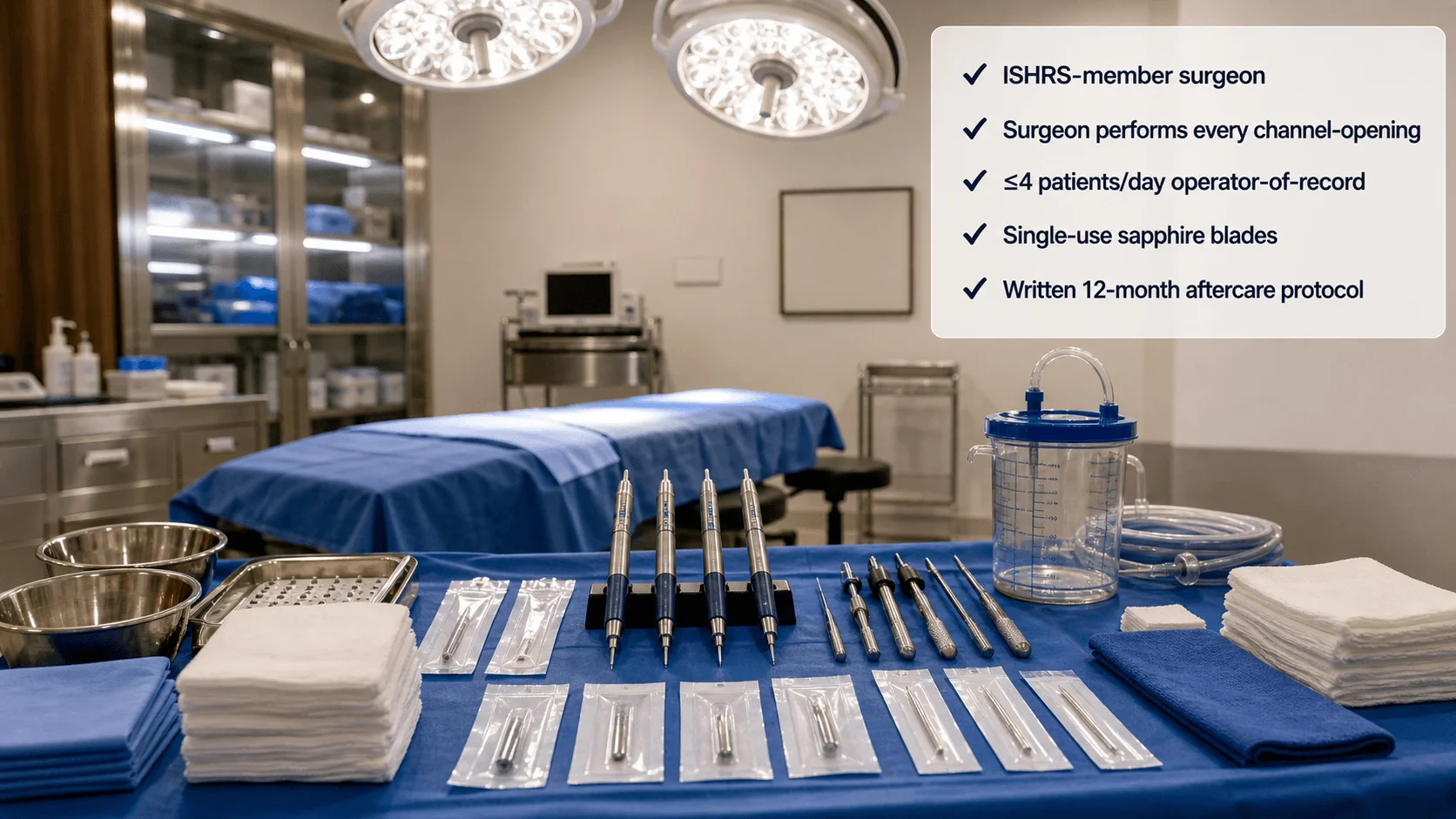
Liv Hospital Ulus, Istanbul — the surgical-pathway hospital. JCI-accredited continuously since 2013, with the certificate publicly listedjciliv-jci. The hair-transplant department is led by Dr. Hamid Aydın, ISHRS member, 25,000+ procedures since 2000, former president of SAÇDER (the Turkish Hair Restoration Association)ishrs. Surgical schedule limited to two to four patients per day so Dr. Aydın performs 100% of his own extraction and channel-opening — the operator-of-record commitment is named in writing on every booking.
99 Harley Street, London — the consulting and minor-procedure clinic. CQC-registered as a healthcare provider in England, with the inspection rating publicly listed in the CQC provider registercqc. Led by Dr. Sumeyye Yuksel, GMC-registered consulting surgeon and named UK operator-of-record (GMC reference number cited on the booking pack — pending doctor sign-off pass)gmc. Handles consultations, post-op reviews at month 1, 3, 6, 9, and 12, prescription medications (finasteride, oral minoxidil), PRP procedures, and minor in-clinic interventions. UK-pathway surgery is performed by Dr. Yuksel and the named Harley Street consulting team at the Harley Street facility under the same operator-of-record clause printed on every booking confirmation.
Both clinics share a single Liv Group / BergemHealth surgical-protocol set, supply chain, and aftercare network:
- Surgeon-led extraction and channel-opening in both pathways.
- Single-use sapphire blades on Sapphire FUE and single-use Choi pens on Direct DHI — standard across both sites; method detail in Sapphire FUE, Direct DHI, and the FUE/DHI/Sapphire comparison.
- Anaesthesia review documented before every surgery; aftercare programme at month 1, 3, 6, 9, 12 — see recovery and aftercare.
- Same touch-up policy at both clinics, with the density threshold defined in pre-op documentation.
- Same per-graft pricing — Standard FUE from £1,250, Sapphire FUE from £1,750, Direct DHI from £2,250 — on both sides; full breakdown in the cost article.
Both surgeons are publicly verifiable in their respective registers (GMC for Yuksel, ISHRS for Aydın). Booking documentation includes reference numbers and direct lookup links so patients can verify before signing. Patient choice between Istanbul and London is, deliberately, a logistical decision rather than a clinical one — methods, protocols, and aftercare are common to both sites.
What to do next
For the wider clinic-choice framework, see the choosing-a-clinic pillar; the accreditation detail in JCI vs CQC vs GMC; patterns of clinics that fail the credential checks in the red-flags article; and Istanbul-vs-London logistics in Istanbul vs London. For surgical methods and how method choice intersects with surgeon credentials, see the hair-transplant pillar. For aftercare structure, see the recovery and aftercare pillar.
If you’ve worked through the verification process and want a per-case quote with the credential-and-protocol pack in writing, request a free assessment from BergemHealth’s London or Istanbul team. The booking pack includes JCI certificate, CQC registration confirmation, surgeon GMC and ISHRS member IDs, operator-of-record commitment, anaesthesia plan, aftercare protocol, and touch-up policy — itemised in writing within 48 hours of consultation.
Frequently asked questions
What credentials should a hair transplant surgeon have?
National medical registration (GMC for UK doctors, the equivalent body for international surgeons) plus ISHRS membership for specialty competence. Either alone has a gap; together they cover legal entitlement to practise plus hair-restoration specialty experience. Both are publicly verifiable in 30 secondsgmcishrs.
Is ISHRS membership important?
It is the closest international professional standard for hair-restoration surgeons. Membership requires verified medical qualification, a minimum number of hair-restoration cases, annual continuing education, and code-of-ethics adherenceishrsishrs-ethics. A non-ISHRS surgeon isn’t automatically disqualifying, but it shifts the burden of proof to the clinic.
What anaesthesia is used for hair transplant?
Local anaesthesia (lidocaine or bupivacaine), often with adrenaline, sometimes with mild oral sedation for anxiety. The patient is awake throughout. General anaesthesia is rarely indicated for elective scalp surgery. Standard local-anaesthesia complications are uncommon in regulated facilitiesstatpearls.
What are the risks of hair transplant?
Rates well under 1% for serious adverse events in regulated facilitiesgarg. Most common: folliculitis (~1–2%), temporary donor numbness (5–10% transient), small risk of donor scarring or recipient cysts (each <1%), and poor graft survival in specific zones (addressed by the touch-up policy). Risk distribution rises substantially in unregulated, technician-led settings.
How do I check a hair transplant surgeon’s credentials?
Four 30-second public-register lookups: GMC at gmc-uk.orggmc, ISHRS at ishrs.orgishrs, JCI at jointcommissioninternational.orgjci, and CQC at cqc.org.ukcqc. If credentials don’t appear in the relevant register, the clinic’s claim is unverified.
Can hair transplant go wrong?
In three ways: surgical complications (rare in regulated facilities); disappointing aesthetic results (more common — driven by inadequate planning, technician-led extraction, or poor donor-area economics); and donor-area damage (rare with proper technique; difficult to correct). Each correlates with the credential layer and operator-of-record disciplinegargsharma.
What is technician-led hair transplant?
A model where the named surgeon performs only consultation and hairline drawing, while extraction, channel-opening, and implantation are handled by technicians under varying supervision. The 2024 ISHRS practice census reports this as a growing share of the unregulated medical-tourism market and a source of outcome varianceishrs. Detailed in the red-flags article.
How do I know who will actually perform my surgery?
Ask in writing for the operator-of-record commitment: which named surgeon performs extraction, channel-opening, and implantation, and what percentage of each phase is performed personally by them versus by technicians. The named surgeon should appear on the booking confirmation and on the operative report. Vague answers are themselves information.
Who should design the hairline?
The accountable clinician designs the hairline with the patient before surgery, with the rationale recorded. A defensible clinic respects age, long-term loss trajectory, and donor-area economics rather than the most aspirational reference photo. The hairline should be photographed and signed off pre-operatively, not improvised on the dayishrs-ethics.
What does ethical patient selection mean in hair restoration?
A clinic declines to operate on patients unlikely to benefit: Norwood VII with thin donor, active progressive AGA in young patients, untreated diffuse loss, and positive BDD screening. It also means an age-21 minimum, conservative hairline design, and donor-area conservation for future need. The decision should be documented in writingishrs-ethicsbaaps.
What if I have a complication after surgery?
A defensible clinic provides 12-month structured aftercare with same-day responsiveness. At BergemHealth, post-op concerns are reviewed via photo and message channel with same-day input from the surgical team and escalation to in-person review at Harley Street if needed. Most issues are minor and treatable when caught earlygarg.
Is JCI more important than CQC?
They regulate different things. JCI accredits hospitals as systems internationally; CQC registers UK clinics for compliance with the Fundamental Standards. A defensible clinic clears the body relevant to its country: JCI for Istanbul, CQC for London. Neither replaces individual surgeon credentials. Full detail in JCI vs CQC vs GMC.
Sources
- NHS — Cosmetic procedures: Hair transplant. https://www.nhs.uk/conditions/cosmetic-procedures/hair-transplant/ ↩
- General Medical Council — The Medical Register (online lookup). https://www.gmc-uk.org/registration-and-licensing/the-medical-register ↩
- Care Quality Commission — provider register and inspection reports. https://www.cqc.org.uk/ ↩
- Joint Commission International — accredited organisations directory and standards. https://www.jointcommissioninternational.org/who-we-are/accredited-organizations/ ↩
- Liv Hospital — certificates and accreditations (Liv Hospital Ulus JCI certificate). https://www.livhospital.com/en/certificates-and-accreditations ↩
- International Society of Hair Restoration Surgery — 2024 Practice Census and member directory. https://www.ishrs.org/practice-census/ ↩
- International Society of Hair Restoration Surgery — Code of Ethics. https://ishrs.org/about-the-ishrs/code-of-ethics/ ↩
- British Association of Aesthetic Plastic Surgeons — surgeon register and patient-safety publications. https://baaps.org.uk/ ↩
- Garg AK et al. Complications in hair transplantation. J Cutan Aesthet Surg, 2021. https://www.ncbi.nlm.nih.gov/pmc/articles/PMC8719980/ ↩
- Sharma R, Ranjan A. Follicular Unit Extraction (FUE) Hair Transplant: Curves Ahead. J Cutan Aesthet Surg, 2019. https://www.ncbi.nlm.nih.gov/pmc/articles/PMC6795649/ ↩
- StatPearls — Hair Transplantation. National Center for Biotechnology Information. https://www.ncbi.nlm.nih.gov/books/NBK547740/ ↩
Як BergemHealth підходить до цього
Операції виконуються у Liv Hospital Ulus (Стамбул) з акредитацією JCI д-ром Hamid Aydın та резидентною хірургічною командою. Консультації у Великій Британії та 12-місячний догляд у нашому офісі на Harley Street з регулюванням CQC. Прозорі ціни та безкоштовна корекція за потреби.
Безкоштовна консультація →