Hair Loss: Causes, Types, and When to Act (UK Patient Guide 2026)
What kind of hair loss do you have? A diagnosis-led guide to causes, types, the Norwood and Ludwig scales, when to see a trichologist, and treatment options.
Medical disclaimer. This article is educational and not medical advice. Hair restoration outcomes are individual; only a qualified clinician can assess your case in a personal consultation.
Quick answer
The most common question patients walk into a hair-loss consultation with is “is it normal?” — and the more useful question is “what kind of hair loss am I having?”. Roughly 80% of UK adult hair loss falls into one of three categories: androgenetic alopecia (genetic, gradual, pattern-based), telogen effluvium (temporary shedding triggered by stress, illness, or hormonal change), and alopecia areata (autoimmune, patchy). Each has a different cause, a different timeline, and a different treatment pathway. This pillar gives you the diagnostic framework to figure out which one you’re dealing with, when to see a clinician, and what your options are once you know.
- Genetic pattern hair loss is the most common; it’s progressive but treatable, and usually only needs surgical intervention at moderate stages onward.
- Telogen effluvium is reversible if the trigger is identified and resolved; it’s not a transplant candidate.
- Patchy or scarring hair loss needs a clinician’s diagnosis before any treatment plan — wrong diagnosis = wrong treatment.
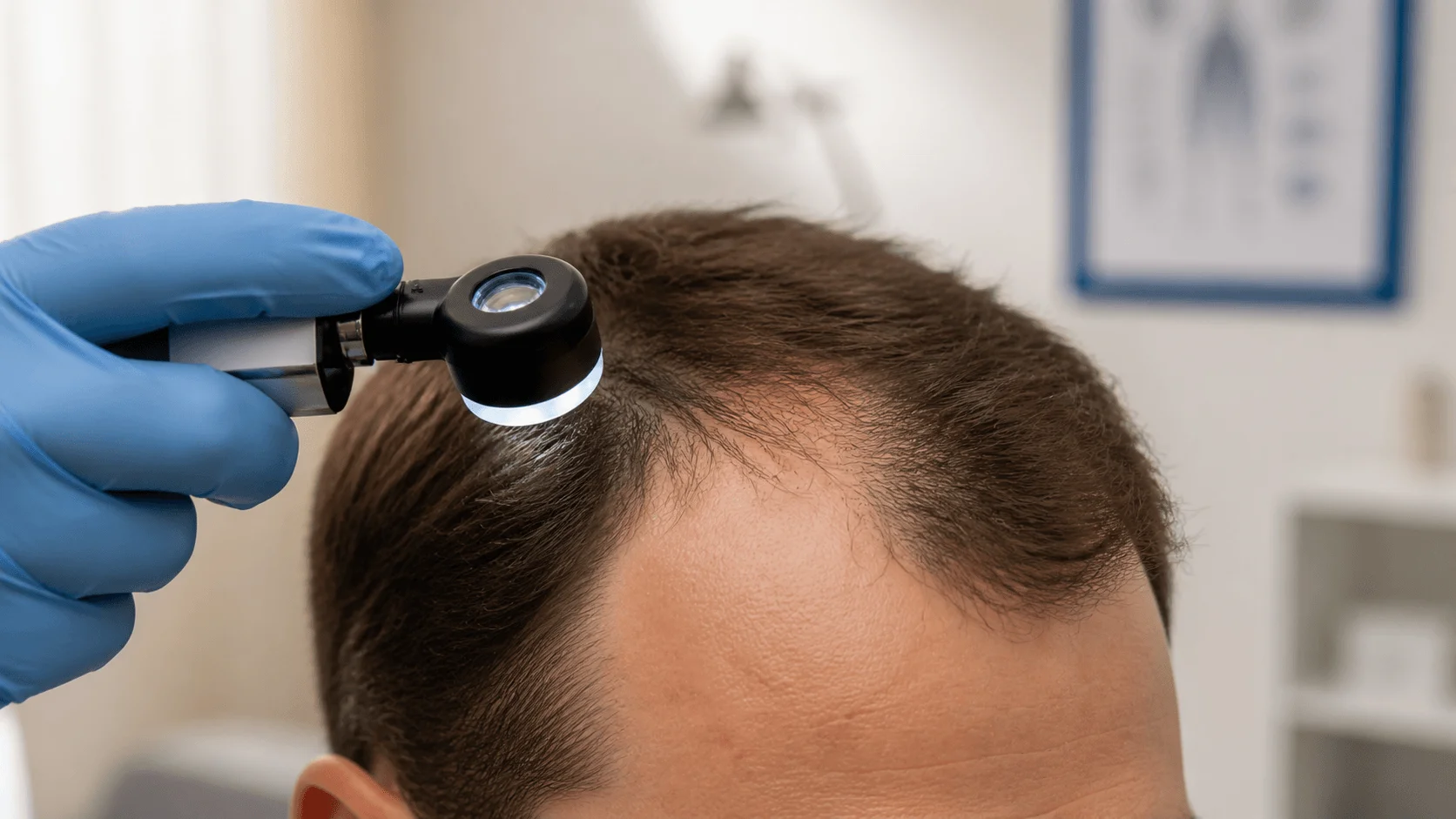
- Tools that diagnose accurately include trichoscopy (scalp dermoscopy), basic blood work, and clinical examination — none of which are exotic.
Table of contents
- Hair loss is mostly diagnosable
- The seven types of hair loss you might have
- How to tell which one you have: a decision tree
- Androgenetic alopecia (the most common one)
- Telogen effluvium (the temporary one)
- Alopecia areata and scarring alopecias (the medical ones)
- The Norwood scale (men) and Ludwig scale (women)
- When to see a trichologist or dermatologist
- The diagnostic tools clinicians actually use
- How BergemHealth approaches diagnosis
- What to do next
- Frequently asked questions
Hair loss is mostly diagnosable
Most internet articles on hair loss start by listing causes. That’s the wrong order. The first useful question isn’t “what could cause hair loss?” — that list is too long to be helpful — but “what does my hair loss actually look like, and which category does the appearance match?”. Pattern, distribution, timeline, and what was happening in your life when it started are the four variables that narrow the answer to one or two categories within minutes.
This pillar is structured as a diagnosis-led guide rather than a symptom catalogue. The reason is practical: the treatments for the seven categories of hair loss are different. Treating androgenetic alopecia like telogen effluvium wastes 18 months. Treating alopecia areata like male pattern baldness can damage hair that would have grown back on its own. Getting the category right is the single highest-leverage step in the whole hair-loss pathway.
The good news is that the categorisation isn’t difficult. NHS guidance, NICE Clinical Knowledge Summaries, and standard UK trichology practice converge on the same diagnostic frameworknhsnice-mpbnice-flutrichology. This article walks through it.
The seven types of hair loss you might have
Definition. “Hair loss” is the visible reduction of hair on the scalp (or eyebrows, beard, body) that exceeds the normal cycle of shedding and regrowth. Adults shed roughly 50–100 hairs a day as part of normal hair-cycling — that’s not hair loss; that’s the cycle. Hair loss is when the regrowth side of that cycle slows, fails, or shifts pattern.
The seven categories that account for the overwhelming majority of UK adult hair-loss cases:
| Category | Quick description | Reversible? | Transplant candidate? |
|---|---|---|---|
| Androgenetic alopecia (AGA) | Genetic; gradual; pattern-based (frontal/crown in men, diffuse central in women) | No, but treatable and slowable | Yes, at moderate stages onward |
| Telogen effluvium | Diffuse shedding 2–3 months after a trigger (illness, stress, childbirth, weight loss) | Yes, if trigger resolved | No (resolves on its own) |
| Alopecia areata | Sudden patches of complete hair loss; autoimmune | Often yes; can recur | Generally no while disease is active |
| Traction alopecia | Caused by tight hairstyles, extensions, or repeated mechanical pulling | Yes, if caught early | Yes, once hairstyle pattern is changed |
| Scarring alopecias (cicatricial) | Inflammation destroys the follicle; permanent local hair loss | No (follicle is destroyed) | Sometimes, if disease is inactive ≥1 year |
| Anagen effluvium | Sudden shedding caused by chemotherapy or radiation | Usually yes (regrows after treatment) | No |
| Postpartum/hormonal hair loss | Specific subtype of telogen effluvium tied to childbirth or hormonal shift | Yes, typically resolves 6–12 months | No |
The first two — AGA and telogen effluvium — account for roughly 75% of the cases that walk into a UK hair-loss consultation. The remaining five are less common but have important distinguishing features that matter for treatment. The next sections cover the three biggest categories in more depth.
How to tell which one you have: a decision tree
Patients tend to over-research the cause of their hair loss before they’ve identified the category. The order is meant to be the other way round. Here’s a practical decision tree based on the four variables — pattern, distribution, timeline, recent life events — that NHS and NICE guidance usenhsnice-mpb:
Question 1: Is the hair loss in patches, or is it diffuse (all over)?
- Patches → Likely alopecia areata (small round patches, sudden), traction alopecia (along the hairline or where hair has been pulled tight), or scarring alopecia (with redness, scaling, or skin changes). See a clinician.
- Diffuse → Continue to Question 2.
Question 2: Is the diffuse loss in a male or female pattern, or all over?
- Male pattern (receding hairline, vertex thinning) → Androgenetic alopecia (men). See the Norwood scale.
- Female pattern (widening centre parting, thinning crown, hairline preserved) → Androgenetic alopecia (women) or female pattern hair loss (FPHL). NICE and most UK trichologists use the Ludwig scale to stagenice-flu.
- All over, including sides and back → Continue to Question 3.
Question 3: Did the shedding start 2–3 months after a major life event (illness, surgery, childbirth, significant stress, rapid weight loss, severe diet change)?
- Yes → Likely telogen effluvium. Usually resolves within 6 months of trigger resolution.
- No, no obvious trigger → See a clinician — could be telogen effluvium with an unidentified trigger (thyroid, iron deficiency, vitamin D, medication side-effect), early diffuse AGA, or another condition.
Question 4: Is there pain, itching, redness, or scaling on the scalp?
- Yes → See a dermatologist promptly — this can indicate scarring alopecia, which is permanent if not treated early.
- No → AGA, telogen effluvium, and traction alopecia are typically non-symptomatic on the scalp surface.
This tree gets most patients to a probable category in under five minutes. It does not replace clinical examination — but it tells you what kind of clinician to see and how urgently.
Androgenetic alopecia (the most common one)
Definition. Androgenetic alopecia (AGA) is genetically-mediated hair loss in which scalp follicles in susceptible regions become progressively miniaturised under the influence of dihydrotestosterone (DHT), a derivative of testosterone. The pattern is sex-specific — receding hairline and vertex thinning in men, diffuse central thinning with preserved frontal hairline in women — and progressive over decades.
Some core facts:
- Roughly 50% of men show visible AGA by age 50, and the lifetime prevalence in men of European ancestry approaches 80%nice-mpb.
- In women, prevalence rises after menopause; by age 65, roughly 40% show some FPHL changesnice-flu.
- The donor zone at the back and sides of the scalp is genetically resistant to DHT and retains its hair throughout the AGA process — this is the biological basis of hair transplantation.
- Onset is typically in the late teens to early 30s in men and the 30s–40s in women, but can begin earlier or later. Pace of progression varies widely between individuals and is not strongly predictable from initial speed.
- AGA is not caused by stress, diet, hat-wearing, or shampoo — these are common myths. It’s caused by genetic susceptibility to androgens at the follicle level.
Treatment is layered: finasteride (oral 1mg daily) blocks DHT and stabilises loss in 80–90% of menmella-fin; minoxidil (topical 5% or low-dose oral) extends the anagen phasecochrane-min; hair transplant (FUE / Sapphire FUE / Direct DHI) redistributes DHT-resistant donor follicles at moderate-to-advanced stages. Detail in the AGA cluster and the hair treatment pillar.
The single most important thing to understand about AGA is that it’s progressive — meaning untreated, it tends to continue. A 28-year-old at Norwood II is not “stable” because they haven’t visibly progressed in two years; the trajectory is decadal. Treatment decisions made at Norwood II have very different outcomes from treatment decisions made at Norwood V. Earlier identification = more options.
Telogen effluvium (the temporary one)
Definition. Telogen effluvium (TE) is a temporary increase in the proportion of scalp follicles in the telogen (resting) phase, leading to excessive shedding 2–3 months after a triggering event. Unlike AGA, TE does not miniaturise follicles — it just shifts more of them into rest at once, then they all shed together when their telogen phase ends.
Common triggers:
- Major illness or fever (especially viral infections, including post-COVID hair shedding)
- Surgery and general anaesthesia
- Childbirth (postpartum TE peaks 3–4 months after delivery)
- Significant stress — bereavement, divorce, redundancy
- Rapid weight loss or severe dieting
- Thyroid disease (hypo- or hyperthyroidism)
- Iron deficiency — particularly relevant in women with menstrual blood loss
- Vitamin D insufficiency (controversial as a primary cause; common as a comorbidity)
- Medication start or stop — beta-blockers, statins, anticonvulsants, oral contraceptives, retinoids
- Severe psychological stress
The classic TE timeline: trigger event at week 0; affected follicles enter telogen over the next few weeks; shedding begins roughly 8–12 weeks after the trigger and may last 2–4 months; recovery begins 6 months after trigger resolution; full density returns by month 9–12.
Distinguishing TE from AGA in early stages can be difficult because both can present with diffuse thinning. Key TE features: clear trigger 2–3 months before shedding started, hair loss is all over the scalp (including sides and back, not just the AGA pattern zones), the texture and shaft thickness of the remaining hair is normal (whereas AGA hair is miniaturised and thinner), and shedding gradually resolves.
TE is not a transplant candidate. Performing a transplant during active TE risks confounding the post-op picture and can damage hair that would have regrown anyway. The right approach is identifying and resolving the trigger, basic blood work (FBC, ferritin, TSH, vitamin D), and patience.
Alopecia areata and scarring alopecias (the medical ones)
These are the two categories that most need a clinician rather than self-management.
Alopecia areata is an autoimmune condition in which the immune system mistakenly attacks hair follicles, producing sudden, well-defined patches of complete hair loss. The classic appearance: smooth, round bald patches the size of a 50p coin or larger, with characteristic “exclamation-mark hairs” at the edges (short broken hairs that taper toward the scalp). Alopecia areata can affect the scalp, beard, eyebrows, or body hair. Severe variants — alopecia totalis (entire scalp) and alopecia universalis (all body hair) — are rarer.
Treatment options include topical or intralesional corticosteroids, topical immunotherapy, and JAK inhibitors (oral baricitinib gained UK MHRA / EMA approval in 2022 for severe alopecia areata)nice-mpb. Many cases of mild alopecia areata resolve spontaneously within 12 months. Hair transplant is generally not appropriate while the disease is active — transplanted follicles can be attacked by the same autoimmune process.
Scarring alopecias (cicatricial alopecias) are a group of conditions in which inflammation around the hair follicle causes scarring and follicle destruction. Subtypes include lichen planopilaris, frontal fibrosing alopecia (increasingly recognised in postmenopausal women), central centrifugal cicatricial alopecia, and folliculitis decalvans. The signs that distinguish scarring from non-scarring alopecia:
- Loss of follicular openings on close inspection (a dermatologist can see this with a dermatoscope)
- Redness, scaling, or pustules on the scalp
- Itching, burning, or tenderness in affected areas
- Smooth, shiny scalp surface in advanced areas
Scarring alopecias need urgent specialist input because the inflammation is the active process — once a follicle is destroyed, it’s gone, but stopping the inflammation prevents further destruction. Hair transplant into a scarring-alopecia zone is sometimes possible, but only when the underlying disease has been inactive for at least 12 months and only with specialist co-management.
If you have any of the warning signs in the previous list — patches of redness, itching, scaling, or smooth bald patches with skin changes — see a dermatologist directly, not a hair-transplant clinic.
The Norwood scale (men) and Ludwig scale (women)
Definition. The Norwood-Hamilton scale (1975) is the standard staging system for male androgenetic alopecia, dividing it into 7 main stages (I to VII) plus a Type A variant in which the recession progresses front-to-back rather than starting at the temples and crownnorwood. The Ludwig scale (1977) is the equivalent for female pattern hair loss, with 3 main stages graded by central-parting wideningludwig.
A fast tour of each — full visual references in the Norwood stage-by-stage walkthrough:
Norwood (men):
- I: No visible recession.
- II: Slight temporal recession (a “maturing hairline” — sometimes normal at 25+, sometimes early AGA).
- III: Recognisable temporal recession, deeper at the corners; may include early vertex thinning (Norwood IIIv).
- IV: Recession more pronounced, vertex thinning visible, but a “bridge” of hair still separates the front and crown.
- V: The bridge thins further; front and crown beginning to merge.
- VI: Bridge gone; large area of frontal and vertex baldness.
- VII: Most extensive — only a horseshoe of donor hair remains at the back and sides.
The Type A variant follows a different pattern, with recession progressing front-to-back without a distinct vertex stage — relevant clinically because graft requirements differ.
Ludwig (women):
- Type I: Mild thinning visible at the central parting, hairline preserved.
- Type II: Moderate thinning, central parting clearly widened, scalp visible through the hair.
- Type III: Diffuse thinning across the central scalp; advanced cases approach near-complete loss in the central zone, with hairline still preserved.
The female pattern almost always preserves the frontal hairline — total frontal recession in a woman is unusual and warrants consideration of frontal fibrosing alopecia or another diagnosis rather than typical AGA.
These staging systems matter because they map onto graft-count requirements (roughly: Norwood II–III needs 1,500–2,500 grafts; IV–V needs 2,500–4,000; VI–VII needs 4,000+, often staged) and onto medical-management decisions.
When to see a trichologist or dermatologist
You should book a clinical appointment promptly if any of the following apply:
- Sudden hair loss (developing in days or a couple of weeks rather than over months)
- Patches rather than diffuse thinning
- Pain, itching, redness, scaling, or pustules on the scalp
- Hair loss accompanied by other symptoms — fatigue, weight change, skin changes, joint pain — that might point to systemic illness
- Hair loss in a child (always warrants paediatric input)
- Hair loss that’s progressed quickly enough to cause significant distress, regardless of pattern
For typical slow-progression AGA, the urgency is lower, but earlier consultation is genuinely useful. The treatment options narrow as the stage advances, and finasteride/minoxidil work better when started before substantial miniaturisation has occurrednice-mpb.
In the UK, the routes are:
- GP first for a basic assessment, blood work, and referral if appropriate. Note that hair restoration is classified as cosmetic by the NHS and treatment is generally not funded except for reconstructive cases (e.g., burns, scarring trauma)nhs.
- Trichologist (private, member of the Institute of Trichologists) for non-medical scalp and hair assessmenttrichology.
- Dermatologist (NHS or private) for any case where scarring alopecia, alopecia areata, or other inflammatory cause is suspected.
- Hair transplant clinic for surgical assessment once the diagnosis is established and the AGA stage is appropriate. The hair transplant pillar covers candidate selection in detail.
The diagnostic tools clinicians actually use
Most hair-loss diagnoses in 2026 are made with:
- Clinical history (timeline, pattern, family history, medications, recent illness or stress)
- Visual examination with adequate lighting and parting at multiple sites
- Pull test — a controlled tug on a small bundle of hair at multiple scalp regions; >6 hairs released suggests active shedding
- Trichoscopy — scalp dermoscopy using a hand-held dermatoscope (in clinic) or full-field digital trichoscopy (specialist centres). Can identify miniaturisation, peripilar signs of AGA, exclamation-mark hairs of alopecia areata, and follicular openings (preserved in non-scarring, lost in scarring alopecias)
- Blood work — typically full blood count, ferritin, thyroid function tests, vitamin D, sometimes vitamin B12 and zinc; in women, hormonal panel where indicated
- Scalp biopsy — reserved for cases where the diagnosis is unclear or scarring alopecia is suspected; performed by a dermatologist
What you typically do not need: extensive “hair-mineral analysis”, expensive vitamin panels marketed direct-to-consumer, or genetic-testing kits for AGA susceptibility (the test rarely changes management).
How BergemHealth approaches diagnosis
BergemHealth’s pre-surgical pathway is structured around getting the diagnosis right before surgery is on the table. The free initial assessment — at Harley Street in London, at Liv Hospital Ulus in Istanbul, or by video — covers the same diagnostic ground a UK trichologist or dermatologist consultation would: clinical history, scalp examination with trichoscopy, donor area assessment, and a discussion of which category of hair loss the patient appears to have.
For patients whose hair loss looks like AGA at a transplant-appropriate stage, the assessment moves to graft-count estimation and surgical planning. For patients whose hair loss looks like telogen effluvium, an active inflammatory condition, or AGA at an earlier stage where medical management is the better next step, the assessment recommends that pathway instead — which sometimes means the patient doesn’t need surgery at all.
The patients we genuinely help most aren’t always the ones we operate on the next available date — they’re the ones we direct to the right next step, which might be a referral back to their GP for blood work, a dermatology referral if scarring alopecia is suspected, or starting on finasteride and minoxidil and reviewing the trajectory in 12 months. Surgery is one tool among several. Calibrating expectations honestly is part of the job.
Per-graft pricing is the same on both sides of the network — from £1,250 (Standard FUE), £1,750 (Sapphire FUE), £2,250 (Direct DHI) — at both Liv Hospital Ulus in Istanbul (JCI-accredited) and 99 Harley Street in London (CQC-registered). Dr. Sumeyye Yuksel leads the GMC-registered consulting team at Harley Streetgmc; Dr. Hamid Aydın leads the surgical team at Liv Hospital Ulus, ISHRS member with 25,000+ proceduresishrs.
What to do next
If you’ve worked through the decision tree and your hair loss looks like AGA at an early stage, the most useful next step is probably starting medical management (finasteride for men, minoxidil for both sexes) with a UK GP or private dermatologist. Detail in the finasteride article and the minoxidil article.
If your AGA looks moderate-to-advanced and you want to explore the surgical option, request a free assessment from BergemHealth’s London or Istanbul team. The consultation includes scalp trichoscopy, donor area assessment, graft-count estimate, and a written quote — and an honest answer about whether surgery is genuinely the right next step. Method choice is covered in FUE vs DHI vs Sapphire.
If your hair loss looks patchy, sudden, or accompanied by skin changes, see a dermatologist before any cosmetic intervention. These cases need a medical diagnosis first.
For staging help, see the Norwood walkthrough, the early-signs guide for younger patients, and the dedicated androgenetic alopecia article.
Frequently asked questions
How much hair loss is normal?
Adults shed roughly 50–100 hairs per day as part of normal hair-cycling — that’s not hair loss; that’s the cycle. Hair on a pillow, in the shower, or in a brush at this volume is normal. Hair loss is when the regrowth side of the cycle slows, fails, or shifts pattern, leading to visible thinning or recession over weeks to months. The “100 hairs a day” rule is a useful reassurance for short-term shedding worry but not a diagnostic test on its ownnhs.
Can stress cause hair loss?
Yes, but not in the way most people imagine. Stress doesn’t usually cause androgenetic alopecia — it doesn’t change the genetic susceptibility of follicles to DHT. What stress can do is trigger telogen effluvium: a temporary shift of more follicles into the resting phase, with shedding 2–3 months later. The shedding usually resolves within 6–12 months once the stress trigger is identified and managed. Stress can also worsen alopecia areata and trichotillomania.
Will my hair loss stop if I take vitamins?
If your hair loss is caused by a vitamin or mineral deficiency — most commonly iron deficiency in women, vitamin D insufficiency, or zinc deficiency — then correcting the deficiency typically resolves the hair loss within 6–12 months. If your hair loss is androgenetic alopecia, vitamin supplementation will not stop it; AGA is genetic and androgen-driven, not nutritional. Blood work (FBC, ferritin, TSH, vitamin D) is the way to find out which category applies; over-the-counter “hair vitamins” without a deficiency present are unlikely to helptrichology.
Is hair loss after COVID permanent?
Hair loss following COVID-19 infection is overwhelmingly telogen effluvium triggered by the viral illness, peaking 2–3 months after infection and resolving over 6–12 monthsnice-mpb. The follicles are not destroyed; they’re temporarily synchronised into the resting phase. In patients with underlying AGA, COVID-related TE can unmask AGA that was previously subclinical, which can make the recovery look incomplete — but the COVID-specific component is reversible.
Can I tell if my hair loss is genetic by looking at my mother’s father?
The “look at your mother’s father” rule is folklore that contains a grain of truth — the androgen receptor gene most strongly associated with AGA is on the X chromosome, which men inherit from their mothers — but the actual genetic picture is multi-gene and influenced by both parental lines. Many men with bald maternal grandfathers retain their hair, and many men with hairy maternal grandfathers go bald. Family history is a probability indicator, not a deterministic one.
Why do I shed more hair when I wash it?
The hair shed during washing is hair that was already in the telogen phase and ready to shed; the mechanical action of shampooing and combing simply releases it. Washing doesn’t cause additional hair loss. The reason daily-washers tend to shed less per wash than infrequent-washers is purely a matter of cumulative release: the hairs come out roughly the same amount over a given week regardless of wash frequency.
Is hair transplant the only solution?
No, and for many patients it’s not the right first step. Most adult AGA can be slowed or stabilised with finasteride and/or minoxidil, particularly when started at earlier stages. PRP, LLLT, and other adjuncts may help. Hair transplant becomes a useful tool at moderate-to-advanced stages where medical management alone isn’t sufficient to restore the desired density or hairline position. It’s also worth noting that some hair loss types (telogen effluvium, active alopecia areata) shouldn’t be transplanted.
Can women get hair transplants?
Yes. Female pattern hair loss (FPHL) is amenable to hair transplant once the diagnosis is established and the donor area has been assessed. Women with diffuse miniaturisation across the entire scalp (DUPA-like patterns) may not have sufficient donor density. Women with frontal fibrosing alopecia or other scarring causes need specialist co-management before any transplant is considered. The hair transplant pillar covers method specifics.
How long should I wait to see if it’s just temporary shedding?
If you’ve identified a likely trigger (illness, surgery, childbirth, significant stress) 2–3 months before the shedding started, give it 6 months from trigger resolution before assuming the hair loss is something other than telogen effluvium. If shedding persists beyond 6–9 months, or if it’s progressed to visible thinning rather than just shedding, see a clinician for trichoscopy and blood work to differentiate persistent TE from underlying AGA.
What blood tests should I ask my GP for?
Standard initial panel for unexplained hair loss: full blood count (FBC), ferritin (not just haemoglobin — ferritin can be low even when haemoglobin is normal), thyroid function tests (TSH, free T4), vitamin D, and B12. In women with hair loss accompanied by acne, irregular periods, or hirsutism, a hormonal panel (testosterone, DHEA-S) is also reasonable. Your GP may run additional tests based on history. Most of this is on the NHS via the GPnhs.
I’m 25 and my hairline has changed — is this normal?
A “maturing hairline” — slight, even recession at the temples in the late teens to mid-20s — is normal in many men and represents the transition from adolescent to adult hairline. Active receding (asymmetric, accelerating, accompanied by vertex thinning) at any age is consistent with early AGA. The distinction is covered in the early-signs guide for 25/30/35 patients. If you’re worried, a 30-minute trichoscopy consultation will tell you which category applies.
Sources
- NHS — Hair loss overview. https://www.nhs.uk/conditions/hair-loss/ ↩
- NICE Clinical Knowledge Summary — Male pattern baldness. https://cks.nice.org.uk/topics/male-pattern-baldness/ ↩
- NICE Clinical Knowledge Summary — Female pattern hair loss. https://cks.nice.org.uk/topics/female-pattern-hair-loss/ ↩
- StatPearls — Hair Transplantation. National Center for Biotechnology Information. https://www.ncbi.nlm.nih.gov/books/NBK547740/ ↩
- Institute of Trichologists (UK) — Position statements and member directory. https://www.trichologists.org.uk/ ↩
- Mella JM et al. “Efficacy and safety of finasteride therapy for androgenetic alopecia.” Arch Dermatol. 2010. DOI: 10.1001/archdermatol.2010.256 ↩
- Gupta AK, Charrette A. “Topical minoxidil for androgenetic alopecia.” Cochrane Database Syst Rev. DOI: 10.1002/14651858.CD007628 ↩
- Norwood OT. “Male pattern baldness: classification and incidence.” South Med J. 1975. ↩
- Ludwig E. “Classification of the types of androgenetic alopecia (common baldness) occurring in the female sex.” Br J Dermatol. 1977. DOI: 10.1111/j.1365-2133.1977.tb15179.x ↩
- International Society of Hair Restoration Surgery — Member directory and 2024 Practice Census. https://www.ishrs.org/ ↩
- General Medical Council — The Medical Register. https://www.gmc-uk.org/registration-and-licensing/the-medical-register ↩
How BergemHealth approaches this
Procedures are performed at JCI-accredited Liv Hospital Ulus, Istanbul, by Dr. Hamid Aydın and the resident surgical team. UK consultation and 12-month aftercare at our CQC-regulated Harley Street office. Transparent pricing and a free touch-up if indicated.
Free consultation →